
Wooden Exhibition Booths
Wooden Exhibition Booths Drawn Around the Material
Wooden exhibition booths are built from boards, not clipped together from an aluminium system, and that changes what the design can do: curved walls, deep niches, flush doors and a painted surface with no frame in sight. It also changes the weight, the transport and the labour. This page explains the boards, the surfaces, the CNC work and the honest trade offs, so you know exactly what you are asking for when you ask for a booth in wood.
What Wood Allows That a System Frame Does Not
An aluminium system gives you straight panels between posts. Wooden exhibition booths give you whatever the drawing shows, as long as someone has thought about how each part is cut and carried.
Curves and shapes of your own
A system frame turns corners at the angles its connectors allow. A wooden wall can sweep in an arc, lean, step back or end in a rounded corner, because the board is cut to the shape and not the other way round. A logo can be cut through the wall itself and lit from behind.
Thick walls that do work
A joinery wall has depth. That depth holds niches for product, shelves that sit inside the wall instead of hanging from it, a hidden cable route and a flush door to a store room that reads as part of the wall when it is closed.
A painted wall with no frame showing
Panels in a system are divided by posts and beams. An MDF wall can be filled, sanded and sprayed so it reads as a single surface in your brand colour, with the joins planned where the eye does not go.
Weight on the walls and a floor of your own
Large screens, loaded product shelves and heavy samples can be fixed to a timber backed wall at the height you choose. The floor can be raised to hide cables and carry a ramp at the edge, so a trolley or a wheelchair rolls on without a step.
What Goes On and Around the Joinery
Wood is the body of the booth. These are added by teams under the same roof.
Printing & Promotional Gifts
Printed graphics mounted on wood, vinyl lettering over paint, and the giveaways on the counter. Graphics are printed in 1 to 5 working days.
Acrylic & Wood Fabrication
Lit acrylic letters set into a routed recess, display cases and product risers cut on the same CNC and laser machines.
Promoters & Brand Ambassadors
Hosts who know the product, with a supervisor, so the booth is staffed as carefully as it was built.
Branding & Creative Studio
Colour references, logo files and wall artwork prepared so the paint code and the print match.
Digital Solutions
Screens recessed flush into a wall, a touch table, and lead capture on a tablet at the counter.
Experiences & Events
A tasting bar, a demonstration bench or a small stage built into the stand as joinery.
Social Media & Content
Photos and short video of the booth at work during the show, ready to publish the same day.
Custom Exhibition Stands
The full service, from the first drawing to dismantling, for any custom stand whatever it is made of.
What Wooden Exhibition Booths Are Made Of
A booth in wood is rarely a single material. Each board does a different job, and a good materials sheet says which board goes where.
MDF, the board for paint
MDF has no grain and a smooth, dense face, so it takes spray paint better than any other board and routes cleanly into letters and grooves. Its weaknesses are just as clear: it is heavy, its edges crumble when a screw goes in and out more than once, and it swells when water reaches it.
Plywood, the board that carries
Plywood is thin layers glued with the grain crossed, which makes it strong for its weight and able to hold a screw again and again. It goes where the load is: raised floors, platforms, steps, the backing behind a screen, and any part that will be bolted and unbolted at every show.
Blockboard and timber framing
Behind most panels sits a frame of timber or blockboard that keeps the wall straight and gives the fixings something solid to bite. The face board is what you see. The frame is what stops a tall wall from bowing and a door from dropping on its hinges.
Solid wood where hands touch
Solid timber is kept for the places people handle: the edge of a counter top, a handrail on a ramp, a bar front. It survives knocks that would chip a painted corner, and it can be sanded and oiled again. Building whole walls from it would add cost and weight for nothing.
Paint: matt, satin or high gloss
Spray paint gives the exact brand colour. Matt hides small flaws and does not glare under hall lights. Satin wipes clean more easily. High gloss looks rich in photographs and is the least forgiving, because a mirror surface shows every seam, every filled screw head and every fingerprint.
Laminate, veneer, vinyl and print
Laminate, the HPL sheet the Saudi market calls Formica, is the hard wearing choice for counter tops and doors. Veneer is a thin slice of real timber that gives a natural grain. A vinyl wrap or a printed graphic mounted on the board changes the look quickly and can be replaced for the next show.
How a Wooden Booth Is Designed
The drawing decides how the booth looks. The decisions below decide whether it can be cut, carried and stood up without surprises.
The space and the exhibitor manual
We start from the space size, the open sides and the manual. For wood the manual matters more than usual: height limits, rules on timber and painted surfaces, the hall floor loading and the build hours all shape the design before a line is drawn.
A board for every part
The materials sheet names each surface and the board behind it: MDF where a wall is sprayed, plywood where it carries load or gets bolted, laminate where hands and cups land. You approve the sheet together with the rendered views, not after them.
CNC files from the design drawings
Curved ribs, cut out logos, grooves, recessed light channels and fretwork in a mashrabiya style pattern are all cut by a CNC router. The machine follows a file taken from the design drawings, so the pattern you approved is the pattern that is cut, at the size drawn.
Colour and surface samples
A colour code on a screen is not a colour on a board. We agree the paint reference, the sheen and the laminate or veneer from physical samples, and spray all visible panels of a colour together so the batch is the same.
Joins drawn, not hidden later
Every wooden booth travels in sections. The drawing fixes where sections meet: at a corner, behind a shadow gap or under a cover strip, and never across a logo or a gloss wall facing the aisle. For a booth that will stand again, the sections bolt together instead of being glued.
Built, checked and installed by the same team
The stand is built and fully test assembled in our factory before it ships, then installed by our own team, who stay for the opening and dismantle when the show closes.
How Long a Wooden Booth Takes
A custom wooden booth
6 to 8 weeks from brief to opening, with design approval at the start of that period.
An island or a double deck
8 to 10 weeks, because structure, drawings and organiser approvals take longer.
If wood does not fit the date
A modular stand with new graphics takes 2 to 4 weeks and can carry wooden feature pieces.
Graphics on the wood
Printed in 1 to 5 working days once the artwork is approved.
What Wood Costs in Return
We publish no price list, because wooden exhibition booths are priced from their drawings. These are the things joinery adds to a quote, named so you can compare offers fairly.
Weight
Boards are heavy, MDF most of all. Weight means more hands to lift each section, stronger cases, and a check against the floor loading the venue allows, above all on an upper level or a raised platform.
Transport volume
A system frame packs into cases. Joinery travels as large flat sections and finished pieces that cannot be stacked on their painted faces, so it fills more of a truck. Where transport applies, it is a named line in the quote.
Labour, in the factory and on site
Cutting, assembling, filling, sanding and spraying are skilled hours, and installing heavy sections takes a bigger crew than clipping panels into posts. The quote shows labour for the build and for installation as separate lines.
The surface you choose
Matt paint on flat MDF walls is the economical end. High gloss, veneer with matched grain, curved surfaces and deep routed patterns each add preparation time, and gloss adds the most because every flaw has to be removed before the last coat.
Single use or built to return
A booth glued and painted for a single show is cheaper to make and is waste when it comes down. One designed for reuse costs more at first, with its bolted joints and protective cases, and less each time it stands again.
What the organiser asks of timber
Fire retardant boards or coatings, certificates, structural drawings for tall walls or platforms: when the exhibitor manual asks for them they are quoted as named lines, and the organiser's own fees stay with the organiser.
Send the space size, the show, its dates and any reference images. An itemised quote for your wooden booth reaches you within 24 hours. Request a quote or message 0567069088 on WhatsApp. To see how a budget is put together line by line, read our guide to exhibition stand cost in Saudi Arabia.
Wood in the Hall: What Organisers and Venues Ask
Wooden exhibition booths raise questions that an aluminium kit does not, and the exhibitor manual decides every one of them. Many organisers ask for fire retardant treatment or a certificate for timber and boards. Many do not allow spray painting or dusty cutting inside the hall, so a wooden stand has to arrive with its paint done, leaving only small touch ups by hand on site. A raised floor usually needs a closed, clearly marked edge and a ramp, and heavy joinery has to respect the weight the hall floor can take. We prepare the drawings and material details the organiser asks for, and the approval is theirs. For the wider picture start at our exhibition booths in Saudi Arabia hub, and for a full custom build see custom exhibition stands. Lit letters and display cases come from acrylic fabrication, and a frame you can reuse with wooden feature pieces is on the modular and portable stands page. If you need the drawings first, read booth design in Riyadh. Budget questions are answered in our article on exhibition booth prices, and show dates are in the Saudi exhibitions calendar.
Wood, Aluminium System or a Hybrid of Both
Wooden exhibition booths are not the better choice in general, and neither is a system. Each is right for a different year of exhibiting.
Does the design need shapes a frame cannot make?
If the concept depends on a curve, a thick wall with niches, a seamless sprayed face or a flush door, it is a wooden booth. If it is flat printed walls with a counter in front, a system does the same job lighter and faster.
How often will it stand?
For a flagship show once a year, wood built for that space is the natural choice. For many shows in different sizes, a modular aluminium stand that changes only its graphics is easier to move and to store.
What has to hang on the walls?
Heavy screens, glass shelves loaded with product and working equipment want a timber backed wall. Light graphics and a small screen sit happily on a system frame.
How much time is left?
Joinery needs the 6 to 8 weeks of a custom stand. With less time, a modular stand with new graphics in 2 to 4 weeks is the realistic route, and it still looks complete.
Would a hybrid do it?
A hybrid uses a system frame for the plain walls and wood for what visitors remember: the counter, a curved entrance, a lit feature wall, a product display. You carry less weight and keep the pieces that make the stand yours.
Failures That Belong to Wood Alone
Each of these is avoidable at the drawing stage, and expensive on opening morning.
MDF swollen at the base
A wet mop, a spilled drink or a damp floor reaches the bottom edge of an MDF wall, and the board swells and lifts its paint. Bases need a sealed edge, a plinth of a tougher material or a small gap off the floor.
Chipped painted corners
A sharp painted MDF corner is the first thing to break in a truck. Corners are eased or protected in the design, sections travel with corner guards, and a tin from the same paint batch comes to site for touch ups.
Seams showing under gloss
Under hall lighting a gloss wall shows the line where sections meet, however well it is filled. Either the join moves to a corner or becomes a deliberate groove, or the wall is specified in matt.
Doors that warp or drop
A store room door made from a single unframed board twists as the hall air dries it, then no longer closes. Doors need a frame, hinges fixed into solid timber and a latch that tolerates a little movement.
A colour that changes between panels
Panels sprayed on different days, or from a different tin, can differ just enough to see when they stand side by side. All faces of a colour are done in a single session, and the paint reference is recorded for later repairs.
A screen on a wall with nothing behind it
A heavy screen fixed into MDF alone pulls its screws out slowly over the show days. The position of every screen and shelf is fixed in the drawing, so plywood or timber backing is built in behind it.
One Factory for Drawing, Cutting and Paint
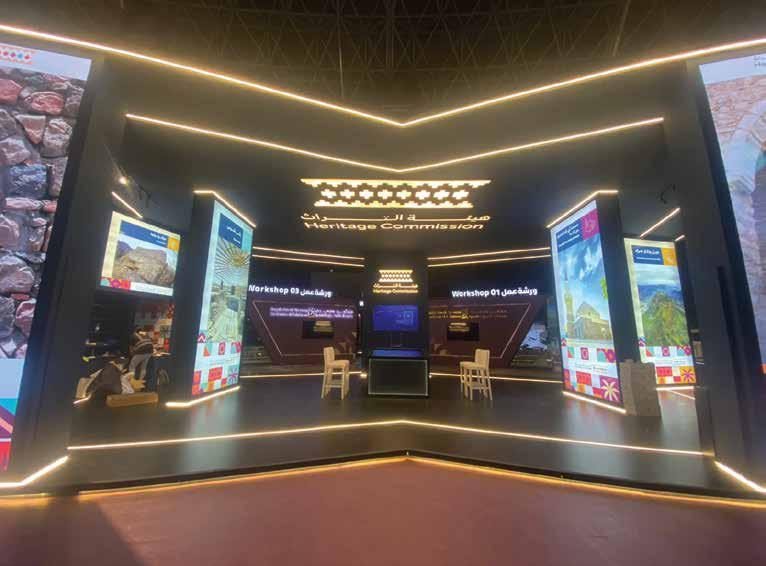
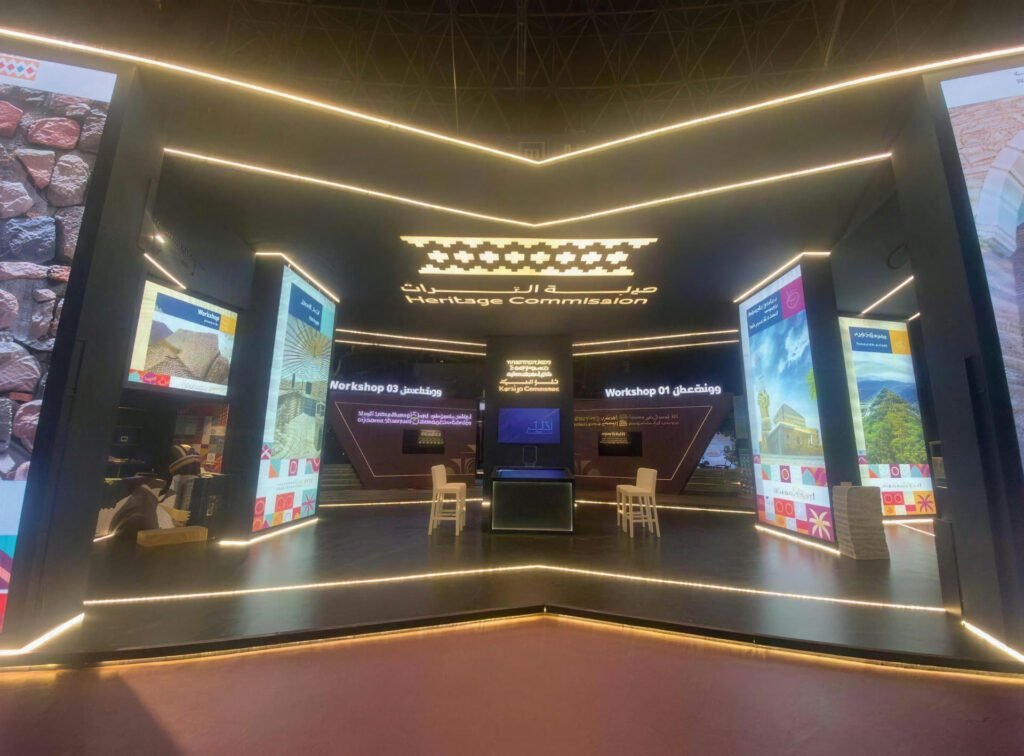
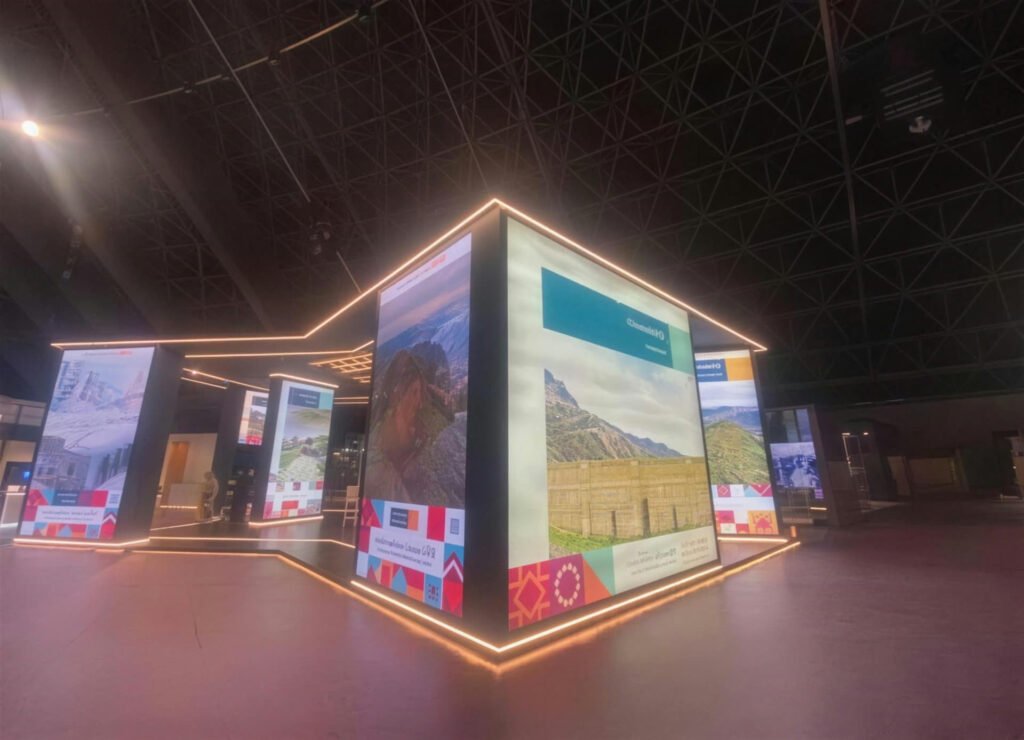
Design, CNC and laser cutting, joinery, paint, acrylic, large format print and installation sit under one roof with us, which is why the wall that was drawn is the wall that is cut and painted. Our stands and displays have stood for Kinan, the Heritage Commission, Saudia Holidays, Johnson & Johnson MedTech and Cartoon Network.
From Our Factory to the Show Floor
Stands and displays our own team designed, built and installed, with no middleman.


Questions About Wooden Exhibition Booths
What buyers ask before they choose wood.
What are wooden exhibition booths made of?
Mostly engineered boards, not planks. MDF is used for sprayed walls and routed shapes, plywood for floors and anything that carries load, timber or blockboard for the frame behind, and solid wood only for edges people touch. The surface is paint, laminate, veneer or a printed wrap.
Is MDF or plywood better for a booth?
They do different jobs. MDF gives the smoothest painted surface and cuts cleanly on a CNC router, while plywood is lighter for its strength, holds screws repeatedly and copes better with a damp floor. A well designed booth uses both, each where it belongs.
Should the walls be painted, laminated or veneered?
Paint gives an exact brand colour and a seamless wall. Laminate is harder wearing and suits counters, doors and anything that will travel to several shows. Veneer is the choice when you want real grain, and a printed wrap when the look must change between shows.
Can you make curved walls and mashrabiya patterns?
Yes. Curves are built on ribs cut by CNC and skinned with a board that bends, and fretwork panels are routed from a drawing file. Send the pattern or a reference image and we redraw it at the size of your wall.
Can a wooden booth be used again?
Yes, if reuse is decided before it is drawn. The stand is then made in sections sized to travel, joined with bolts instead of glue, with cover strips on the joins, and repainted or touched up between shows. Plywood sections take the repeated bolting better than MDF. It can be kept in our storage until the next date.
Does the wood need to be fire retardant?
That depends on the exhibitor manual of your show. Many organisers ask for treated timber or a fire retardant coating, with a certificate. Tell us the show early, so the boards are specified to match and the paperwork is prepared for your submission.
Do you paint the booth inside the hall?
No. Many venues do not allow spray painting or dusty cutting in the hall, and a hall is a poor place for that work anyway. The booth arrives with its surfaces done, and only small repairs by brush or roller happen on site.
How long do wooden exhibition booths take?
A custom stand takes 6 to 8 weeks from brief to opening, and 8 to 10 for an island or a double deck. The date in your quote is counted back from the build days the organiser gives.
Is wood more expensive than a modular stand?
At the first show, usually yes, because there is more material, more skilled labour and more to transport. The gap narrows when the booth is designed for reuse, and a hybrid of a system frame with wooden feature pieces often sits between the two.
Where is the booth built, and how do we start?
We work from more than one location in the Kingdom. Your booth is built in our own factory and our own team installs it. Send the space size, the show and its dates on WhatsApp at 0567069088 or through the quote page, and an itemised quote follows within 24 hours.
A Booth in Wood for Your Next Show?
Send the space size, the show and its dates. Within 24 hours you have an itemised quote that names every board, every surface and every line of labour.
More specific pages on this
If your question is narrower than this page, these are written for one question each.

