
Exhibition Booth Manufacturing
Exhibition Booth Manufacturing Under One Roof
Exhibition booth manufacturing is where a design either survives or comes apart. This page follows one booth through our own factory, from the approved drawings to the loaded truck: who cuts it, who checks it, what you approve and when, and why it stands complete on the factory floor before it reaches the hall. Read it before you compare quotes, because the stages a quote leaves out are the ones that fail on build day.
What Our Own Factory Protects You From
A booth rarely fails because of its design. It fails in the handovers between the people who make it, and when every stage sits in the same factory most of those handovers disappear.
The drawing you approved is the drawing that is cut
The designer's build drawings go straight to the cutting machines in the same building. Nobody at another company redraws the booth from a picture, so a wall cannot quietly change length on the way from the design to the factory.
Faults appear where the tools are
A panel that runs a little long, a socket hidden behind a shelf, a logo that sits low, a door that swings into the counter: the test assembly shows them on the factory floor, where saws, paint and spare material are a few steps away.
No truck between one stage and the next
Joinery, paint, acrylic, print and wiring share a floor and a schedule. A part that fails a check returns the same day to the machine that made it, instead of waiting for another supplier's delivery.
Made to come apart and stand again
If the booth has another show ahead of it, the factory builds it for that from the start: sections that separate cleanly, fixings that survive repeated use, and crates that become its storage between shows.
What Is Made Alongside the Booth
These teams work beside the factory floor, so their parts reach the test assembly together with the rest of the booth.
Printing & Promotional Gifts
Wall graphics printed in 1 to 5 working days and applied to finished panels before the booth stands for its trial.
Acrylic & Wood Fabrication
Lit logos, raised lettering and product plinths, cut on the same machines as the booth itself.
Promoters & Brand Ambassadors
Hosts who know before opening where the storage is, where the light switches are and how the screen starts.
Branding & Creative Studio
Artwork prepared to the real panel sizes taken from the cut list, with the brand guide open beside it.
Digital Solutions
Screens and tablets whose brackets, power points and cable routes are drawn before any panel is cut.
Experiences & Events
A demonstration or tasting that needs water, power or a counter able to carry weight goes into the drawings, not onto the site.
Social Media & Content
Stills and video of the finished booth in use on the show floor, shot while visitors are inside.
Custom Exhibition Stands
The service page for the whole job, with design and installation next to what happens in the factory.
The Factory Control Points and Who Signs Each One
A check that nobody signs is only an intention. Each of these has a name written against it on the job sheet, and the booth does not move to the next stage without the signature.
Dimensions before paint
Every cut part is measured against the build drawing while it is still bare. The joinery supervisor signs, because a correction now is a quick recut, and after paint it is a recut and a repaint.
Colour against the approved reference
The painted surface is held beside the physical sample you approved, not beside a screen. The paint supervisor signs, and the sample travels with the job until packing.
Graphics proof against the brand guide
Logo proportions, colours, spelling in Arabic and English and the position of every seam between panels are checked on a printed proof. The designer signs before the full print run starts.
Lighting switched on
During the test assembly every spotlight, lit logo and socket is powered and left running. The electrician signs once nothing flickers, nothing runs hot and no cable is visible.
Brackets, doors and locks
Every screen bracket is loaded with weight before a screen hangs on it, and each door is opened, closed and locked with its own key. The installation lead signs, since that team receives the booth after the factory.
The snag list closed
Everything found during the test assembly goes onto a single list. The project manager signs it closed item by item, and only then is the booth released for packing.
One Booth Through the Factory, Stage by Stage
In exhibition booth manufacturing, sequence counts for more than speed. Every stage passes on something that has been measured, checked and signed.
Build drawings, cut list and nesting
The approved design becomes build drawings that show every joint and fixing. The cut list is taken from them, and the parts are nested on the sheets so that as little material as possible is wasted.
CNC and laser cutting, joinery and framing
Machines cut the parts to the drawing, including the openings for sockets, cables and brackets. Joiners then frame and close the walls, counters and plinths in sections sized for the truck and for the hall doors.
Surface preparation, paint, acrylic and lettering
Edges are filled and sanded, then surfaces are primed and painted to the approved reference. In parallel the acrylic parts and raised lettering are cut and tried on their walls while the booth is still in the factory.
Print, graphics and electrical pre wiring
Large format graphics are printed and applied to the finished panels. Lighting, sockets and screen mounts are wired in advance, with cable routes inside the walls and an access opening wherever a connection may need a hand later.
Test assembly, snag list and corrections
The whole booth is built on the factory floor as it will stand at the show, with its lighting and graphics. Faults are written on the snag list and corrected, and the client sees the booth standing before it ships.
Labelling, packing and loading
Every part receives a number that matches the installation drawing. Corners are protected, graphics travel rolled or flat as the material requires, fragile acrylic is packed on its own, and a crate of tools and spares goes with the load. The truck is loaded in reverse order of installation, so the first part the team needs is the first one off.
How Long Manufacturing Takes
Custom booth
6 to 8 weeks from brief to opening, and 8 to 10 for an island or a double deck. Design approval and the factory stages share that time.
Modular booth with new graphics
2 to 4 weeks, because the frame exists and only what is new enters the factory.
Upgraded shell scheme
2 to 3 weeks for the counter, graphics and lighting added to the organiser's shell.
Graphics alone
1 to 5 working days of printing once the proof is signed.
What You Approve, and What a Late Change Costs
The figure follows the drawing, so there is no price table on this page. What can be said plainly is how the cost of changing your mind grows as the booth moves through the factory.
On paper: the drawings
You approve the plan, the views and the build dimensions. A change here costs a redrawn line. This is the moment to move a wall, widen a counter or add a store room.
Samples: material and colour
You approve physical samples of the surfaces and of the paint colour. Changing a colour before the paint is ordered is still cheap. The signed sample becomes the reference for every check that follows.
After the cut list
Once the parts are nested and cut, a new size means new material and repeated machine time. A change that was free on paper is now a line on the invoice, and it pushes back the stages behind it.
After paint
A change now is very expensive: the part is recut, prepared and painted again, and the new paint has to match parts that were painted earlier. Some changes at this stage move the delivery date itself.
Graphics proofs
You approve a proof for each printed surface. A correction on the proof costs nothing. After printing it becomes a reprint, and after application a reprint plus the labour of removing the first print.
The booth standing
Your last approval is the test assembly, when you see the booth standing before it ships. Adjustments here should be small ones, a shelf height or the angle of a spotlight, because the large decisions were signed earlier.
Send us your space size, the show, its dates and any drawings you already hold, and an itemised manufacturing quote reaches you within 24 hours. Request the quote or message 0567069088 on WhatsApp. For the budget side of the decision, our guide to exhibition stand cost in Saudi Arabia lists what moves it.
Where Exhibition Booth Manufacturing Sits in Our Work
We have more than one location in the Kingdom. Your booth is built in our own factory and installed by our own team, and where transport applies it is a named line in the quote. This page covers the factory stage only. For every kind of booth we make, start at exhibition booths in Saudi Arabia, and for the full service from the brief to dismantling night read custom exhibition stands. The parts that reach the test assembly from neighbouring teams have pages of their own: acrylic fabrication for lit logos and lettering, and printing and promotional production for the graphics. If you are still at the drawing stage, see booth design in Riyadh, and if the booth is one part of a larger day, see event management in Saudi Arabia. Count the factory weeks back from your opening day on the Saudi exhibitions calendar, and read exhibition booth prices to see how each manufacturing decision moves the final figure.
One Factory or Several Suppliers: Questions That Show the Difference
Much exhibition booth manufacturing is split: one company designs, another joins, another prints and someone else installs. Each may be good at its part. The trouble lives in the gaps between them, and these questions bring it out.
Who cuts and joins the booth?
If the answer is another company, ask who turns the design into build drawings. When the joiner redraws from a render, dimensions are guessed, and the guess is discovered at the show.
Who prints, and from which measurements?
Graphics sized from the design file instead of the built wall come up short at a corner or split a logo on a seam. When print and wall come from the same factory, the print is sized from the cut list and checked on the panel.
Where does the whole booth stand before the show?
With separate suppliers nobody owns the test assembly, because nobody holds all the parts. Walls, prints and lighting meet for the first time in the hall, inside a build window that is counted in hours.
Who answers when a part does not fit?
The joiner points to the drawing, the printer to the joiner, the installer to both. In a single factory the question has one address, and whoever fixes the fault can walk to the machine.
Did the installers see it standing?
A team that meets the booth for the first time on site reads the labels and hopes. Ours has already assembled it once in the factory, knows the order, and knows which crate holds the spares.
Mistakes Buyers Make Before the Factory Starts
None of them is about taste. Each is a decision taken late or a file sent in the wrong form, and each carries a cost the factory can name.
Approving from a render without drawings
A render shows mood, not measurements. Ask for the plan and the build dimensions with it, and sign those. The factory cuts from figures, never from a picture.
Changing the size after the cut list
A swapped space or a late wish for extra width turns cut parts into waste. If the organiser may still move you, say so early and the walls can be drawn to adjust.
Sending logos in low resolution
A logo copied from a website or a chat breaks into squares when it is enlarged to wall size. Send the vector file and the brand guide, and the proof is right at the first attempt.
Leaving screen content to the last days
The screen is ordered, wired and mounted on schedule, then plays nothing on opening morning. Content needs a deadline of its own, and a format that suits the screen named in the drawing.
Nobody named to approve
When drawings, samples and proofs each wait for a full committee, the factory waits with them. Name the person whose signature is enough, and a deputy for the days that person travels.
Judging colour on a phone
Every screen shows a different red. Approve the colour on the physical sample in ordinary light. That same sample is the one held beside the painted wall in the factory.
Booths That Left This Factory
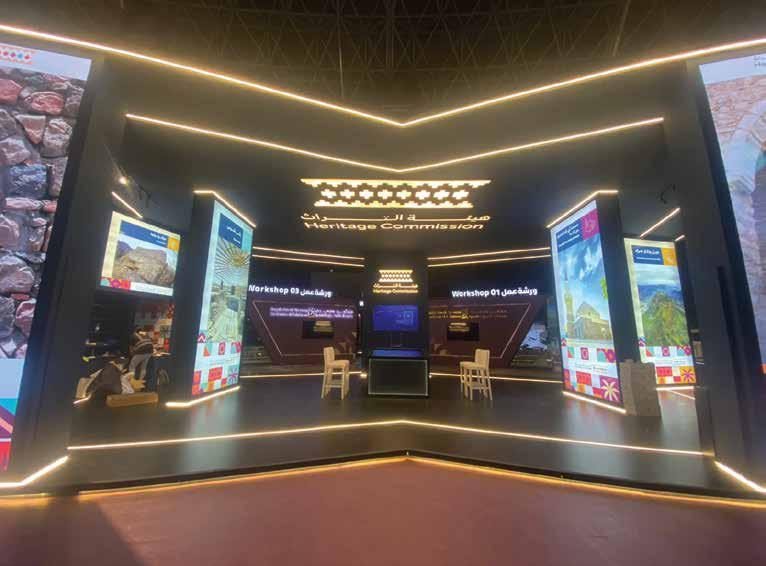
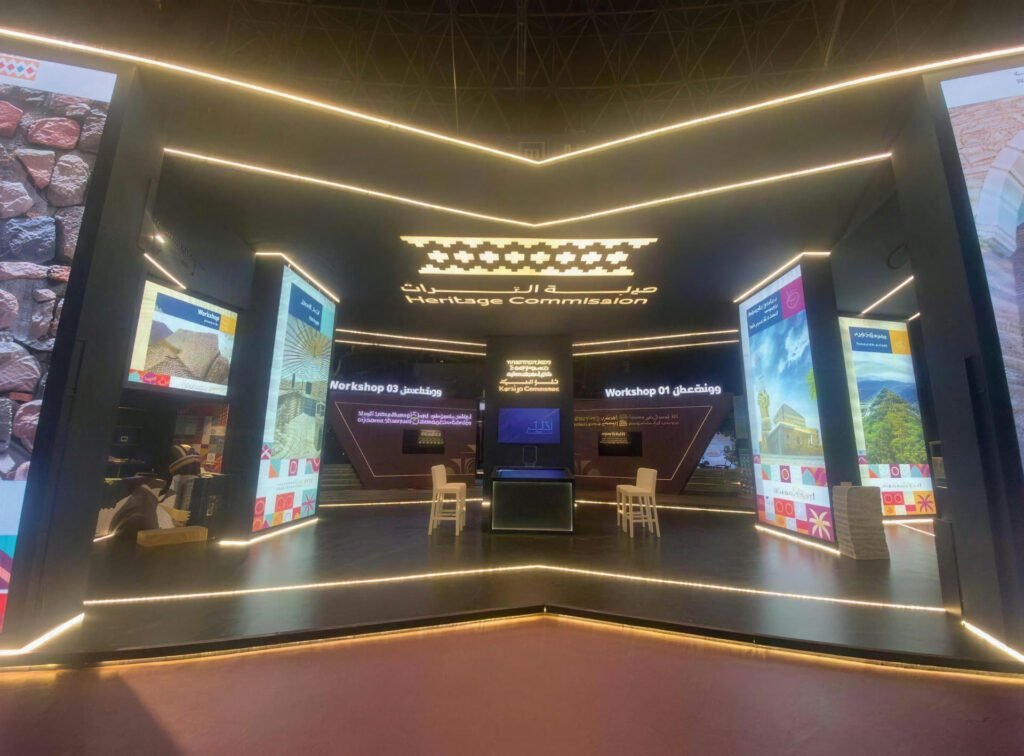
Our stands and displays have stood for Kinan, the Heritage Commission, Saudia Holidays, Johnson & Johnson MedTech and Cartoon Network. Each went through the stages written on this page: cut and joined in our own factory, stood up in its test assembly, numbered, packed, and installed on site by our own team.
From Our Factory to the Show Floor
Stands and displays our own team designed, built and installed, with no middleman.



Questions About Exhibition Booth Manufacturing
What buyers ask before they sign a manufacturing order.
What does exhibition booth manufacturing include?
Build drawings and a cut list, CNC and laser cutting, joinery, surface preparation and paint, acrylic and lettering, large format print, electrical pre wiring, then a full test assembly, packing and loading. All of it happens inside our own factory, and the same company installs the booth at the show.
Do we get to look at the booth before it ships?
Yes. Every booth is fully test assembled in the factory, and the client sees the booth standing before it ships. That is also your last approval point, so the person who looks should be the one who decides on your side.
What if we need a change after production has started?
It can usually be made, at a cost that follows the stage. On paper it is a redrawn line, after cutting it is new material and machine time, and after paint it is a recut and a repaint in a colour that must match what is already done. We tell you the cost and the effect on the date before we go ahead.
How long does manufacturing take?
A custom booth takes 6 to 8 weeks from brief to opening, and 8 to 10 for an island or a double deck. A modular booth with new graphics takes 2 to 4 weeks and an upgraded shell scheme 2 to 3 weeks. How those weeks divide between design approval and the factory depends on how fast drawings and samples are signed, and the quote states the dates.
What is a snag list?
A single list of everything found unfinished or faulty during the test assembly: a scratch, a gap between panels, a spotlight at the wrong angle, a door that catches. Each item is corrected and ticked off, the project manager signs the list closed, and only then is the booth packed.
Is the electrical work done in the factory or at the show?
Both, each with its own part. Lighting, sockets and screen mounts are wired inside the walls in the factory and tested during the test assembly. The connection to the hall supply is ordered from the organiser and made on site under the venue's rules.
How is the booth packed for transport?
Every part carries a number that matches the installation drawing. Corners are protected, graphics travel rolled or flat depending on the material, acrylic is packed on its own, and a crate of tools and spare parts goes with the load. The truck leaves the factory loaded in reverse order of installation.
Can a manufactured booth be used again at a later show?
It can, provided reuse is settled before the drawings are approved, because it changes how the sections join and how they are crated. Between shows the crates are the booth's storage, at your premises or in our storage. Before the next show the factory checks the parts, touches up the paint, replaces tired fixings and reprints whatever graphics have changed.
Which files does the factory need from us?
Logos as vector files, the brand guide, the dimensions and weights of any products the booth has to carry, and the content format for each screen. The organiser's exhibitor manual matters too, since its height limits and build rules shape the build drawings.
Who is responsible if a part does not fit on site?
We are, because every stage was ours. Design, cutting, joinery, paint, print and installation answer to one roof and one project manager, so there is no supplier to pass the question to. In practice the test assembly means that question rarely reaches the hall.
A Booth to Build for Your Next Show?
Tell us the space, the show and when it opens. An itemised quote that names every stage in the factory, from the build drawings to the loaded truck, is with you within 24 hours.
More specific pages on this
If your question is narrower than this page, these are written for one question each.

