
Illuminated Signs and Light Boxes
Illuminated Signs and Light Boxes With an Even Glow
Illuminated signs and light boxes do a job a printed board cannot: they carry your name after dark and in dim halls and corridors, where everything unlit fades into the background. Whether a lit sign looks expensive or cheap is decided inside it, by the spacing of the LEDs, the depth of the box, the face that spreads the light and the print on top. This page explains the types, from fabric light boxes to slim panels and neon flex, how an even glow is achieved, what changes between indoor and outdoor builds, and what the sign needs in power and care once it is up.
What Light Adds That Print Alone Cannot
Illuminated signs and light boxes cost more than printed boards and need a power point. They earn that back in four ways.
Read after sunset
Shopping streets in the Kingdom are busiest in the evening, which is exactly when an unlit board becomes a dark shape. A sign lit from inside keeps its colours and its name readable once the sun is down, and its glow is the first thing a passing driver picks out along a row of fronts.
Seen first in a dim space
Exhibition halls, mall corridors with low ceilings and restaurants with warm, soft lighting all make printed surfaces look flat. A light box is the brightest object around it, so the eye goes to it before it reads anything else.
A face that changes while the frame stays
A light box is a frame and a light source that stay where they are, with a printed face that comes out. A new offer, a new menu or a new campaign means printing a new face, not building a new sign.
Mood as well as message
Neon is less about information and more about atmosphere: a line of warm glow spelling a slogan on a café wall, an outline around a photo spot, a signature that visitors photograph and share on their own accounts.
What Sits Around a Lit Sign
The glow is one part of the job. These come from teams under the same roof.
Printing & Promotional Gifts
Fabric and film printed for backlight in light box faces, plus window graphics, menus and posters around the sign. A printed face is ready in 1 to 5 working days once the artwork is approved.
Acrylic & Wood Fabrication
The service behind the box: acrylic faces, and backs for neon flex and lit letters, cut on the same CNC and laser machines as every other piece of the job.
Promoters & Brand Ambassadors
Hosts with a supervisor for a shop opening or an exhibition stand, so visitors are welcomed as well as the space is lit.
Branding & Creative Studio
Logo files redrawn as lines a flexible tube can follow, and colour references checked as they look with light behind them rather than in front.
Digital Solutions
Screens where content has to move, beside light boxes for the content that stays, and simple forms that capture visitor details.
Experiences & Events
Slogans in a line of light, glowing photo walls and lit entrance pieces for product launches, openings and corporate evenings.
Social Media & Content
Photos and short video of the sign switching on for the first time at dusk, ready to post the same day.
Custom Exhibition Stands
Light boxes and neon flex built into a custom stand and test assembled with it in our factory before it ships.
Types of Illuminated Signs and Light Boxes
Many lit signs look alike from a distance, but each type spreads light in its own way, and that decides where it belongs. A good quote names the type, not only the size.
Fabric tension light box
A printed fabric face with a silicone strip sewn around its edge, pressed into a groove in an aluminium frame so it pulls tight like a drum skin, with LEDs behind it. No seams cross the image, the fabric folds for transport and a new print goes in by hand, which is why it is the light box of exhibition stands and of shops that change campaigns often.
Acrylic face light box
A deeper box, usually metal, with an opal acrylic face that diffuses the light, and the design printed on the face or cut from vinyl on top of it. It is rigid and closed, so it is the type that goes outdoors on a facade or a pole. With a dark face where only the logo lets light through, it reads after sunset like separate letters.
Slim LED panel
A thin panel lit from its edges: LEDs run along the frame and a light guide sheet inside turns that light forward across the whole face. It is the shallow option for a clinic wall, a counter front or a mall corridor, and it often comes with a frame that opens at the front so a printed poster can be changed quickly without tools.
Double sided and projecting boxes
A box with a face on each side, fixed at a right angle to the wall or hung from a bracket, so people walking along a pavement or a mall concourse see it before they reach the front. Both faces must glow equally, which means the lighting sits in the middle of the box rather than against one face.
Lit menu boards
Boards above a counter or beside a drive through lane, carrying the items and their pictures, which change with the season. They are built so a single face or panel can be swapped without switching off the whole row, and food photographs are printed for backlight so they do not look pale.
Neon flex signs
A flexible silicone tube with LEDs inside and a diffusing skin, bent along a drawn line and fixed onto a clear or coloured acrylic back. It gives the continuous line of light that old neon was known for, and it is used for logos, handwritten slogans, outlines and interior feature walls. We make neon flex in our own factory.
How a Lit Sign Is Made
The drawing decides what the sign says. These steps decide whether it glows evenly and keeps glowing.
The place and how it is seen
We start from the place: indoors or outdoors, on a wall, hung from a ceiling or on a pole, the distance and angle it is read from, and where the nearest power point is. A photograph of the wall and what surrounds it answers most of these questions before anything is drawn.
Artwork printed for light from behind
Light passing through ink weakens it, so colours on a lit face are printed deeper, white areas are planned as the brightest parts, and anything that should stay dark gets a blocking layer behind it. A logo on a dark face is the clearest way to make a box read like letters at night.
LEDs laid out for an even face
Hot spots, the bright dots you see on cheap signs, come from LEDs spaced too far apart for the depth of the box, or set too close to the face. The layout is drawn to the depth: a deeper box spreads light further, a slim one needs edge lighting and a light guide, and the corners get modules of their own so they do not fall dark.
Neon flex bent to the line
Here the logo or the handwriting is redrawn as a continuous path the tube can follow, with its start, end and crossing points planned so joins and cables sit behind the acrylic back. The tube is then bent into a cut channel or clipped along its length, and its ends are sealed.
Lit in the factory before it leaves
Every box and every tube sign is assembled, wired and switched on in our factory before it is packed, so a dark corner, an uneven face or a stretch of neon flex that does not glow is found and fixed there, not on the wall.
Installed, timed and handed over
Our own team fixes the sign, connects it to the supply point your electrician has prepared and sets a timer to your opening hours, and you see it lit before we leave. Keep a list of the lighting parts, the driver and the LED type, so any later repair matches the original.
How Long a Lit Sign Takes
A new printed face for an existing box
Printed in 1 to 5 working days once the artwork is approved, then fitted into the frame.
A new light box or neon sign
It depends on the type, the size, the number of pieces and whether it is built for outdoors. The quote states the date.
A light box inside a custom stand
Built within the stand's own schedule, 6 to 8 weeks from brief to opening.
Your quote
An itemised quote within 24 hours of receiving the photo, the place and the artwork.
What Decides the Price of a Lit Sign
We publish no price list, because illuminated signs and light boxes are priced from their drawings. These are the lines that move a quote, named so you can compare offers on the same terms.
The type of box
A fabric light box, an acrylic face box, a slim panel and a neon flex sign are built in very different ways. For the same area of face, fabric or a slim panel usually takes fewer working hours than a deep, sealed outdoor box.
One face or two
A double sided or projecting box needs a second face, lighting that serves both faces, and a bracket or fixing strong enough to hold it away from the wall.
Indoor or outdoor build
Outdoors the box has to keep out water and dust, take the sun on its face and the heat inside it, and be fixed against wind. Sealed joints, parts rated for outdoor use and a face that resists yellowing all add to the quote.
Length and colours of the line
Neon flex is priced along its line: a long handwritten slogan costs more than a short word, and every extra colour means another run of tube and another connection.
Control of the light
A sign that only switches on and off is the simplest. A timer, a dimmer for a quiet restaurant or colour change for an event sign each adds parts that the quote names.
Height and access on site
A sign above a counter goes up from a ladder. A box high on a building facade needs access equipment and more time, and that is a line of its own in the quote.
Send a photo of the wall or the front, the place, and your logo or artwork. An itemised quote for your lit sign reaches you within 24 hours. Request a quote or message 0567069088 on WhatsApp. If your light box is part of an exhibition stand, our guide to exhibition stand cost in Saudi Arabia shows how the whole budget is put together.
Light Boxes, Letters and the Shop Front
This page is about the lit product itself, and a few neighbouring jobs have pages of their own. When the sign is the shop front as a whole, with its facade design and the municipal licence we prepare and follow with you, start at shop signage. Indoor signs in acrylic for an office, a clinic or a showroom, from the reception logo to door signs, are on acrylic signage. Lit letters, where every letter is a small light box of its own, glowing through its acrylic face or throwing a halo from its back onto the wall, sit with raised letters and props on 3D letters and props. The difference is simple: a light box lights a whole panel, lit letters light only the shape of the name, and many fronts combine the two. The machines and materials behind every piece are explained on acrylic and wood fabrication. On a stand, the printed faces of light boxes are part of exhibition stand graphics, and a lit header or a glowing menu on a retail unit inside a mall is covered on mall kiosks.
Which Lit Sign for Which Place
With illuminated signs and light boxes, the right type is decided less by taste than by where the sign hangs and how often its message changes.
Shops and showrooms
On a street front, a sealed acrylic face box or lit letters carry the name. Inside, a fabric box or a slim panel behind the counter or on a side wall shows the offer of the month, and a projecting box catches people walking along the pavement.
Restaurants and cafés
Menu boards above the counter carry the items and their pictures, and a neon slogan or logo on the seating wall sets the mood. In a dim interior, warm white neon on a dimmer keeps the glow from overpowering the room.
Exhibitions
Fabric light boxes were made for stands: light, seamless, quick to fit and quick to reprint for the next show. A lit header and a glowing back wall are seen from the far end of the hall.
Malls
Mall rules usually decide what light a unit may use, and the tenant guide often asks for internal lighting and hidden fixings. Slim panels suit corridors and kiosks, and a lit outline frames a pop up shop.
Offices and events
In an office, a lit logo at reception or a line of light carrying the company values is a permanent piece. At an event, lit hashtags, glowing photo walls and lit entrance signs are built to travel and to be packed for the next date, and they can be kept in our storage between events.
Common Faults in Lit Signs
Most are decided inside the box before it is closed, and all of them show after dark.
Hot spots and stripes
A row of bright dots or bands across the face means the LEDs are spaced too widely for the depth of the box, or the diffuser is too thin. Turning the brightness down does not cure it. The layout has to be redrawn.
Dark corners and edges
A box lit only from the middle leaves its corners grey. The modules have to reach the edges, and a slim panel needs light along every side it was designed for.
Colours that wash out
Artwork prepared for a wall looks pale on a lit face, and reds and brand colours drift towards pink or orange. The cure is a file printed for backlight and a test print seen lit before the full run.
Water and dust inside an outdoor box
Unsealed joints let in rain, storm dust and insects drawn to the glow, and they gather behind the face as dark patches. An outdoor box needs sealed seams, drain holes at the bottom and a face that closes tightly.
A driver that overheats
The driver turns mains power into the low voltage the LEDs run on, and it is the first part to fail when it is shut in a hot box with no air. Placing it where heat can escape and where a technician can reach it without taking the sign down saves a lot of trouble later.
Neon flex that lifts or shows its joins
Flex held only by glue peels away in the heat, and a visible cut or a bright point where two pieces meet breaks the line. It needs a channel or clips along its length, and joins planned where the line passes behind the acrylic back.
One Factory for the Box, the Face and the Neon
Design, CNC and laser cutting, acrylic, joinery, paint, neon flex, large format print and installation sit under one roof with us, so the light box that was drawn is the one that is cut, wired, printed and fixed. We have worked for Kinan, the Heritage Commission, Saudia Holidays, Johnson & Johnson MedTech, Cartoon Network and Swarovski.
Light and Neon From Our Work
Illuminated signs and neon we made for shops and events.

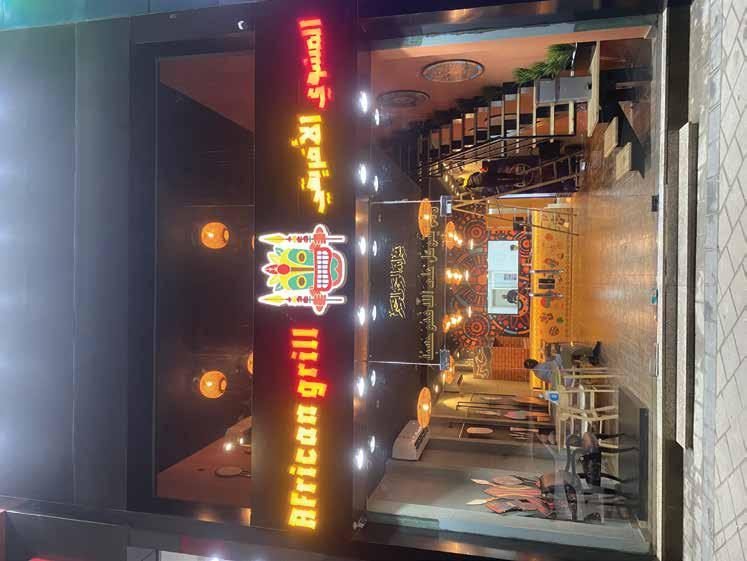

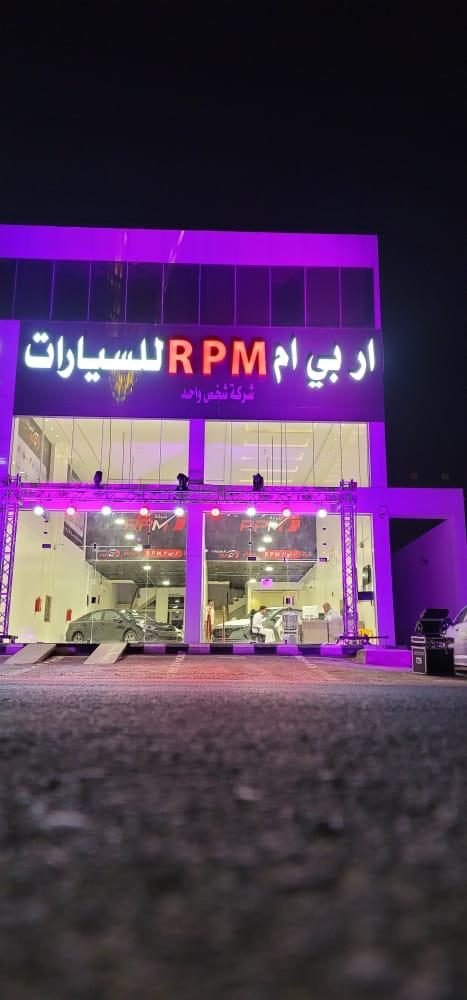
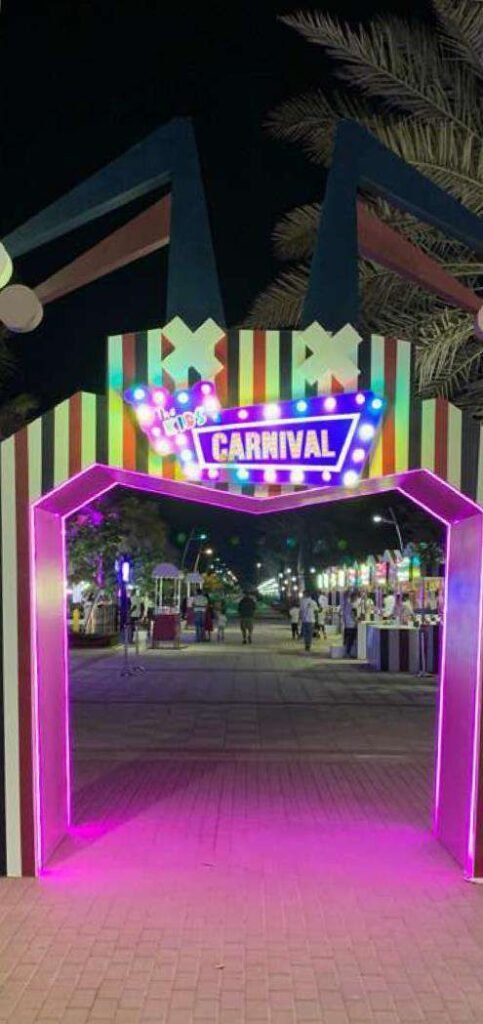
Questions About Illuminated Signs and Light Boxes
What buyers ask before they order a lit sign.
What is the difference between a light box and lit letters?
A light box lights a whole panel, with the design printed on its face. Lit letters are cut and built one by one, so only the shape of the name glows and the wall shows between them. A light box is quicker to change and usually costs less for the same width of front, while lit letters look more refined on a facade.
How does neon flex differ from real glass neon?
Glass neon is a glass tube bent by hand over a flame, filled with gas and driven by a high voltage transformer, and it breaks if it is dropped. Neon flex is a silicone tube with LEDs inside that runs on low voltage, bends without heat and survives transport, while giving the same continuous line of light. Neon flex is what we make in our own factory.
Can I change the design on a light box later?
Yes, that is one of its main strengths. A fabric box takes a new printed fabric in the same frame, a panel with a front opening frame takes a new poster, and an acrylic face box takes a new face or new vinyl. A new printed face is ready in 1 to 5 working days once the artwork is approved.
How do you avoid hot spots and uneven light?
By drawing the LED layout for the depth of the box, choosing a face that diffuses the light, and lighting the corners on purpose rather than by chance. Every sign is switched on in our factory before it leaves, so any patch with a weaker glow is seen and corrected there.
Can a light box go outdoors?
Yes, if it is built for outdoors from the start: sealed seams, parts rated for weather, a driver placed where heat escapes, a face that keeps its colour in the sun and fixings that resist wind. An indoor box placed outside does not last long in the Saudi sun and dust.
How much electricity does a lit sign use?
LED light boxes and neon flex use far less power than the fluorescent tubes and glass neon that came before them, and most of the running cost comes from the hours they are switched on. A timer that turns the sign off after closing and a dimmer indoors are the simplest ways to keep it low. Ask for the driver and LED details in the quote if your electrician needs to plan the load.
What maintenance does a light box need?
Wiping the face, checking the seals and fixings of outdoor signs after dust storms, and replacing a driver or an LED module if part of the face dims. These are standard parts, so a well built box is repaired, not thrown away. Keep the list of parts from the handover so a replacement matches the original.
Does an illuminated sign need a licence?
An outdoor sign on a shop front usually needs a municipal licence, and a mall has its own approval through the tenant guide. Signs inside an office or an exhibition follow the rules of the venue or the organiser. For shop fronts we prepare the drawings and the application and follow it with you as part of our shop signage service.
Can you make a neon sign from our logo?
Yes, in most cases. The logo is redrawn as lines the tube can follow, and very fine details or small text may be simplified or moved onto the acrylic back as print. You see the drawing of the path the tube follows before it is made.
Where are the signs made, and how do we start?
We have more than one location in the Kingdom. Your sign is made in our own factory and installed by our own team. Send a photo of the place, your logo and what the sign should say on WhatsApp at 0567069088 or through the quote page, and an itemised quote follows within 24 hours.
A Lit Sign for Your Space?
Send a photo of the wall, your logo and where the sign will hang. Within 24 hours you have an itemised quote that names the type, the face, the lighting and the fixing.
More specific pages on this
If your question is narrower than this page, these are written for one question each.

