
Exhibition Display Stands
Exhibition Display Stands From Roll Up to Built Booth
In the Saudi market the word stand covers a whole ladder of pieces, from a roll up banner beside a reception desk to a booth built for a trade show. Most people who search for exhibition display stands do not yet know which rung they need. This page is the map: what each piece is, where it works, what its design has to get right, and how display stand rental compares with owning. At The Touch we design the artwork, print it, supply the hardware and install it with our own team.
Artwork Is Designed for the Hardware, Not the Screen
A display stand is a printed sheet held by a mechanism, and every mechanism hides, bends or cuts part of the sheet. Design that ignores this looks right in the PDF and wrong in the hall. This is the part of designing exhibition display stands that a general designer tends to miss.
The bottom of a roll up never comes out
The lower strip of the print stays wound inside the cassette to hold the tension, and the top edge is gripped by the rail. Nothing that matters goes in either strip. We carry the background colour through them and keep text and logos clear.
A pop up wall has seams in fixed places
The panels of a pop up meet along vertical joins that never move, and the end panels curve away towards the back. We place faces, logos and small text between the joins, and treat the curved ends as side views read from the aisle.
Logo high, message at eye level, contact low
The logo sits in the top band, where it shows above the heads of people standing in front. The message sits at eye level. Phone, website and QR code go lower, but above knee height, because nobody bends down to scan a code.
One message per stand
A visitor gives a banner one glance while walking. Each piece therefore carries one job: a promise, a product or an offer. The second message belongs on the second stand, and the details belong in the brochure the visitor takes away.
What Stands Around the Display
A display stand rarely works alone. The same team supplies what surrounds it, and each service has its own page.
Printing & Promotional Gifts
Banner film, fabric, vinyl and rigid board printed under one roof in 1 to 5 working days, with the giveaways for the table.
Acrylic & Wood Fabrication
Risers, sample trays, brochure pockets and lit logos made to fit the shelf or the counter top.
Promoters & Brand Ambassadors
A briefed host beside the stand, under a supervisor, because a banner cannot answer a question.
Branding & Creative Studio
The grid, colours and type that keep a family of pieces looking like one brand.
Digital Solutions
A screen on a floor mount, or a tablet form that takes visitor details where paper would pile up.
Experiences & Events
A tasting, a draw or a product trial that gives a passer by a reason to stop.
Social Media & Content
Photos and short clips of the set in place, published while the event is still running.
Custom Exhibition Stands
The top rung of the ladder, for the show where a set of portable pieces is not enough.
The Ladder of Exhibition Display Stands
From the lightest piece to the heaviest. Each rung says what the piece is, where it works and what its design must get right.
Roll up and X banner stands
A roll up banner retracts into a floor cassette and stands on a single pole. An X banner hangs a print by its corner eyelets on a light folding frame. Both suit receptions, registration desks and store entrances. The design must read from top to bottom in one glance, and an X banner needs still indoor air.
Pop up walls and fabric tension displays
A pop up is a folding lattice frame, curved or straight, that carries printed panels and makes a backdrop for a row booth or a photo corner. A fabric tension display stretches one printed sleeve over a tube frame, with no seams at all. The design decides where the joins fall and how the sides read.
Tabletop, brochure and sample stands
A tabletop display stands on a sponsor table at a conference where floor pieces are not allowed. Brochure stands and sample stands hold what the visitor takes away. Their design is about reach and refill: pockets that stop paper curling, a tray at hand height, and a header that says what is on offer.
Product display stands for shops and malls
A stand that holds stock in a shop or a mall aisle, with a header, shelves and price strips. Shoppers approach from both directions, so the side panels sell as much as the front. The weight of the product decides the material: light printed board for a short promotion, wood, metal or acrylic for a long one.
Lightbox stands and portable counters
A lightbox stand is a frame lit from inside behind printed fabric, and it is seen first in a dim hall. A portable counter gives the host a surface, a logo front and a shelf. A lightbox needs a socket within cable reach, and backlit artwork is prepared with deeper colour because light washes it out.
Modular and custom built stands
A modular stand is a frame system with walls, a counter, lighting and flooring, reconfigured from show to show. A custom built stand is designed and made for one space and one brand. Both are booths in the full sense, and each has its own page on this site.
How a Set Is Designed as One Family
A roll up, a counter and a backwall bought at different times from different printers look like different companies. Designed together, they read as a single brand.
The place and the job
We start with where the pieces will stand and what each must do: stop people, explain a product or collect contacts. A photo of the spot and the viewing distance tell us more than a list of sizes, because what reads up close at a reception does not read from an exhibition aisle.
Choosing the rungs
We propose the smallest set that does the job, piece by piece, with an itemised quote within 24 hours. A reception needs a roll up banner. A row booth usually needs a backwall, a counter and a banner at the aisle.
One grid for every piece
The logo band sits at the same height on the roll up and on the backwall, so the lines meet when they stand side by side. One typeface, one colour set, one photo style. Arabic and English are stacked, not set side by side, because a banner is narrow.
Print files to each template
Every piece has a template that shows the visible area, the hidden strips and the joins. Logos go in as vector artwork, photos at full size, fonts converted to outlines, with bleed where the template asks for it.
Colour matched across materials
The same brand colour prints differently on banner film, on polyester fabric, on counter vinyl and on a backlit face. We print a strip of the key colours on each material, compare them under one light, and adjust each file until the set matches.
Trial assembly, packing and handover
The set is assembled in our factory, photographed as a family and packed in its bags and cases. You receive it with a short set up guide, or our own team installs it at the venue.
How Long Each Rung Takes
Graphics for hardware you own
Approved artwork is printed and fitted in 1 to 5 working days.
A kit from the rental stock
Hardware from our stock with your new print: 5 to 10 working days after the order is confirmed.
A modular stand with new graphics
2 to 4 weeks, including the layout for your space.
A custom built stand
6 to 8 weeks from brief to opening day.
Display Stand Rental: What Is Rented and What You Keep
Display stand rental splits every piece in two. The hardware is rented and goes back to our stock. The graphic is always printed new for you and stays yours.
What the rental covers
The mechanism: the roll up cassette and its pole, the pop up frame with its case, the lightbox frame and its lighting, the counter body, the brochure stand. It leaves our stock checked and returns to it after the event.
What is printed new and kept
The graphic. A print carries your brand and wears with use, so it is never passed from one client to the next. After the event it is rolled into a tube and handed to you, ready for your next rental.
When rental beats buying
One event, a launch day, a conference that happens once, or a first show you are still testing. You pay for the days, store nothing, and nobody in the office has to look after cases.
When buying wins
A sales team that travels, a showroom, a company reception, or a calendar of repeated events where rental fees add up. Hardware you own is paid for once and after that only the print changes, and we can keep it in our storage between events.
What a rental quote lists
Each hardware piece on its own line, each printed graphic with its material, the rental period by date, then delivery, set up, dismantling and collection. Where transport applies it is a named line in the quote.
Condition on return
Rental hardware is checked out and checked back in against one signed list. The quote states how normal wear and a damaged part are treated, so the rule is agreed before the event and not after it.
Tell us the event, the venue, the dates and the pieces you have in mind. Within 24 hours you receive an itemised quote for rental, for purchase, or for both side by side. Ask for the quote, or write to us on WhatsApp at 0567069088. If the answer turns out to be a built booth, the first step is its 3D concept and build drawings, explained on our booth design in Riyadh page.
Where to Go From Each Rung
This page is the map, and each destination has its own page. Start at the exhibition booths in Saudi Arabia hub for the whole picture. A stand designed and made for one space is on the custom exhibition stands page, and a frame system you rent or own is on modular and portable exhibition stands. Banners, fabric and board are produced by our printing and promotional production service, and when the display is one part of a larger day, see event management in Saudi Arabia. To match a budget to a rung, read our article on exhibition booth prices, and to plan the season use the Saudi exhibitions calendar. The counter on its own is covered on our promotional counters page. We work from more than one location in the Kingdom, and the exhibition display stands on this page are prepared in our own factory and installed by our own team.
When a Display Stand Is the Wrong Answer
Portable pieces have limits. If one of these describes your event, the honest answer is a built booth.
The plot is space only
A space only plot comes as bare floor, with no walls, carpet or power. A line of banner stands does not turn it into a booth, and the exhibitor manual issued by the organiser says what a booth on that plot must have.
You need a room, not a wall
A meeting corner, a lockable store or a hospitality corner needs walls that carry doors and shelves. A pop up carries a print and nothing else.
The product is heavy or needs services
Machines, vehicles, cooking equipment and anything that needs water, drainage or a strong power supply stand on a built floor with the cabling under it.
It is your main show of the year
Where competitors arrive with built booths, a set of portable displays reads as a smaller company. Keep the portable set for the conferences and roadshows around that show.
The space is wider than a row booth
Portable walls suit a 9 square metre row booth and stretch to 18. On a corner, a peninsula or an island, the open sides need structure, height and lighting that a banner cannot give.
What Breaks First and How to Prevent It
Portable exhibition display stands live in car boots, lifts and store rooms. They are made to travel and to be set up by one person without tools, and they fail in the same few places.
The cassette spring
Let go of a roll up and the spring snatches the print back into the cassette, tearing the leader and bending the top rail. Guide it down by hand every time, and never pull it past the end of the print.
The pole joints
A support pole is made of short sections held by an elastic cord. Forced together at an angle, the joints split. The sections should slide together straight, and a spare pole in the bag earns its place.
Creased prints
A crease in banner film is permanent and catches every light in the hall. Film is rolled with the print facing out and never folded. Fabric can be folded, and its marks relax under tension or steam.
Heat in the car boot
One summer in a parked car curls the edges of a banner and softens the adhesive on counter vinyl. Between events the kit belongs indoors, in its bags, in a cool dry room or in our storage.
Bags and cases
Each roll up banner travels in a padded carry bag, a pop up in a wheeled case that becomes a counter once its printed wrap is on, and fabric in a soft bag. A piece that travels loose arrives scratched.
Packing away damp or dusty
Wipe the print with a soft dry cloth and let it dry before it is rolled. Check magnets, connectors and feet as you pack, so a missing part is found at the office and not at the venue.
The Same Factory Behind the Smallest Stand
Design, CNC and laser cutting, joinery, paint, acrylic, large format print and installation sit under one roof, so a roll up banner and a full booth come from the same team. Our stands and displays have stood for Kinan, the Heritage Commission, Saudia Holidays, Johnson & Johnson MedTech and Cartoon Network.
Display Stands From Our Factory
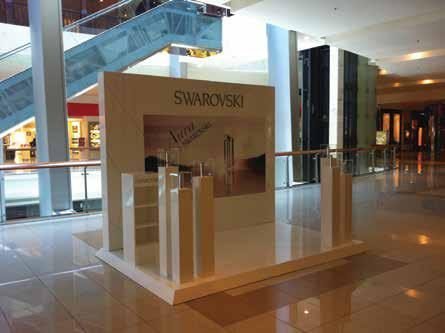
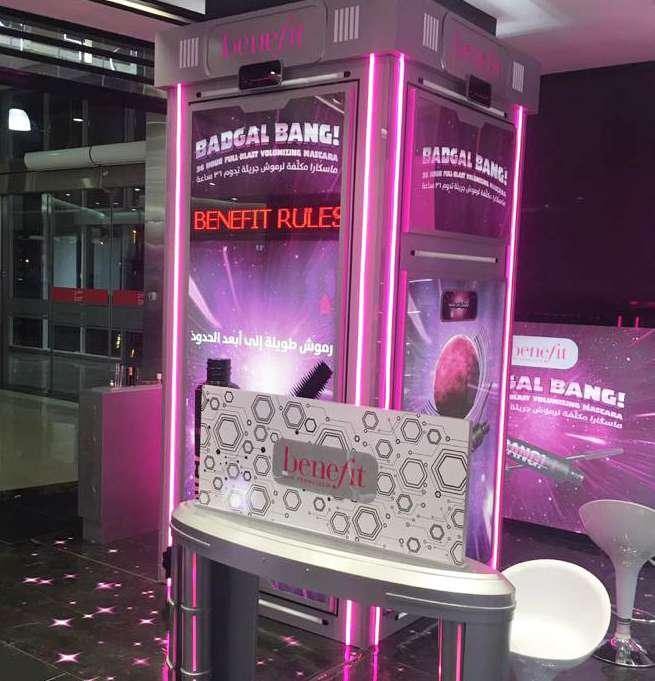
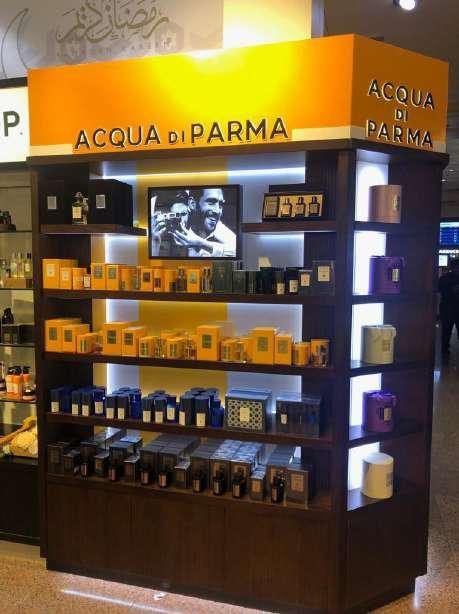
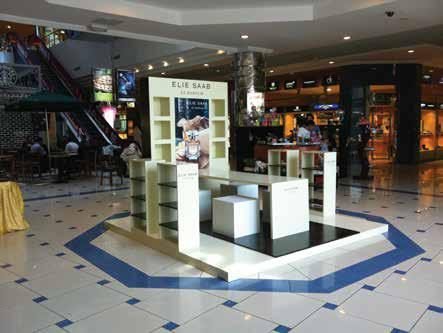
Product stands and showcases we built for shops and exhibitions.

Questions About Exhibition Display Stands and Rental
What marketing teams ask before ordering their first set.
Which exhibition display stands does a small booth need?
For a 9 square metre row booth the usual set is a backwall, a counter and one roll up banner at the aisle. Send the space and what you sell, and we propose the smallest set that does the job.
What is the difference between a roll up and an X banner?
A roll up stores its print inside the floor cassette, so the print is protected in transit and looks tidier at a reception. An X banner is lighter and its print hangs exposed on a folding frame, which suits a short indoor campaign. Both carry one message.
Can I send my own artwork?
Yes. Ask for the template of each piece first, because it shows the hidden strips and the joins. We check the file before printing and tell you if a logo or a line of text sits where the hardware will hide it.
Why does my brand colour look different on each piece?
Each material takes ink in its own way, and a backlit face looks lighter once it is switched on. We print the key colours on every material in the set, compare them under one light and correct each file.
How does display stand rental work?
You rent the hardware for the dates of the event and we print a new graphic for it. After the event the hardware returns to our stock and the graphic is handed to you. A rental kit from stock takes 5 to 10 working days after the order is confirmed.
Can I reuse the graphic on my next rental?
Usually yes, when you rent the same model of hardware and the print has been stored rolled and clean. Tell us which graphic you kept, and we check it before the event instead of on the day.
Can one person set the pieces up?
Roll up banners, X banners, tabletop displays, brochure stands and most pop up walls are made to be set up by one person without tools. A lightbox stand or a modular stand is better left to our team, who also install at the venue.
How fast can a banner be printed?
Graphics are printed in 1 to 5 working days after the artwork is approved. Where your order falls in that range depends on the material, the quantity and whether the colours have to match pieces you already own.
Do you deliver outside the main cities?
Yes. We work from more than one location in the Kingdom, and our own team has installed in more than 30 cities. Where transport applies it is a named line in the quote.
What should we send to get a quote?
A photo of the place, the event dates and the pieces you are considering. Send them through the quote page or by WhatsApp to 0567069088, and the itemised quote is back within 24 hours.
Not Sure Which Rung You Need?
Tell us where the stand will be and what it has to do. We reply within 24 hours with the right pieces, an itemised quote, and the choice between rental and owning.
More specific pages on this
If your question is narrower than this page, these are written for one question each.

