
Restaurant Packaging
Restaurant Packaging Printed With Your Identity
Restaurant packaging is the part of your brand that leaves with every order: the burger box, the fries cone, the wrap sleeve, the kraft bag and the sticker that seals it. For a restaurant, a café or a cloud kitchen, those pieces are often the first thing a delivery customer sees of you, before the first bite. We print restaurant packaging with your identity, from burger boxes and pizza boxes to greaseproof paper, cup sleeves and carriers, and we plan it per menu item so every piece fits the food it holds. This page explains the pieces in the family, how each one copes with grease, heat and the trip to the door, what to ask about food contact and what to send for a quote, so the offers you compare are built on the same lines.
Why Restaurant Packaging Sells the Next Order
In a dining room the décor, the staff and the plates speak for you. In a delivery order, restaurant packaging does all of that on its own, on a doorstep you will never see.
It is the shop front of a cloud kitchen
A cloud kitchen has no dining room and no sign on a busy street. The customer meets the brand when the bag is handed over, so the bag, the seal and the burger boxes inside carry the whole impression. Printed restaurant packaging makes a kitchen that sells through delivery apps feel like a place with a name worth ordering from again.
It arrives in photos
People photograph a good meal before they eat it, and the box lid, the wrapping paper and the fries cone are in the frame. A clear logo, a colour that reads on a phone screen and a pattern that survives a crease turn each of those posts into exposure the restaurant did not pay for.
It decides how the food arrives
A box with no vents steams crisp fries into a soft heap, and a lid without a proper lock opens in the bag. Packaging chosen for the food keeps the bun dry, the sauce inside and the heat where it belongs, and the customer judges the kitchen by what comes out of the bag.
It makes every piece look like one brand
When the burger boxes come from one supplier, the bags from another and the stickers from a print shop down the road, different shades of the same red end up on one table. One artwork system and one colour reference across all your restaurant packaging make the order look planned, from the bag down to the sticker that seals it.
What Comes With the Packaging
Restaurant packaging is one part of the counter. These services work from the same identity files and reach your branches with it.
Printing & Promotional Gifts
Menu cards, loyalty cards, thank you cards for the bag and seal stickers, all printed from the packaging artwork. Printed items are ready in 1 to 5 working days after the artwork is approved.
Acrylic & Wood Fabrication
Acrylic menu holders, counter displays for sauces and add ons, and a lit logo above the pickup window, cut on CNC and laser machines in our factory.
Promoters & Brand Ambassadors
Hosts with a supervisor who hand out tasting portions in your printed boxes at a mall, a food festival or an opening day.
Branding & Creative Studio
A logo redrawn as clean vector files, a pattern and colour system that runs across every box, bag and wrap, and artwork laid out on each dieline.
Digital Solutions
A QR code on the box or the bag seal that opens the menu, a review page or the loyalty sign up.
Experiences & Events
Opening days, food festivals and launch nights in which printed restaurant packaging is part of the scene.
Social Media & Content
Photos and short clips of the new boxes with the food in them, ready for your accounts before the launch.
Custom Exhibition Stands
Stands for food and hospitality exhibitions built in our own factory, with a counter that serves samples in your printed packaging.
Burger Boxes, Fries Cones, Pizza Boxes and Bags: The Restaurant Packaging Family
Each menu item needs its own piece, and each piece has its own job. These are the shapes that most restaurant packaging for fast food and delivery is built from.
Burger boxes
A clamshell folded from one sheet of board, with a lid that locks into the base. Good burger boxes have small vents near the hinge so steam escapes and the bun does not go soggy, a grease resistant inner face so sauce does not soak through to the print, and a lock firm enough to stay shut when the boxes are stacked in a bag. The lid is the largest printed face, and the best place for the logo.
Fries boxes and cones
An open scoop or a cone that stands in a cup holder or lies flat in the bag. Fries need air more than insulation, so the shape is open or vented, and the board needs a grease barrier where the oil sits. The narrow front of a fries box carries the logo, while a cone lets a pattern wrap all the way round.
Sandwich and wrap boxes
Wedge boxes for club sandwiches, tray boxes for subs, and sleeves or wrapping paper for tortilla wraps and shawarma rolls. Some have a window so the filling shows. A wrap held in a printed sleeve can be eaten from the hand without the paper tearing, so the sleeve size is taken from the real wrap, not from a catalogue.
Pizza boxes
Corrugated board, because a pizza box has to stay flat under the weight of the box stacked on top and keep the heat in. Vents in the lid or the sides let steam out so the crust does not soften. The lid is a wide printed face that the whole family sees when it opens on the table, and a simple design in few colours prints cleanly on corrugated board.
Meal and bento boxes
Lidded boxes for a main dish and its sides, with or without compartments, for rice dishes, grills, salads and set meals. They need a closure that holds when carried flat, a lining that copes with sauce and steam, and a lid shape that stacks. In bento boxes the compartments are planned from the actual dishes, so nothing slides into the next section.
Bags, wrapping paper and the small pieces
Kraft takeaway bags with a flat base for delivery, paper bags with handles for the counter, greaseproof wrapping paper printed with a repeat pattern, cup sleeves and carriers for drinks, and stickers and seals that close the bag and show it has not been opened on the way. Small as they are, these pieces tie your restaurant packaging to one identity.
From Your Menu to Cartons at Every Branch
Good restaurant packaging is planned from the menu, item by item, long before any artwork is drawn. These are the steps in order.
The menu, item by item
We start with what leaves your kitchen: each menu item, how it is served, whether it goes out by delivery, takeaway or both, and how hot, oily or saucy it is. A burger, loaded fries and a rice bowl each need a different piece. The list becomes the packaging plan, one line per item, with the bag, the wrapping paper and the stickers that go around them.
Structure and board for each piece
For each line we choose the shape and the board: folding board for burger boxes and fries cones, corrugated board for pizza boxes, kraft or white, with a grease barrier where the food needs it. Vents, locks and handles are agreed at this step, because they decide whether the food arrives the way it left the kitchen.
One identity across the family
Your logo, colours and pattern are laid out on the dieline of each piece, so the burger box, the bag and the wrap look like one family on the table. Each dieline marks the folds, the glue flap and the lock, so the logo never lands on a crease and the main mark faces the customer when the lid opens.
Food grade board and inks
Ask for food grade board and inks suited to food contact, especially for any face that touches the food. Print usually sits on the outer face, and the quote names the board, its coating and the inks for each piece, so you can keep the material details on file for your own food safety records.
Sample, proof and a real food test
You sign a proof for each piece with the colours written on it. A printed sample can be requested in the quote, and it is worth filling it with the real dish: a hot burger for a trip across town, fries to test the steam, a sauce to test the grease. That test is the safest way to judge venting, closure and colour on kraft.
Printing, packing and delivery
Each piece of restaurant packaging is packed flat in cartons marked with the item and the branch, ready to fold at the station where it is used. We have more than one location in the Kingdom, and delivery reaches every branch or central kitchen address you give us.
How Long a Restaurant Packaging Order Takes
A new design on standard shapes
It depends on the board, the print method, the plates needed for each colour and the production schedule. The delivery date for each piece is written in the quote once the artwork is approved.
A custom structure or a new size
A box shaped around a signature dish needs a new dieline and a structural sample before printing, and that time drives the whole schedule.
A reorder of an approved design
Usually shorter than the first order, because the dielines, the colours and any plates already exist. Ask for the reorder time of each piece to be stated in the quote.
Stickers, menus and opening pieces
Seal stickers, menu cards, flyers for the bag and counter graphics are printed in 1 to 5 working days after the artwork is approved.
Restaurant Packaging Prices: What Sets Them
We publish no price list, because every restaurant packaging order is built from the same few lines in different proportions. Put the quotes side by side, compare them line by line, and the reason for the gap shows.
The board and the structure
Folding board, corrugated board and kraft are each priced differently, and a grease barrier or a coating adds to the board. A clamshell with a lock, a box with compartments or a bag with handles takes more forming than a plain tray.
Colours and the print method
Methods that need a plate for each colour carry a setup cost that weighs less the longer the run. Digital print needs no plates and suits short runs and trial designs, at a higher price per piece.
The quantity per item
Each piece has a minimum per design, and the price per piece falls as the run grows. Your best selling item and a seasonal special rarely need the same quantity, so each is quoted on a line of its own.
The number of pieces and designs
Every piece has its own dieline and every design its own setup. Burger boxes in more than one size, a fries cone and a bag each need a setup of their own, and a Ramadan design beside the everyday one is another.
Windows, handles and extras
A window in a sandwich box, a handle on a bag, a divider in a meal box or a printed inside face each add a line.
Packing, storage and delivery
Packing per item and per branch, marking the cartons and splitting the delivery across addresses all take time. Where transport applies, it is a named line in the quote.
Send your menu items, the sizes you serve, your logo or brand files, a rough quantity for each item and your delivery city, and an itemised quote for your restaurant packaging reaches you within 24 hours. Request a quote or message 0567069088 on WhatsApp. If your brand is also serving samples from a stand at a food exhibition, our guide to exhibition stand cost in Saudi Arabia sets out the other lines of that stand budget.
Restaurant Packaging in Jeddah, Riyadh and Dammam: Who Orders It and Why
Printed restaurant packaging serves very different kitchens. A burger restaurant needs burger boxes in the sizes on its menu, fries cones, wrapping paper for sliders and a bag that carries a family order. A cloud kitchen that works only through delivery apps needs packaging that does all the branding on its own and survives a long ride. A café or a bakery packs sandwiches, pastries and cakes, and a pizza place depends on corrugated boxes that stack. A food brand launching a new concept wants every piece to carry its identity from the first day, and a caterer packs set meals for offices and events. Whether your kitchen is in Jeddah, Riyadh, Dammam or another city, a restaurant packaging order runs the same way and the cartons reach every branch. Boxes made for retail products such as dates, sweets or coffee beans are covered on custom printed boxes. The cups that leave with the meal are on paper cup printing, the bag on its own on printed paper bags, and seal stickers and labels on sticker and label printing. The menu that sits beside the packaging has its own page, restaurant menu design, and if the logo itself needs work before it goes on a box, start with our logo design company page.
Which Packaging for Which Kitchen
The right restaurant packaging comes from the food and the way it leaves the kitchen, not from the cheapest line in the quote.
A burger and fries restaurant
Vented burger boxes with a firm lock, open fries boxes or cones with a grease barrier, wrapping paper for sliders and wraps, and a flat based kraft bag that keeps the boxes level. The lid of the box carries the logo on the table, and the bag carries it to the door.
A cloud kitchen on delivery apps
Restaurant packaging that does all the branding: printed burger boxes or meal boxes, a bag sealed with a sticker that shows it has not been opened, and a thank you card or a QR code inside. Closures and venting matter most here, because the ride is far longer than the walk to a table.
A café or a bakery
Sandwich wedges, pastry boxes with a window, paper bags with handles for the counter, and cup sleeves and carriers for the drinks. Kraft board suits a bakery look, and white board suits bright colours.
A pizza place
Corrugated pizza boxes with vents and a simple lid design in few colours, side boxes for wings and starters, and a bag or carrier for larger orders.
An opening, a season or a food event
A launch set for the first days of a new restaurant, a Ramadan or National Day design beside the everyday one, or tasting boxes for a food festival or an exhibition stand. These runs are planned with their own quantities so the everyday stock is not touched.
Mistakes That Show Only When the Order Arrives
Each of these restaurant packaging mistakes is visible on a sample filled with real food, and costly once the run is printed.
A box with no way for steam to escape
A sealed box keeps a hot burger hot, and turns its bun and the fries beside it soft and wet. Vents near the hinge or in the lid let steam out without losing the heat, and they are tested with the real dish before the run.
Grease that comes through the print
Board with no grease barrier soaks up oil from fries and sauces, and a dark stain spreads across the logo before the bag is even opened. Ask for a grease resistant inner face on every piece that touches oily food.
A lid that opens in the bag
A tuck that is too loose or a lock that is too shallow lets the lid spring open when the box tilts on a motorbike. The lock is tried on a full box, closed, stacked and carried, before the design is signed.
A brand colour that changes from piece to piece
Boxes from one supplier, bags from another and stickers from a different print shop end up in shades of the brand colour that do not match. One colour reference and one approved proof across all your restaurant packaging keep the family together.
The same quantity for every item
Ordering equal runs for every piece means the box for the best seller runs out while the slow item fills the store room. Quantities follow the sales of each item, with a reorder point set before the stock is empty.
Pale colours on kraft and claims you cannot back
Light grey, pastels and thin text almost vanish on brown kraft, so strong colours or white board work better. And any green claim printed on a box, such as recyclable or compostable, has to match what the board supplier can certify.
One Quote for Every Piece Around the Meal
We print restaurant packaging with your identity and plan it per menu item, so burger boxes, fries cones, pizza and meal boxes, bags, wrapping paper and stickers arrive as one family on one quote. Our studio prepares the artwork on each dieline, and the printed pieces around the packaging, from menu cards to counter graphics, come out of our own factory from the same design and the same colour reference. We have worked for Ganache, Oceanera, Kinan, Saudia, Saudia Holidays and Johnson & Johnson MedTech.
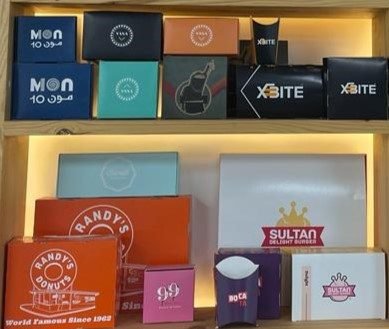
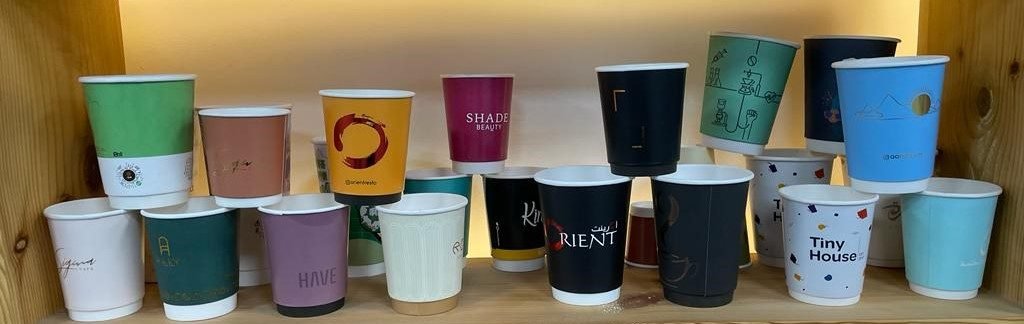
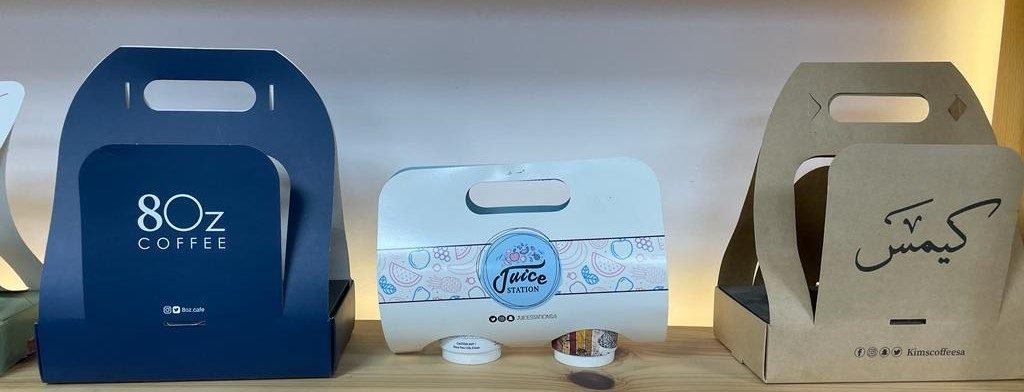
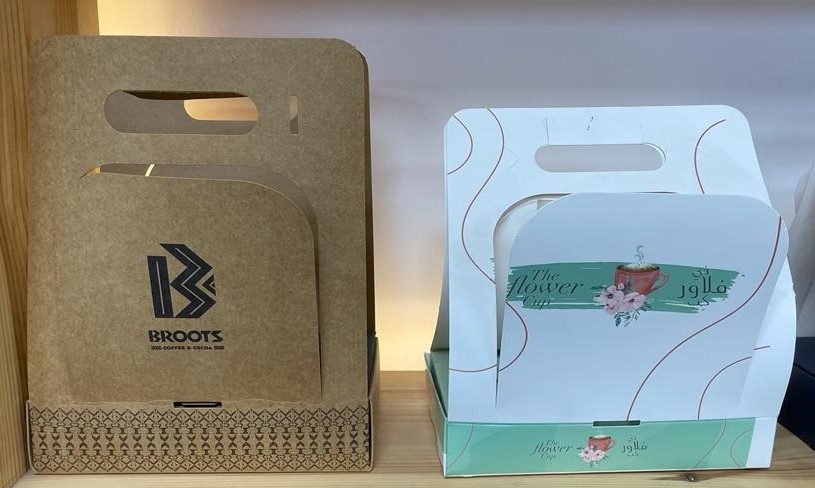
Boxes and Packaging From Our Factory
Product and gift boxes we designed, printed and finished for our clients.

Questions About Restaurant Packaging
What restaurant owners, cloud kitchens and food brands ask before they order printed restaurant packaging.
What does restaurant packaging usually include?
A typical set covers a box for each menu item, such as burger boxes, fries boxes or cones, sandwich and meal boxes and pizza boxes, plus kraft bags, greaseproof wrapping paper, cup sleeves and carriers, and seal stickers. Each piece is a line of its own in the quote, and you can start with the items that sell most.
Kraft or white board?
Kraft looks natural and suits burgers, bakeries and grills, but it darkens every colour printed on it, so pale tones need care. White board shows colours as designed and suits bright identities. Many restaurants mix the two, kraft bags with white boxes, under one colour reference.
Is the packaging safe for food contact?
Ask for food grade board and inks suited to food contact, with print on the outer face and a grease barrier where food touches the board. The quote names the board, the coating and the inks for each piece. As the food business, you decide what your products need and keep the material details on file.
Will burger boxes survive delivery?
They should, if they are chosen for it. Vents near the hinge, a grease resistant inner face and a lock that holds when the box is stacked in a bag are what let burger boxes arrive the way they left the kitchen. A sample filled with a real burger and carried on a real ride is the best test.
What is the minimum order?
The minimum depends on the piece, the board and the print method, and it is set for each design. Ask for it in the quote, together with the reorder quantity for each item, before you approve.
Can each menu item have its own design?
Yes. Each piece has its own dieline, and many restaurants keep one pattern across the family with a different colour or name for each item. A shared design across pieces keeps setup costs down, and seal stickers can mark the flavour or the item.
How should we plan storage and reorders?
Restaurant packaging is delivered flat, so the cartons take less room than you might expect, but they still need a dry place away from kitchen heat. Set a reorder point for each item from its weekly sales, keep the approved proof as a colour reference, and reorder before the best seller runs low.
Can you print a design for Ramadan, National Day or an opening?
Yes. Seasonal and opening designs are printed as separate runs beside your everyday restaurant packaging, with their own quantities. A seasonal sleeve, wrap or sticker over standard boxes is a lighter way to change the look for the season.
What should we send for a quote?
Send your menu items and how each is served, the sizes you need, your logo or brand guidelines, a rough quantity for each item and the delivery city or branches. With that, the quote can name the piece, the board, the print and the quantity on each line.
Where are you, and how do we start?
We have more than one location in the Kingdom, and the cartons reach every branch or central kitchen address you give us. Send your menu and logo on WhatsApp at 0567069088 or through the quote page, and an itemised quote for your restaurant packaging follows within 24 hours.
Your Identity on Every Order That Leaves the Kitchen
Send your menu items, your logo and the branches that receive the order. Within 24 hours you have an itemised quote for your restaurant packaging that names the burger boxes, bags, wrapping paper and stickers piece by piece.
More specific pages on this
If your question is narrower than this page, these are written for one question each.

