
Sticker and Label Printing
Sticker and Label Printing for Products, Packaging and Branches
Sticker and label printing for a company is a different job from a pack of laptop stickers. It is the label on every jar that leaves your kitchen, the roll that feeds a filling line, the seal on a bakery box, the barcode a cashier scans and the vinyl on a branch window. Each one has a surface it must hold to, a hand or a machine that applies it, and a reorder that must look like the last. This page explains the materials, the finish, the shapes and the questions to settle before the first run, so the quote you receive is for the label you actually need.
Label, Sticker or Vinyl: What You Are Actually Ordering
The market uses these words loosely, and quotes for sticker and label printing often mix them up. A printer still needs to know what job the piece does, because the material, the glue and the way it is cut all follow from that job.
A label carries information
A label sits on a product or its packaging and tells the buyer what is inside: the name, the ingredients, the weight, the batch, the barcode and the expiry date. It is applied by hand or by machine, often in large numbers, and it has to stay readable for as long as the product sits on a shelf or in a fridge.
A sticker carries the brand
A sticker is the logo on a coffee cup, the seal across the lid of a cake box, the round mark on a paper bag or the giveaway at an event. Its look matters more than its data, so the shape, the colour of the logo and the finish are what people judge, and it is usually peeled and applied by staff at a counter.
Vinyl dresses a surface
Window and wall vinyl is a film for glass, walls, doors and counters: opening hours, a frosted band that blocks the view, a logo on the glass, a graphic inside a branch. It is cut or printed in larger pieces, it faces sun, cleaning and time, and it is fitted in place rather than peeled from a sheet.
Tape and price labels
Packaging tape printed with a logo on a roll, price labels and shelf labels sit between all of these. They are humble pieces bought again and again, yet a glue that lets go or a colour that drifts shows on every parcel and every shelf, so they deserve the same care as a product label.
What Gets Printed and Made Around the Label
Labels are rarely ordered alone. These services work under the same roof and from the same approved artwork.
Printing & Promotional Gifts
The cards, bags, boxes and giveaways that carry the same logo as your labels, all from the same print service.
Acrylic & Wood Fabrication
Price holders, shelf talkers and counter displays in acrylic, so the price label has something to stand in.
Promoters & Brand Ambassadors
Hosts at a sampling table who hand out event stickers and labelled samples, with a supervisor.
Branding & Creative Studio
Label artwork, colour references and a master file for every flavour, size and language, ready before anything is printed.
Digital Solutions
A QR code on the label that opens a product page, a menu or a registration form, set up and tested before print.
Experiences & Events
A product launch or a sampling day where the product arrives with its new label, the stickers and the giveaways together.
Social Media & Content
Photographs of the product wearing its new label, ready for the launch post on the day.
Custom Exhibition Stands
When the product goes to a show, the stand, its graphics and the labelled samples come from one team.
Materials and Finish for Every Kind of Label
The material decides where a label survives, and the finish decides how it looks and how long the print lasts. A clear specification for sticker and label printing names both.
Paper labels
Coated paper is the everyday label. It comes on sheets or on a roll, prints sharp colour, takes a pen for a date written by hand and suits dry products, cartons and bags. It tears when it gets wet and wrinkles in a fridge, so it is the wrong choice for anything chilled, washed or handled with wet hands.
Synthetic, waterproof labels
Synthetic films such as polypropylene and polyester do not absorb water, do not tear by hand and keep their colour on water bottles, chilled juices, cosmetics and cleaning products. This is the material to ask for when a label meets ice, steam, oil or a damp shelf.
Clear labels
A clear film lets the bottle or the jar show through, so the logo looks as if it were printed on the glass itself. White ink is laid under the colours wherever they must stay solid, otherwise the design turns pale over a dark product or a coloured drink.
Metallic and textured stocks
Silver and gold films, foil details and textured papers are used for perfume, oud, sweets and premium gifts. They catch the light on a shelf, but they also show fingerprints and scratches, so they usually need a protective layer on top.
Matte, gloss or soft touch
Gloss deepens colour and suits food and drink photography on a label. Matte reads calmer and avoids glare under shop lights, and a soft touch finish feels velvety in the hand. The finish changes how the brand colour looks, so it is chosen before the colour is approved, not after.
Lamination and varnish
A laminate or varnish over the print protects it from scratches, water, oil and cartons rubbing in transport. A label handled every day, kept in a freezer or facing the sun in a window needs that layer; a seal on a box opened the same day may not.
How Sticker and Label Printing Goes From File to Branch
Most label problems are decided before the first sheet is printed. These are the stages, in the order they should happen.
The surface and how it is applied
We start from the product, not the design: glass, plastic or carton, a curved bottle or a flat lid, chilled or at room temperature, applied by hand or by machine. That answer chooses the material and the glue before anyone opens the artwork.
A file for every variant
Every flavour, size and language version is a separate file with its own text and barcode. The files are checked for spelling in Arabic and English, for readable text, for a safe margin inside the cut line and for bleed beyond it.
Colour on its own material
The logo colour is matched to the brand reference on the chosen material and finish, because the same colour prints differently on white paper, clear film and metallic film. The approved colour is recorded so that every reorder goes back to it.
A proof you sign
You approve a proof that shows the shape, the cut line, the colours and every word. With a new material or a filling line, the safest proof is a short test run on the real product and on the machine itself.
Printing, protecting and cutting
The run is printed, protected with laminate or varnish where needed, given its finish, cut to shape and delivered on sheets or on a roll as agreed. Short runs of printed pieces are ready in 1 to 5 working days once the artwork is approved.
Packing for each branch
Labels are counted, packed and marked per product and per branch from your distribution list, so each branch receives its own labels, on sheets or on a roll, and not a box to sort.
How Long a Label Order Takes
Sheets and short runs
Printed in 1 to 5 working days once the artwork is approved.
Rolls for a filling line
Depends on the quantity, the material and the finish. The date is written in your quote.
A new shape or a special material
A new cutting shape, a metallic film or a textured paper adds preparation, and the quote states the date.
Your quote
An itemised quote within 24 hours of receiving the artwork, the quantity and the material.
What Sets the Price of a Label Order
We publish no price list, because sticker and label printing is priced from the material, the finish, the shape and the quantity. These are the lines that move the number, so you can compare quotes on the same basis.
Quantity and how it is split
Setup is shared across the run, so the unit cost falls as the quantity rises. A run split into many designs, flavours or languages costs more than the same total in one design, because each version needs its own setup and check.
Material
Paper is the economical end. Synthetic, clear and metallic films cost more, and they earn their price only where water, oil, cold or the look of the product demands them.
Finish and protection
Matte or gloss lamination, varnish, foil and soft touch each add a step. A label that stays a long time in a fridge or a window earns its protection; a seal opened the same day usually does not.
Shape and cutting
Rectangles and circles are cut with standard tools, while an outline that follows a logo may need a new cutting shape, made once and used again for every reorder. A sticker can be cut through its backing as a single piece, or cut through the face only, so many sit on one sheet and peel off one by one.
Sheets or a roll
Sheets suit hand application and small runs. A roll for a machine is wound to that machine's specification, which takes setup, and the roll format is written into the quote.
Variable data and packing
Batch numbers, dates or a different barcode on each label add a data step and a check. Packing per product and per branch, and transport where it applies, are named lines in the quote.
Send the artwork or a photo of the product, the quantity, the material if you know it and whether the labels go on by hand or by machine. An itemised quote reaches you within 24 hours. Request a quote or message 0567069088 on WhatsApp. If your labels and samples are part of a show budget, our guide to exhibition stand cost in Saudi Arabia shows how that budget is built line by line.
Food Labels and Regulators: Who Decides What Is Printed
A label on food, cosmetics or medical products carries text that someone answers for. In Saudi Arabia the content of those labels is set by the regulator of the product, which for food, cosmetics and medical products is the Saudi Food and Drug Authority, and the product owner is responsible for what the label says: the ingredients, the allergens, the dates, the origin and the Arabic text. We print the text you approve exactly as you approved it, and we tell you whether a material and its glue suit the surface of your pack, but we do not decide what your regulator requires. Where a label touches food directly rather than the outside of a pack, ask for a material made for that use and keep its supplier's statement on file. Labels are one part of our printing and promotional production, and the artwork and colour references behind them come from our branding and creative studio. Seal stickers and tags for gift boxes belong with corporate gifts in Saudi Arabia, and shelf labels and window stickers for a retail rollout with POSM production. Vinyl on a stand at a show is covered under exhibition stand graphics, and the sign above a branch door under shop signage.
Sheets or Rolls, and What a Filling Machine Needs
In sticker and label printing the same design can arrive as sheets for hands or as rolls for a machine. Choosing wrongly means labels sitting in a store room or a line that stops.
Who applies the label?
If staff peel and apply labels by hand at a counter or in a kitchen, sheets or small hand rolls are easier. If an applicator or a filling line does it, the labels must come on rolls made for that machine, and nothing else will feed through it.
Which core does the machine take?
An applicator holds the roll on a core, the cardboard tube at its centre, of a set diameter, and it accepts a roll only up to a certain outer size. Take both values from the machine manual or its supplier and write them into the order, not from memory.
Which way is the roll wound?
Labels can face out or in on the roll, and leave it top first, bottom first, left side first or right side first. The machine and the position of the product on the line decide the direction, and a roll wound the other way is printed perfectly and cannot be used. Ask the line supplier for the winding direction chart and send it with the artwork.
How far apart are the labels?
A machine senses the gap between labels or a mark on the back, and expects a steady spacing along the roll. Those details come from the machine, and a good supplier asks for them before printing, not after a roll jams.
Does the surface fight the glue?
A cold bottle, a wet jar from the washer, an oily tub and a rough carton each need a different adhesive. Permanent glue for products that must never lose their label, removable glue for shelves and windows that change, and freezer or wet surface grades for anything chilled or washed.
Label Failures That Show on Every Product
Each of these failures in sticker and label printing is avoided with one question at the start, and each is expensive once a full run is on the line.
Labels lifting from cold bottles
A bottle taken from a fridge sweats, and a standard glue lets go at the edges. Chilled and frozen products need an adhesive made for low temperatures, applied to a dry surface.
Ink rubbing off in transport
Cartons rub against each other on every journey, and unprotected print scuffs until the logo looks old. A protective finish such as laminate or varnish costs far less than relabelling a shipment.
A barcode the scanner cannot read
A barcode printed too small, in a pale colour, across the curve of a bottle or over a busy background fails at the till. Barcodes are printed dark on light, kept clear of folds and tested with a scanner on the proof.
Rolls that do not fit the machine
The wrong core, the wrong winding direction or the wrong gap: the labels are perfect and the line cannot use them. The machine details are written into the order and checked on the first roll.
A seal that tears the bag or will not stick
A seal sticker on a coated paper bag or a waxed box needs a stronger glue than one on plain paper, and a glue that is too strong tears the bag when the customer opens it. Test the seal on the real box or bag before the full run.
A reorder in a different colour
The second run is printed on another day, perhaps on another material, and the brand colour drifts. A reorder is printed from the same approved file and compared with the signed proof of the first run.
Labels That Match the Rest of Your Brand
Design, large format print, acrylic, fabrication in our own factory and installation by our own team sit under one roof, so the label on the product, the sticker on the bag and the vinyl on the window all come from the same approved artwork. We have worked for Ganache, Saudia, Oceanera, Al Khaleej Al Gharbiya, Kinan and Johnson & Johnson MedTech.
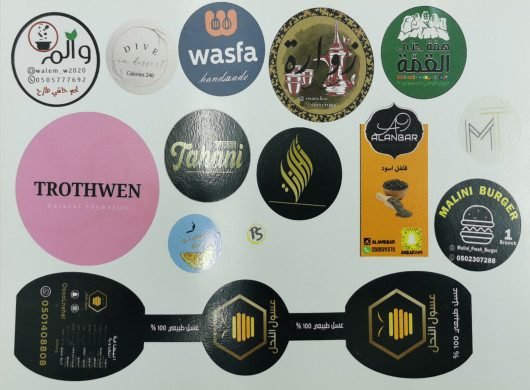
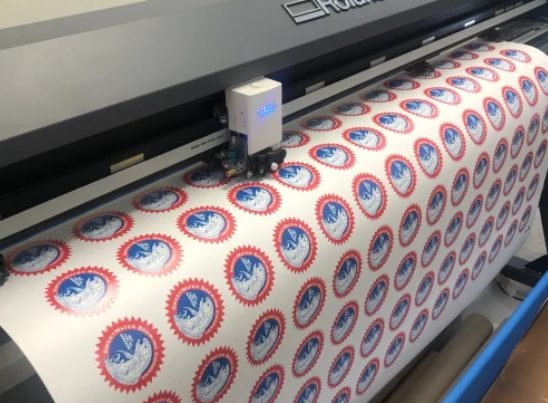
Stickers and Labels From Our Press
Product labels, vinyl and graphics we printed and cut in our own factory.



Questions About Sticker and Label Printing
What companies ask before they order labels in quantity.
What is the difference between a label and a sticker?
In practice they are the same printed, self adhesive piece. It is called a label when it carries product information such as ingredients, dates or a barcode, and a sticker when it carries the brand, such as a logo seal or a giveaway. The difference matters because it decides the material, the glue and the protection.
Which material do I need for bottles that go in the fridge?
A synthetic, waterproof film with an adhesive made for cold and damp surfaces, usually with a laminate finish on top. Paper labels wrinkle and lift as soon as condensation forms on the bottle. Tell us whether the bottles are filled warm, chilled or frozen.
Can you print roll labels for our filling machine?
Yes, as long as the order carries the machine's requirements: the core, the largest roll it accepts, the winding direction and the gap between labels. These come from the machine manual or its supplier. Send them with the artwork and they are written into the quote.
Can each label carry its own batch number or barcode?
Yes. This is called variable data: the fixed design is printed with a field that changes from label to label, filled from a spreadsheet you send. The data and a sample of the printed codes are checked before the full run.
Do you print seal stickers for restaurant and bakery boxes?
Yes. A seal sticker is usually round or oval, carries the logo and sometimes a date or a short message, and its glue is chosen for the box or bag material. It comes on sheets or on a roll, whichever suits the staff who apply it.
Is the label safe for food contact?
Most labels sit on the outside of the pack and never touch the food. Where a label touches food directly, it needs a material made for that use, with its supplier's statement. What the label must say and which materials are allowed is decided by the regulator of your product, and the product owner is responsible for it.
Can the labels match our brand colour?
The colour is matched to your brand reference on the chosen material and finish, and you approve a proof before the run. The same colour looks different on white paper, clear film and metallic film, which is why the material is chosen first.
How quickly can stickers be printed?
Sheets and short runs of printed pieces take 1 to 5 working days once the artwork is approved. Large roll runs, special materials or a new cutting shape take longer, and the quote states the date.
Can you deliver labels to each of our branches?
Yes. Labels are packed per product and per branch from your distribution list, with the contents marked on each pack. Where transport applies, it is a named line in the quote.
Where do you work from, and how do we start?
We have more than one location in the Kingdom, and one team follows your order from the artwork to the packing for each branch. Send the artwork or a photo of the product, the quantity and how the labels are applied on WhatsApp at 0567069088 or through the quote page, and an itemised quote follows within 24 hours.
Sticker and Label Printing for Your Next Production Run?
Send the artwork, the quantity and how the labels are applied. Within 24 hours you have an itemised quote that names the material, the finish, the shape and whether the labels arrive on sheets or on a roll.
More specific pages on this
If your question is narrower than this page, these are written for one question each.

