
Merath Expo Exhibition Stand
Merath Expo Exhibition Stand 2027: Judged by Museum Professionals
Merath, written on its own site as the Middle East Museum and Heritage Expo, is scheduled by dmg events from 1 to 3 June 2027, at the Riyadh Front Exhibition and Conference Center, and the official home page marks those dates as rescheduled. The organiser presents it as the first event in Saudi Arabia given over to museums, heritage and cultural development, and expects 3,000+ industry visitors and 100+ leading companies. The people in the aisles are museum directors, curators, cultural consultants, architects and the government buyers behind new galleries and heritage sites. Their working lives are spent judging how an object is lit, how a caption reads and how a visitor moves through a room. A Merath Expo exhibition stand is therefore inspected the way a gallery is inspected. Glare on a screen, a hurried Arabic caption or a replica rocking on its plinth says more about the exhibitor than any brochure could. From mid November 2026 the first show day lies a little over six months ahead, so every booth format is still open. This page gathers what the organiser publishes, the questions only the organiser can settle, a booth format for each of its seven product sectors and a timetable that runs back from the first morning.
Merath Expo 2027: What the Organiser Publishes
Each row was read on merathexpo.com on the day shown beneath the table: the home page, the pages for exhibitors and visitors, the product sectors, the page on why Saudi Arabia, the booking request and the contact page. The figures are the organiser's own, credited to it. The site prints no opening hours, no stand packages, no prices, no hall plan and no exhibitor manual, so none of those is stated here as fact. Every other date of the season sits in our calendar of Saudi exhibitions, each one traced to an official page.
Merath Expo
| Dates | 1 to 3 June 2027 |
|---|---|
| Venue | Riyadh Front Exhibition and Conference Center |
| City | Riyadh |
| Organiser | dmg events |
| Sector | Museums and heritage |
| Official page | merathexpo.com |
| Name as the organiser writes it | Merath (Middle East Museum and Heritage) Expo, announced on the home page as rescheduled to 1 to 3 June 2027. A directory still carrying a 2026 date for this show is older than that notice |
|---|---|
| How the site describes the show | The first event in Saudi Arabia dedicated to museums, heritage and cultural development, linking cultural institutions, technology providers and government entities with decision makers in the heritage sector |
| Held alongside | Saudi Entertainment Expo and Saudi Light and Sound Expo, which appear in the footer of every Merath page and run on the same days in the same venue |
| Opening hours | Not printed on the Merath site on the day of our reading. The site of the co-located SEA Expo gives 3 PM to 9 PM, so ask the Merath team in writing whether its hall keeps the same hours |
| Size of the show, as the organiser states it | 3,000+ industry visitors and 100+ leading companies. The live counters for exhibitors, visitors and days of networking were still blank on the day we checked |
| Seven product sectors | Audio visual; museology and museum technology; exhibition design and project services; conservation and restoration; museums and cultural institutions; art and cultural merchandise; safety and security systems |
| Inside those sectors | Digital signage, interactive displays, projection and LED walls; ticketing, VR, AR and AI; architecture and design, feasibility studies and market research; art, artefact and archival conservation with restoration tools; museum gift shop suppliers; cameras, fire protection, lockers, tracking systems and alarms |
| Visitor groups the site lists | Museums and galleries, science centres, libraries, archives and knowledge centres, cultural and heritage attractions, zoos, aquariums and wildlife attractions, private collectors and foundations, government and municipal bodies, art centres and cultural institutions |
| Decision makers named for exhibitors | Museum directors, cultural consultants, architects, government entities and procurement decision makers, according to the page on why to exhibit |
| Market context the home page gives | 200+ museums in the Kingdom today with 16 new museums planned by 2030, 7 UNESCO World Heritage Sites, over 10,000 registered archaeological sites and an aim of 150 million visitors by 2030. The same page says the push is led by the Saudi Museums Commission |
| Projects the organiser points to | The Mukaab, King Salman Park, Diriyah Gate and Qiddiya, each named on the page about why Saudi Arabia as a source of museum, exhibition and heritage work |
| Advisory board | Museum and heritage leaders from the Kingdom, the Gulf, Egypt and Europe, listed by name and post on the visitor page |
| How space is booked | Through a stand booking request, a sponsorship enquiry and a downloadable sales brochure. No manual, contractor list or build rule is on the open pages |
| Admission | Trade and industry professionals enter free of charge. Nobody under 18 is admitted |
Official sources we read: Merath Expo, organiser home page, Why exhibit at Merath, Product sectors, Why Saudi Arabia, Why visit Merath, Stand booking request, Sponsorship enquiry, Sales brochure download, Discover Riyadh, Contact the Merath team, SEA Expo home page, for the hours of the co-located show. Sources last checked: 17 November 2026.
Questions Only the Organiser Can Settle for Merath
The open Merath site takes stand requests and brochure downloads through forms and goes no further. Build heights, power orders, deadlines and the build window belong to the exhibitor manual, which reaches an exhibitor after the space contract, and nothing in this section is quoted from it. The site numbers no edition and shows no earlier floor plan, so ask for the hall layout as soon as it exists. Raise the points below with the Merath team before a design is frozen, send us their replies with the brief, and the booth is drawn to fit them.
An original object on the booth
A museum or a collector who wants a genuine artefact on show needs far more than a handsome plinth. Ask whether the organiser allows originals on the floor, what overnight security it provides and what the hall insurance covers. The lender sets its own terms for the case, the climate inside it and who may touch the object. Plenty of exhibitors settle on a faithful replica and keep the original for a private viewing elsewhere.
Conservation products in a closed hall
Solvents, adhesives, consolidants and anything heated, sprayed or strongly scented raise questions indoors. Ask what the manual says about hazardous substances, safety data sheets, extraction and naked flame before planning a live demonstration. A treatment shown step by step on a prepared sample board answers most visitors just as well.
A dark room for projection
Immersive and AV suppliers often need darkness, which means walls, a roof and a door. Ask whether a closed ceiling is allowed, whether it brings conditions for fire detection or sprinklers, and how high you may build at your position. That reply settles whether you build a covered room or choose a bright screen able to hold its own in hall light.
Sound in a shared building
With a light and sound show running under the same roof, audio levels need agreeing. Ask whether a limit applies, how it is measured and where an audio guide or a soundscape may play in the open. Headsets and directional speakers keep a demonstration audible without spoiling a quiet heritage booth next door.
Power and data through the night
Video walls, servers, ticket gates and showcase lighting each draw their own load, and some systems should stay on between show days. Add up the loads from the equipment data, order the supply and a wired line on the organiser's forms before its deadline, and ask whether power is kept live overnight.
Build days and the early June heat
Ask how many build days the hall gives, when exhibitor staff may enter and when unloading slots open. Resin or wax replicas, printed films and electronics should not wait in a closed vehicle through a Riyadh afternoon in early June, so book the arrival close to the start of installation.
Drawings and documents requested by the organiser or the venue are prepared by us; approval remains their decision. If the organiser keeps a list of registered or approved contractors, confirm it with the organiser in writing before signing with any builder. Where an upper floor is planned, read our notes on rules for a two level stand first, and the forms of the closing month are gathered in the thirty day exhibitor list.
A Booth for Each Merath Product Sector
Seven sectors share the floor and each sells something different: a system, a service, a craft, a collection or a product range. Pick the booth format from what the visitor has to see working.
Dark room booth for an audio visual supplier
Projection, LED walls and interactive tables are judged in controlled light. A closed room with black walls, a ceiling where the organiser permits one and a light lock at the entrance shows content as a gallery would. Outside it, a bright counter and a few seats hold the people waiting for the next run. Allow 6 to 8 weeks from brief to opening.
Open plan booth for a museum technology firm
Ticketing, visitor apps, VR and AR need stations rather than walls: a working entry gate or kiosk, a few headsets on stands that are wiped between users, and a replica object that triggers the AR layer. A modular frame carries the screens and hides the cabling, and fresh graphics take 2 to 4 weeks.
Gallery bay for an exhibition design practice
A design firm's booth shows its portfolio in three dimensions. Build a single bay of a gallery at real scale, with a showcase base, a graphic panel, a label rail and the lighting you would specify, then let a model and a screen carry the rest of the work. Directors will run a finger along the joints, so make that bay to the finish you deliver.
Island booth for a cultural institution
A museum, a heritage body or a cultural programme usually comes to Merath to meet partners and suppliers. An island open on every side gives it a landmark, a zone for each project, replicas or models on plinths and a closed room for supplier meetings. Plan 8 to 10 weeks from brief to opening.
Shop fixture booth for a merchandise supplier
Gift shop suppliers sell a retail setting as much as a product. Show a short run of shelving and a lit display table dressed the way a museum shop dresses them, with a till counter and samples of packaging. Buyers from museum retail judge stock density and light before they ask about price.
Upgraded shell scheme for a specialist supplier
A conservation supplier or a security firm on 9 or 18 square metres can still look exact: a printed back wall with one clear sentence, a counter that locks, an acrylic cover over tools or sample materials and a screen running a short film. Ready in 2 to 3 weeks.
Merath Expo Exhibition Stand: a Schedule Worked Back From 1 June 2027
The table runs backwards from opening day, and in mid November 2026 every row is still ahead. For heritage exhibitors the slow items sit outside the factory. Replicas, models and sample objects can take longer to commission than the booth. Text for screens and labels passes through curators, translators and, for a public body, a chain of sign offs. Borrowing anything original brings paperwork the lender controls. Eid al Adha is expected a few weeks before the show, when printing, freight and approvals slow down, so check the official holiday dates and lock the design ahead of them. A brief by early March for an island or an upper floor, and by the end of March for a single level custom booth, leaves a sensible margin. The stages are explained in our guide to stand lead times.
Merath Expo · 1 to 3 June 2027
| Date | Stage | Status |
|---|---|---|
| 6 April 2027 | The brief, the space contract and the exhibitor manual in hand: a custom stand starts here | Ahead |
| 20 April 2027 | Design approved, and drawings sent to the organiser where it asks for them | Ahead |
| 4 May 2027 | Last sensible start for a modular stand with new graphics | Ahead |
| 11 May 2027 | Graphics go to print on the final panel sizes | Ahead |
| 18 May 2027 | Full test assembly in the factory, and the last start for a rental kit from stock | Ahead |
| 25 May 2027 | Transport booked for the build window the organiser sets | Ahead |
| · | Installation in the hall, inside the hours written in the exhibitor manual | Per the exhibitor manual |
| 1 June 2027 | Opening day | Ahead |
| 3 June 2027 | Closing, then dismantling in the organiser's window | Ahead |
What is still realistic for this edition · 201 days to openingThere is time for a custom stand on the normal schedule, provided the design is approved on its date.
Status worked out on 12 November 2026.
What Holds a Museum Visitor on the Merath Floor
Visitors at a Merath Expo exhibition stand know galleries from the inside. They notice glare, read every caption and ask how a system copes on an ordinary weekday with a school group in the room. The booth should answer before anyone speaks.
Gallery light, not showroom light
Museum people read the light first. Use warm, even light on objects, avoid hot spots and reflections in glazing, keep fittings out of the line of sight and choose LED sources free of ultraviolet. A booth lit like a car showroom tells a curator that you have never worked inside a gallery.
Captions written to museum standard
Interpretation is a craft of its own. Give each object a title, a short text and a credit line at a height a seated visitor can read, in a type size legible at arm's length. Arabic and English carry equal weight, and the Arabic is written, never squeezed in late, then read by someone who writes for museums.
Replicas labelled as replicas
A cast or a copy printed from a scan is a perfectly good booth object once it is labelled for what it is. Collection people will ask, and an honest label protects your standing. Fix every replica to its plinth so a curious hand cannot tip it over.
Touch where it is invited
Museums are adding tactile models and handling objects for blind and partially sighted visitors. A booth with a tactile replica, a raised plan or an audio description point shows that you understand access the way a museum does. Mark plainly what may be handled and what may not.
Demonstrations to a timetable
An immersive show, a projection run or a conservation demonstration fills up when the time is announced. Print the run times at the entrance to the booth, keep each run short, and leave the presenter free for questions once it ends.
Headsets kept clean
VR and AR demonstrations put one headset on a long line of faces each day. Keep disposable face covers and wipes in a closed drawer at the station, clean each unit between users, and let a host run the queue so the presenter can stay with the content.
A quiet table for project talk
A new museum is bought slowly, through feasibility, design and tender. Keep a table at the back of the booth, away from the demonstrations, with a large screen for drawings and phasing, and bring the person who can speak about maintenance and training. Meetings with public bodies run long, so seat them in comfort.
Security shown working
Safety and security suppliers can make the booth itself the demonstration: a camera feed on a screen, lockers that open with a card, a sensor on a showcase. If the booth is filmed, say so on a clear notice, and keep recorded faces off any public screen.
Heritage materials without the weight
Heritage subjects invite stone, timber, plaster and woven textures, yet a booth must go up in days. CNC cut panels with a painted stone or plaster texture, timber veneers and printed fabric give the look at a fraction of the mass. Keep the palette quiet so the objects lead.
A welcome for official delegations
Ministries, commissions and municipal bodies tend to arrive as a group with a host. Agree who receives them, a route that ends at seats and coffee, and a short printed summary in Arabic and English to leave behind. Trained hosts with a supervisor can run the welcome while your specialists talk.
Further Reading for Heritage Exhibitors
Merath is held in Riyadh, so hall access, build crews and the practical side of installing in the capital are on our page for stand building in Riyadh, and a partners' reception or a launch dinner in show week is covered by our Riyadh events team. The Saudi Entertainment and Amusement Expo fills the same venue on the same days, and its own guide is building a booth for SEA Expo. A cultural body weighing a gallery that stays open for years, rather than a booth that closes after three days, will find the differences in our article on permanent exhibition design. Light and moving image thrown onto a model or a facade is the subject of projection mapping. The budget, line by line, is in what a stand costs in the Kingdom; a reusable kit starts from modular stand systems; a full build from booths made to order; and lighting objects without glare in our stand lighting guide.
Mistakes That Cost Heritage Exhibitors Credibility
A room full of museum professionals forgives a small booth. It does not forgive carelessness with objects, light or language.
Glare on the main screen
A large screen facing a bright spotlight, or under a glossy ceiling, washes out the very content meant to sell the system. Draw screen angles and light positions on the same plan, and check both again during the test assembly.
A copy passed off as an original
An unlabelled replica invites the question, and a wrong answer travels fast through a small professional circle. Label every object for what it is and where it comes from.
Captions translated in the final week
Arabic fitted into whatever space the English left reads as an afterthought to visitors who care about both. Write the two languages side by side and size each booth panel for the longer text.
A demonstration that needs the internet
A cloud ticketing system or a collection database running on shared hall wifi can freeze in front of a museum director. Order a wired line if the product must be online, and install a local copy on the laptop at the counter.
An original that arrives before its paperwork
A real object turning up without the lender's agreement, the insurance and a secure case is a risk nobody on the booth can carry. If those terms are not settled in writing, bring a replica instead.
No hook for visitors from next door
People from theme parks, entertainment venues and AV integration will walk across from the co-located shows. Give them a reason to stop: a fascia line naming the problem you solve for a venue, such as ticketing, visitor flow or collection security.
Made in Our Own Factory, for Exhibitors Rather Than Collections
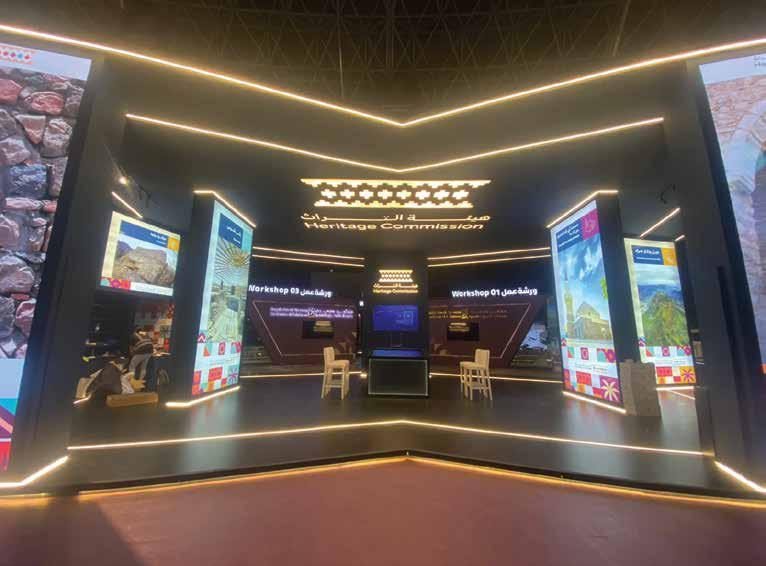
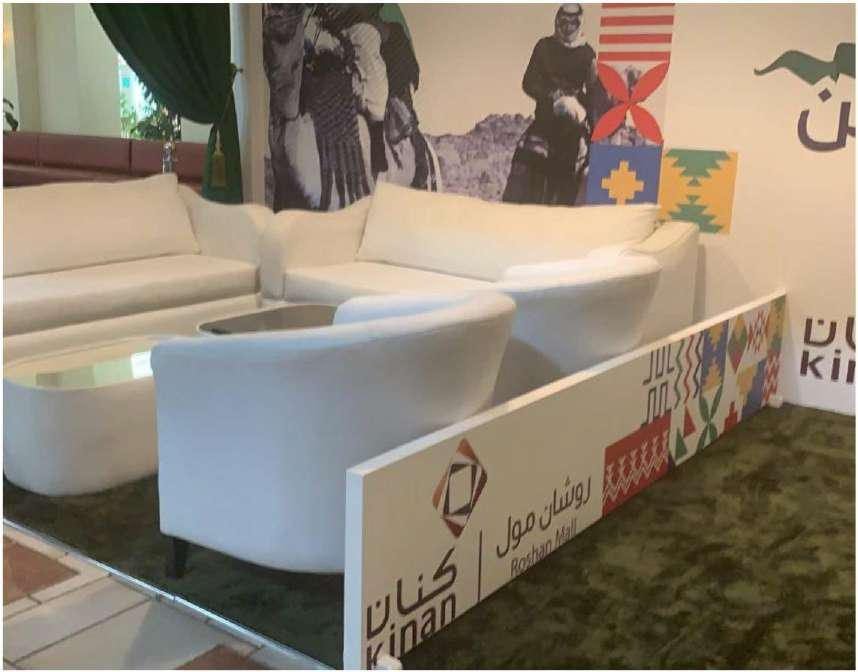
Among the clients we have worked for are the Heritage Commission, Kinan, Saudia Holidays, Johnson & Johnson MedTech and Cartoon Network. We have more than one location in the Kingdom, and every project is made in our own factory and fitted on site by our own team. Design, CNC and laser cutting, joinery, paint, acrylic and large format print share one roof, so plinths, gallery bays, acrylic covers and printed walls are made together and fully test assembled before they ship. That is the moment screen angles, caption heights and light positions are checked against the drawing. Our team installs, stays for the opening and dismantles after the close, and a reusable kit can wait in our storage for your next show. Curation, conservation and the handling of original objects are not our work: they stay with your institution and its specialists. We are an independent builder working for exhibitors on the space they have booked, and we are not an official contractor of Merath Expo, of its organiser or of the venue.


Merath Expo Booths: Questions Exhibitors Ask
Put to us by museum technology firms, design practices, heritage bodies and specialist suppliers preparing for June 2027.
When and where is Merath Expo 2027?
From 1 to 3 June 2027 at the Riyadh Front Exhibition and Conference Center, according to the organiser's site, which marks these dates as rescheduled. Opening hours are not printed there, so confirm them with the Merath team before you plan staff shifts.
Who organises Merath, and what does the name cover?
Merath is run by dmg events, which writes the full name as the Middle East Museum and Heritage Expo. It calls the show the first in the Kingdom dedicated to museums, heritage and cultural development. Space is requested through the booking page on the official site.
Which shows share the venue?
Saudi Entertainment Expo and Saudi Light and Sound Expo are shown beside Merath on its own pages, on the same dates and in the same venue. Expect visitors from attractions and AV integration to cross between halls, and expect busy loading bays during booth build.
What can be exhibited at Merath?
The organiser lists seven sectors: audio visual, museology and museum technology, exhibition design and project services, conservation and restoration, museums and cultural institutions, art and cultural merchandise, and safety and security systems. The booth formats on this page follow those sectors.
Can we bring an original artefact to the booth?
That turns on the organiser's rules, the hall security and the lender's conditions, and all three should be confirmed in writing. The case, its climate and the handling of the object are matters for the lender and its specialists. A labelled replica fixed to its plinth is the safe default.
Is the exhibitor manual online?
No. The open site carries a stand booking request, a sponsorship enquiry and a brochure download, with no manual, prices or build rules. Send us the manual once it arrives, because it fixes heights, deadlines and the build window. Nothing on this page is quoted from it.
Do you build museums or carry out conservation?
No. We design and build exhibition booths, displays and the pieces around them in our own factory, and install them with our own team. Curation, conservation and object handling belong to museum specialists, and a booth from us is shaped around what they require.
How much time does a Merath booth need?
A Merath Expo exhibition stand built as a single level custom booth takes 6 to 8 weeks from brief to opening, and an island or a double deck 8 to 10. A modular booth with new graphics takes 2 to 4 weeks. With opening a little over six months away, most of the time goes on content, replicas and approvals rather than the build.
Can a small booth work for a specialist supplier?
Yes, when it does one thing well. On 9 or 18 square metres a single demonstration, a clear sentence on the back wall, a counter that locks and good light are enough. An upgraded shell scheme is ready in 2 to 3 weeks.
What do you need from us to quote?
The size of the space and its open sides, what must run on the booth, any object or replica to display with its size and weight, the number of screens, and the manual when it comes. An itemised quote follows within 24 hours. Where transport applies it is a named line in the quote.
Taking Space at Merath in June 2027?
Send the size of your space, which sides of the booth open onto the aisle and what has to run on it. A priced, itemised quote reaches you within 24 hours, with an outline design and a programme that ends on 1 June. Phone 0567069088, or use the WhatsApp button on this page.

