
Thirty Days Before the Exhibition: The Complete Exhibitor Checklist
The show opens in thirty days. The design is usually approved by now, the space is booked, and what is left looks like detail. But what is left is the difference between a stand that opens on time with a team who know what to say, and a handsome stand that opens with a panel missing while the team hunts for an extension lead. This is the exhibitor checklist we run with our clients before every show, from day thirty to the opening morning and into the week after.
The checklist is split three ways, because most of what goes missing before a show goes missing between two parties who each assumed the other had it: the exhibitor, the stand builder, and the organiser with deadlines that do not move. The eight weeks before this point, design, approvals and fabrication, are covered in our schedule for an exhibition stand from idea to opening day. This exhibitor checklist starts where that schedule ends.
The exhibitor checklist on one page
Before the detail, the table to print and pin to the wall. Every row has one owner and one deadline.
| Week | The exhibitor does | The stand builder does | The organiser’s deadline |
|---|---|---|---|
| 30 to 22 days before the show | Design sign-off, brand files, goal written down | Drawings submitted, power and rigging ordered, fabrication started | Drawings and service orders |
| 21 to 15 days before | Print proofs approved, field team booked, first invitations sent | Graphics printed, furniture and screens ready, transport confirmed | Badges and vehicle passes open |
| 14 to 8 days before | Dry assembly attended, team brief written, lead form ready | Dry assembly, parts numbered and packed | Insurance and contractor list |
| 7 days to 1 day before | Key meetings confirmed, content plan fixed, site bag packed | Shipping, print and giveaways to the stand, spares checked | Build window opens |
| Build days | One handover walk | Installation, cleaning, inspection requested | Safety inspection |
| Opening day and after | Morning walk, team running, follow-up within a week | First hour on site, maintenance, dismantling | Dismantling window |
Days 30 to 22: deadlines before anything else
The first thing opened this week is not the design file but the exhibitor manual. One page in it carries every date that will govern the month: drawings, power and internet orders, rigging, badges, vehicle passes and insurance. Miss the drawings deadline and you lose the height and the structure; miss the power order and you pay double for it on opening day.
- Exhibitor: approve the final design in writing, from the one decision maker, and hand over the logo files at full resolution with the brand guide. Delay here comes out of the print week, not the show date.
- Exhibitor: write the goal of the show in one line: a number of meetings, a number of qualified contacts, a product launch. That line later decides the counter, the team and the lead form, and our article on measuring exhibition success turns it into figures.
- Stand builder: submits the drawings and the structural declaration in your name, orders power at the load the screens and lighting actually draw, and books rigging points where they exist.
- Stand builder: starts fabrication and sends you a schedule with one date in bold: the last day for changes to the graphics.
- Both together: go through what the organiser supplies inside the space, carpet, a socket, a name board, and what it does not, so nothing is bought twice or forgotten.
If your show is in Riyadh, its halls ask for drawings and a structural declaration for anything above the standard height, and our page on exhibition stands in Riyadh explains how Riyadh Front differs from Malham and RICEC.
Days 21 to 15: files, print and people
This is the print week, when a logo mistake is discovered on a panel three metres wide instead of on a screen. The print proof is not a formality. It is the last cheap chance to correct a colour, a number or a product name before it becomes a wall.
- Exhibitor: approve print proofs at real size, or at least a printed swatch of every material. Screens lie about colour, and our page on printing and promotional gifts sets out how long each graphic needs.
- Exhibitor: book the field team by shifts, not by days, with one supervisor whose number everyone has. Promoters and brand ambassadors are booked at least two weeks before the show, three in the Riyadh seasons.
- Exhibitor: send the first invitations: current clients first, then the prospects you know will be there. An invitation three weeks out gets a slot in a diary; one three days out gets read and forgotten.
- Stand builder: prints the graphics once the real panel sizes are fixed, prepares furniture, screens and lighting, and confirms shipping against the build window in the exhibitor manual.
- Organiser: usually opens the badge and vehicle pass system this week and closes it days before the show. Request badges for the team and the contractors now.
Days 14 to 8: the dry assembly and the brief
This is the week that saves a whole night in the hall. The stand is built in full in the factory, graphics, lighting and screens included, photographed from every side, then dismantled, numbered and packed. Attend it or ask for a video, because what you see here is what will stand in the hall on opening day.
- Exhibitor: attend the dry assembly and sign it off in writing. Any change after it is paid for twice and comes out of the shipping days.
- Exhibitor: set up lead capture: a form on a tablet or a QR code to a short page, connected to your CRM now, not after the show. Business cards in a bowl are not a system; our digital solutions page shows what we build for this.
- Exhibitor: write the team brief on one page: the product in three sentences, the five questions visitors always ask, what we collect from every visitor, and who is called over on price.
- Stand builder: numbers, photographs and packs the parts, and prepares the spares box: replacement graphics for the exposed panels, spotlights, leads and the same fixings.
- Organiser: usually asks for the insurance certificate and the contractor list at this point. Send them now, not at the gate.
The last week: days 7 to 1
Nothing new is made in the last week. What was made is confirmed and shipped, and whatever will be used on site is packed. The rule on the exhibitor checklist here is simple: everything needed in the hall travels on the same truck, because whatever arrives after it arrives at the hall’s price.
- Exhibitor: confirm the meetings booked with key visitors by day, hour and a place inside the stand, and give the team their names.
- Exhibitor: fix the content plan: who films, what goes out on build day, the opening morning and the last day. Content published during the show brings visitors; content published after it only documents.
- Exhibitor: pack the site bag: power strips and extension leads, chargers, double-sided tape, scissors, gloves, cloths for the acrylic, a first-aid kit, paper copies of the brief and the lead form, and water for the team.
- Stand builder: ships the stand to arrive as the build window at your hall opens, and delivers print and giveaways to the stand, not your office.
- Both together: exchange the site contact list: stand supervisor, field team supervisor, the organiser’s hall manager and the truck driver.
The opening dates themselves, for every show in Riyadh, Jeddah and Dammam from its official source, are in our Saudi exhibitions calendar for 2026 and 2027; day thirty is counted back from there.
Build days: what you do and what we do
The build window is two to four days before opening, in hours the organiser sets. The installation team builds, connects the power, hangs the graphics, switches on the screens and cleans, then requests the organiser’s inspection. Your part is one handover walk on the last day before opening. On the walk:
- Test every screen with the real content, not the test pattern.
- Switch on every socket the team will use, and put the chargers out of the visitor’s sight.
- Read every printed line up close one last time, prices and contact details included.
- Walk the visitor’s route yourself: aisle, counter, seating, exit.
- Store the empty cases where the organiser says, because they come back on dismantling night.
Opening morning, closing night and the week after
The installation team is on site for the first hour of opening day, for any loose panel or spotlight that does not switch on, and the field team arrives in uniform with its brief an hour before the doors open. The morning walk takes five minutes: lighting, screens, clean acrylic, giveaways in place, the lead form working on every device.
Closing night needs as much planning as build night: what goes to storage, what is disposed of, what returns to your office, who carries the screens. The full order is in our article on dismantling, transport and storage after the exhibition.
Then the week after, the part most exhibitor checklists leave out: contacts go to sales the next day, the thank-you message goes out within three days, and the meetings promised on the stand are booked within a week. The Center for Exhibition Industry Research, CEIR, keeps finding that a large share of the contacts gathered at shows are never followed up. The exhibitor checklist does not end at the dismantling.
What usually gets forgotten
At almost every show the same items surface in the last hour. Every one is solved a week early if it is on the exhibitor checklist from the start:
- Power load. Ordered for the lighting alone, then the screens and the coffee machine arrive and the breaker trips on day one.
- Contractor badges. The installation team stands at the gate because its badges were never requested, and the hours count against the build window.
- Internet. The lead form on the tablet needs a connection, and the hall’s public network cannot be relied on. Order a line or prepare a fallback.
- Storage inside the stand. Bags, giveaway boxes and coats need a lockable cupboard, or they end up on the floor in the photographs.
- Who answers on price. A host who does not know turns the visitor into “we will be in touch”, and nobody is.
- The dismantling slot. Sometimes a few hours; whoever has not booked a truck for it is dismantled the hall’s way.
A working rule: the exhibitor checklist is reviewed in one meeting each week for the four weeks, with all three parties on the same call. Twenty minutes saves a night in the hall at the hall’s price.
We run this checklist with our clients in Jeddah, Riyadh and Dammam from our own factory. The detail for each city is on our page for event management in Jeddah and on the page for our event management company in Saudi Arabia, which brings the three cities together.
Frequently asked questions
Are thirty days enough to prepare for an exhibition?
Enough for everything on this checklist, if the design is approved and fabrication has started. A custom stand from scratch needs eight weeks from brief to opening day, a modular stand with new graphics four.
What is the first item on the exhibitor checklist?
The dates in the exhibitor manual: drawings, power, rigging, badges and insurance. Everything after them is counted back from those.
Who submits the drawings to the organiser?
The stand builder prepares and submits them in the exhibitor’s name, because the organiser corresponds with the exhibitor, not the contractor. Keep a copy on site.
When should I book the promoters?
At least two weeks before the show, three in the Riyadh seasons, with a written brief that reaches them three days before day one.
What should I bring to the site?
One bag: power strips and extension leads, chargers, double-sided tape, scissors, gloves, cloths for the acrylic, a first-aid kit, and paper copies of the brief and the lead form.
What do I do in the week after the show?
Contacts to sales the next day, a thank-you message within three days, the promised meetings booked within a week, then the goal from day thirty reviewed against what was achieved.
From Our Factory to the Show Floor
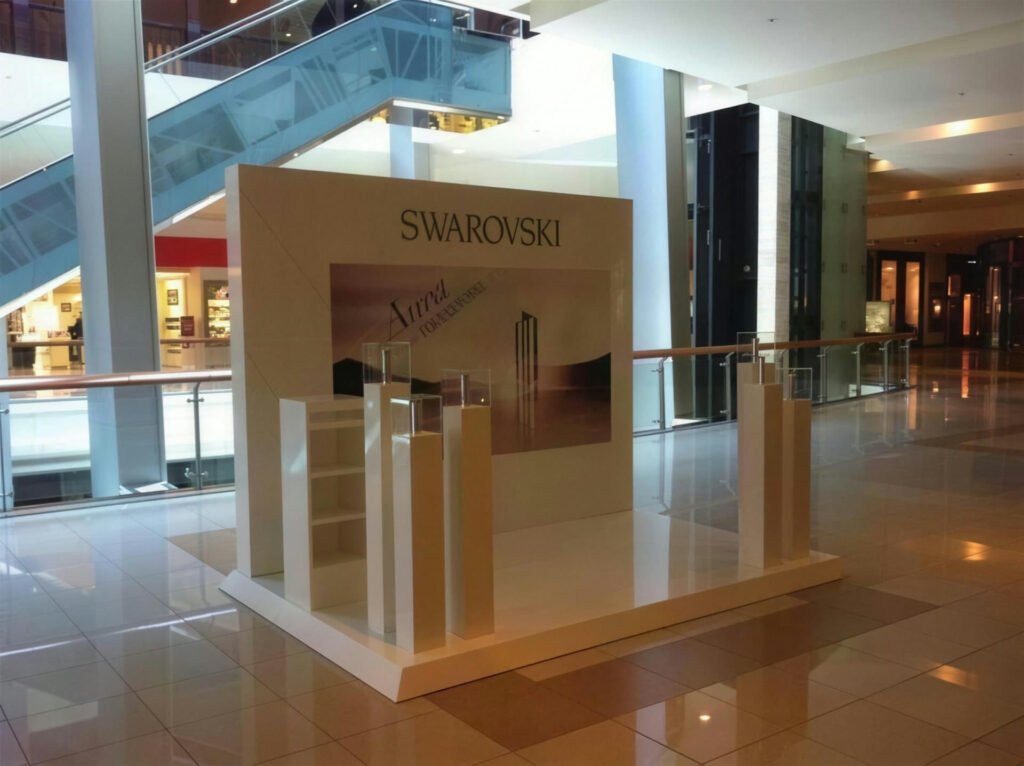
Photographed on site after handover, no renders.


Have a project and want a real number?
Send the area, the date and the city, and we come back with an itemised quote within 24 hours. No commitment, and no vague all-in price.

