
LED Screen Rental
LED Screen Rental for Ceremonies, Conferences and Outdoor Events
LED screen rental for an event is more than a screen on a stand. It is a pixel pitch chosen for the distance of your nearest guest, a panel made for a hall or for the sun, a shape that suits the stage, and the processor, power and structure that keep the picture alive until the last guest leaves. We supply LED walls for events across the Kingdom, sized from your venue, your audience and your programme. This page explains each choice in plain words, so every quote you collect describes the same video wall.
The Shapes a Video Wall Can Take
An LED video wall is assembled from cabinets that lock into each other, so its shape is decided by the way they join and by what holds them from behind or above. These are the shapes most events ask for.
A flat wall behind the stage
The video wall most events book: a rectangle behind the speaker or the band, standing on ground support or hanging from a rigging point. It carries the event name between segments, the slides during a talk and the live camera picture at a concert. Its width and height come from the stage, the ceiling and the content, not from a menu of fixed sizes.
A curved wall that wraps the stage
Curved cabinets, or flat ones fitted with angle locks, bend the wall into a concave arc around the stage or a convex arc that faces the room from more than one side. A concave curve pulls the eye to the centre and suits galas and product launches. The content is drawn for the bend, and the frame behind it is not the frame of a flat wall.
A vertical poster screen
A tall, narrow LED screen standing on its own base, called a poster screen in the trade, works as a digital sign at the gate, a reception screen that welcomes guests, or a sponsor panel along a walkway. Several posters can be linked to show one picture across them or separate content on each. It needs a power point close by and a base that stays put when someone leans on it.
A corner screen
LED faces meet at a corner, so the content runs around it and reads from more than one direction. In a public plaza or a mall atrium, content drawn for the corner gives a sense of depth that people film on their phones. The line where the faces meet is the first thing to check on site, because any gap or ridge in it shows in every frame.
Around the Screen: The Rest of the Event
In LED screen rental the screen is one line in the quote. The frame it sits in, the content it plays and the people standing around it come from teams under one roof.
Printing & Promotional Gifts
The printed skirt that hides the base of the screen, the sponsor boards beside it, the invitations and the gifts at the door. Graphics are printed in 1 to 5 working days.
Acrylic & Wood Fabrication
A wooden frame or a joinery fascia that turns a bare screen into part of the set, and lit acrylic letters beside it, cut on CNC and laser machines in our factory.
Promoters & Brand Ambassadors
Hosts and ushers who welcome guests at the reception screen and show them to their seats, led by a supervisor.
Branding & Creative Studio
Holding slides, sponsor loops and the event identity laid out on the exact content canvas, so no edge or curve cuts through a logo.
Digital Solutions
The registration page and attendance at the door, and a welcome page shown on the reception screen.
Experiences & Events
The whole occasion the screen belongs to: the stage, the programme, the running order and the night itself.
Social Media & Content
Clips of the big moments on the wall, cut short and posted the same night.
Custom Exhibition Stands
When the screen belongs inside an exhibition stand, the stand is designed around it from the first drawing.
Pixel Pitch: Which LED Screen for Which Distance
Pixel pitch is the distance between the centres of neighbouring LEDs, measured in millimetres, so P2.5 means about 2.5 millimetres. The trade uses a rough rule to tie it to an audience: the closest comfortable viewing distance in metres is about the pixel pitch in millimetres, and a sharp picture wants the viewer further back than that. Read it as a starting point for any LED screen rental, never as a promise.
P1.6: close range and fine detail
The finest pixel pitch in the indoor range we supply. A guest can stand from about 1.6 metres and still see a picture rather than dots. It suits a reception screen people walk up to, a VIP majlis, a launch in a small room and a wall the camera will film in close up. It is the dearest per area, so it is chosen where people really do stand close.
P1.9: small rooms and cameras
From about 1.9 metres. A common choice for a conference room whose front row sits near the lectern, for a press briefing in front of cameras, and for slides with tables and small text that have to be read. It keeps most of the sharpness of P1.6 at a lower cost for the same area.
P2.5: the usual hotel ballroom pitch
From about 2.5 metres. The usual choice for a hotel ballroom, an awards dinner or a mid sized conference, where the front row is a few metres from the stage and most guests sit behind it. Text, video and the camera picture all read clearly.
P2.9: large halls and stage backdrops
From about 2.9 metres. For a large indoor wall behind a concert stage, in a wide graduation hall or at an opening where the crowd stands well back. On a wall that wide the eye has no use for a finer pixel pitch, and the difference in cost is large.
P3.9: the typical outdoor screen
From about 3.9 metres. An outdoor panel at this pixel pitch is brighter, sealed against dust and rain, and made for the afternoon sun and heat of the Kingdom. It suits plazas, open air concerts, sports events and festival grounds where people stand at a distance. Inside a hall the same panel is brighter than it should be and too coarse for a seated audience close by.
Indoor and outdoor panels do not swap
An indoor panel fades to grey in direct sun and does not tolerate dust, sprinkler spray or rain. An outdoor panel brought into a hall dazzles and shows its pixels to the front row. Between them sit half open spaces such as tents, glass atriums and shaded courtyards, so tell the supplier the hour of the event and where the sun will be before anyone chooses.
How LED Screen Rental Runs From Brief to Last Guest
A video wall that runs smoothly on the night is the sum of decisions made long before the doors open. These are the steps, in their order.
The brief: venue, audience, programme
We start from the venue, the date, the number of guests and how they are seated, and from what will appear on the screen: slides, video, a live camera, a countdown or sponsor loops. The size, the pixel pitch and the shape follow from that, so the screen is built around the event and not the other way round.
The site visit
Someone has to see the screen position with their own eyes: the power available and how far away it is, the route from the loading area to the stage, the floor or the ground, the ceiling height and any rigging points, and the hour the venue opens for the build. Outdoors, the direction of the sun and the wind at event time matter as much as the stage.
The wall plan and the content canvas
The supplier draws the wall in cabinets and states its resolution in pixels across and down. That is the canvas. Every video, slide and loop is made on that exact canvas and not on a television format, or it arrives stretched, cropped or with black bars. For a curve or a corner the canvas is drawn flat with the fold line marked on it.
Processor, player and signal
The processor takes the picture from the player, maps it across the cabinets, scales it and switches between sources. The player can be a media server, a laptop or the vision mixer of a camera team. The plan states where the operator sits, how the signal travels from the stage to the screen, and what plays if the main source drops.
Build and test before the doors open
The structure goes up first, then the cabinets, then the data and power cables, then the processor. A full test follows: every colour on a plain screen to find dead pixels and cabinets that do not match, the real content at full brightness, the camera feed, and the switch to the backup source. Any frame or fascia we build around the screen is made and test assembled in our factory before it reaches site.
On the night and after it
An operator for each desk is a named line in the quote and stays at the processor from the rehearsal to the end. Changes to the running order go to the operator, not shouted from the front of the stage. Once the last guest has left, the video wall comes down within the window the venue allows and the site is handed back clean.
How Long LED Screen Rental Takes
The quote
An itemised quote within 24 hours of the brief, with the screen, the structure and the operator each on a line of its own.
Print around the screen
Skirts, frames and sponsor boards are printed in 1 to 5 working days once the artwork is approved.
Build and test on site
It depends on the size and shape of the wall, ground support or rigging, the route from the loading area and the hours the venue allows. The quote states the build day and the test time.
Content ready
Final files reach the operator before the rehearsal, at the canvas size, so they can be loaded and checked on the video wall itself.
What Moves the Price of LED Screen Rental
We publish no price list for LED screen rental, because the figure moves with the items below. Ask every supplier to price these same items and you will be comparing like with like.
Area and pixel pitch together
The price follows the area of the wall and its pitch at the same time. A finer pixel pitch packs more LEDs into each cabinet and costs more for the same area, which is why stepping down a pixel pitch where the audience sits far back can pay for a wider wall.
Indoor or outdoor
Outdoor panels cost more than indoor ones, and an outdoor video wall adds a frame that stands up to weather, ballast or ground anchors, and usually a generator.
Shape
Curves, corners and linked poster screens need special cabinets or locks, more structure and longer build time than a flat rectangle. A curved wall also needs content drawn for the bend.
Structure: ground support or flown
A wall standing on the floor needs a frame and ballast, and a flown wall needs a rigging point the venue approves plus truss or a flying frame. Each is a line in the quote with its name, its type and who supplies it.
Days on site
The quote counts build, rehearsal, event and dismantle days. A wall that stays for a conference over several days costs more than a single evening, though not in proportion, and a night build in a venue that is busy by day costs more.
Processor, operator, cameras and power
Each is a line of its own: the processor and a backup player, an operator for each desk, a camera team if the wall shows a live picture, and the power, from the venue or a generator. Where transport applies, it is a named line in the quote.
Send the venue, the date, the number of guests and what will play on the screen. An itemised quote for your LED screen rental reaches you within 24 hours. Request a quote or message 0567069088 on WhatsApp. When the screen is going into an exhibition stand, see how that budget is built in our guide to exhibition stand cost in Saudi Arabia.
Where a Video Wall Earns Its Place at an Event
At a ceremony the video wall carries the opening film, the names of the people being honoured and the live picture of the stage. At a conference it carries the slides, the speaker names and the countdown between sessions, usually with a poster screen at the registration desk. A concert or a company party wants a large wall behind the band and a camera picture for the back of the room. An opening or a plaza event wants an outdoor screen that holds its picture in daylight. The screen stands on a stage or in front of one, and the platform itself is on our event stages page. For the programme around it see conference organisers in Saudi Arabia, for an evening of music and dinner corporate party organisers, and for a ribbon cutting or a store launch grand opening events. When the picture belongs on a building rather than a screen, read about projection mapping. A screen inside an exhibition booth is a different job with its own page: LED screens for exhibitions. Our LED screen rental covers events across the Kingdom, in Riyadh, in Jeddah, in Dammam and wherever your event takes place.
What the Venue Must Provide Before the Wall Goes Up
LED screen rental is only as good as the place the screen stands. Agree these points with the venue in writing before the quote is signed.
Power meant for the screen
A video wall draws steady power and should not share a circuit with the kitchen or the sound system. Ask the venue for a dedicated supply close to the screen position or plan a generator, and agree who brings the distribution board and the cables. A flicker that starts when the coffee machines switch on is a power problem, not a screen problem.
Ground support or a rigging point
The video wall either stands on its own frame or hangs from the ceiling. Standing needs a floor that carries the weight, and hanging needs points the venue approves with a load set by its engineer. Many hotels and halls allow hanging only from the points they list, so ask for the rigging plan early.
A dry, flat, firm base outdoors
In the open air the frame needs level, firm ground that will not sink after an irrigation cycle on a lawn or in sand. A wall on soft ground or across a slope leans slowly through the night. A raised floor or a levelled platform is often needed, with a covered route for the cables where people walk.
Wind, sun and rain
An outdoor wall behaves like a sail. Its frame is ballasted or anchored against the wind, and the plan says when the screen is lowered or switched off and who makes that call. Ask where the sun will be at the hour of the event, and whether the operator and the processor need a canopy.
Access, the load in window and the person in charge
Cabinets arrive in wheeled road cases, so the route from the loading area needs a lift or a ramp and doors wide enough to pass. Ask for the hours allowed for building and dismantling, who signs off the structure and what paperwork is wanted. Approvals belong to the venue or the authority, and we prepare the drawings and details they ask for.
What Goes Wrong With a Video Wall at an Event
In LED screen rental each of these is cheap to prevent and costly to discover in front of an audience.
Content made for a television
A film exported in the usual television shape and played on a wide or tall video wall appears stretched, cropped or framed in black. Ask for the canvas in pixels on the day the wall plan is approved, and hand it to whoever makes the content.
A pixel pitch too coarse for the front row
A wall chosen for the back of the hall shows dots to the VIP seats at the front. Measure from the nearest seat, not the average one, and check slides with small text on the real wall at rehearsal.
Flicker and lines on camera
A video wall that looks perfect to the eye can roll with lines on a phone or a broadcast camera when its refresh rate is low or the camera has not been set for it. If the event is filmed or streamed, say so in the brief and test the camera on the wall before the doors open.
A black screen when the laptop sleeps
A presenter laptop that sleeps, starts an update or loses its cable takes the whole wall to black. A backup player loaded with the same content and ready on the processor turns that failure into a moment nobody notices.
Dead cabinets and colours that do not match
Cabinets from different batches can show slightly different whites, and a cabinet that loses its data shows as a dark square. Spare cabinets on site and the full colour test after the build catch both before any guest sees them.
An outdoor wall in the afternoon sun
A screen tested in the evening can be unreadable in the afternoon if it faces the sun, and panels run hot when the frame blocks the air behind them. Test the wall at the hour the event starts, keep its back open to the air, and ask for high contrast content for daylight.
One Team for the Screen and Everything Around It
We supply the screen and coordinate with your audio visual supplier or with ours, while our own team builds the frames, stages, backdrops and branding around it in our factory: design, CNC and laser cutting, joinery, paint, acrylic, large format print and installation, all under one roof. We have worked for Kinan, the Heritage Commission, Saudia Holidays, Johnson & Johnson MedTech, Cartoon Network and Swarovski.
Screens From Our Work
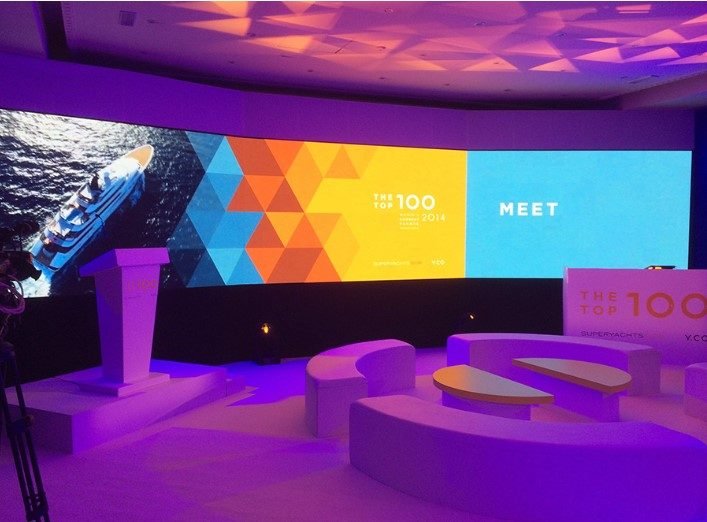
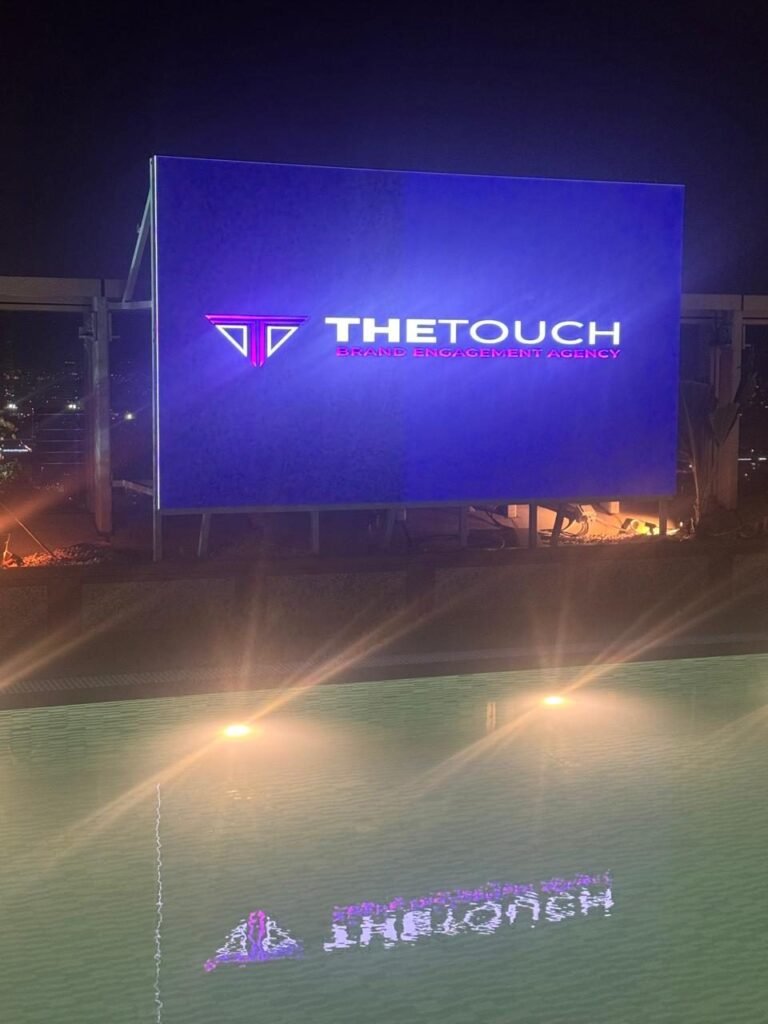
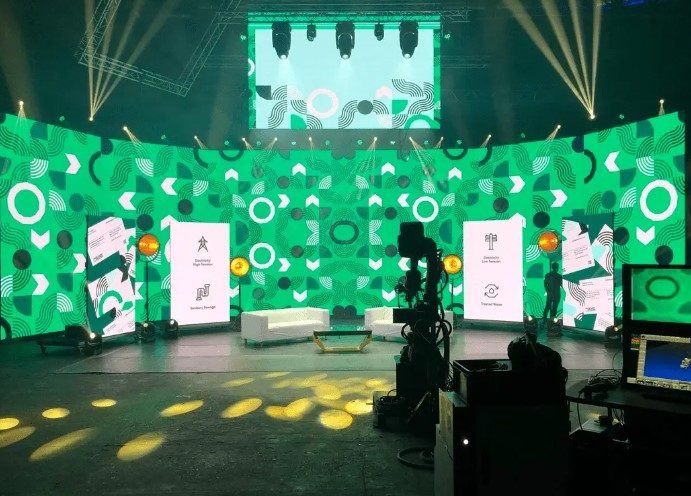
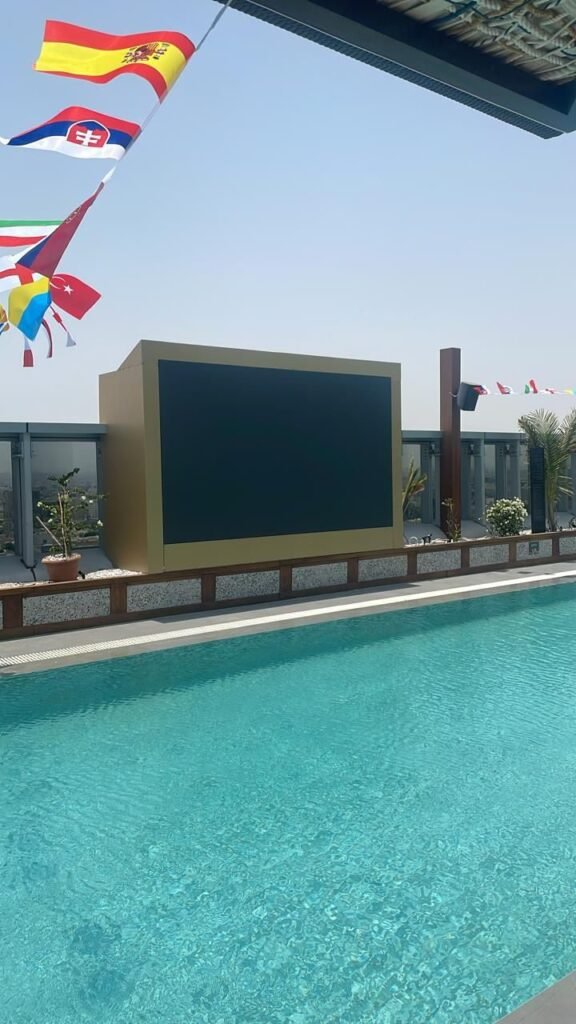
Display screens we installed at exhibitions and events.

Questions About LED Screen Rental
What event planners ask before they book a video wall.
What pixel pitch does my event need?
Start from the nearest guest, not the size of the hall. As a rough rule the closest comfortable distance in metres is about the pixel pitch in millimetres, so P2.5 suits guests from about 2.5 metres and further back for a sharp picture. Most ballrooms and conference halls take P2.5 or P2.9, close viewing calls for P1.6 or P1.9, and outdoor walls are usually P3.9.
Can an indoor LED screen be used outdoors?
Not in the sun and not in changeable weather. An indoor panel is not bright enough for daylight and is not sealed against dust and rain. A shaded courtyard after sunset can sometimes take an indoor wall under a canopy, but the supplier should confirm that in writing for your hour and your site.
What is the difference between an LED video wall and a projector?
An LED video wall makes its own light, so it stays bright with the room lights on and in daylight, and it takes any shape the cabinets allow. A projector needs a dark room and a clear path for its beam. For lit conferences and open air events the video wall is the safer choice.
Do you supply curved and vertical LED screens?
Yes. We supply indoor LED walls from P1.6 to P2.9 as flat, curved and vertical poster screens, and outdoor walls usually at P3.9. Each item is a named line in the quote with its type, its quantity and who operates it.
What do you need from the venue for LED screen rental?
Power meant for the screen or room for a generator, a floor or ground that carries the wall or approved rigging points, a route for the cases from the loading area, and the hours allowed for building and dismantling. Outdoors, add a dry, flat base and a plan for wind.
Who runs the screen during the event?
An operator for each desk is a named line in the quote. The operator sits at the processor from the rehearsal to the end, plays the content in the order of the programme and switches to the backup if the main source drops.
What size should the content be?
Exactly the canvas of the wall in pixels across and down, which the supplier gives you once the wall is drawn. Content made at any other size appears stretched or cropped. Send the video, slides and loops early enough to be loaded and checked at the rehearsal.
How much does LED screen rental cost in Saudi Arabia?
There is no fair single figure, because the price moves with the area, the pixel pitch, indoor or outdoor panels, the shape, the structure, the days on site, the operator and the power. We price from your brief with each of these on its own line, so you can see what moves the figure and where a change saves money.
Can the video wall show a live camera picture?
Yes, when a camera team and a vision mixer feed the processor, and we coordinate that with your audio visual supplier or with ours. It is what lets the back of a large hall see the speaker or the singer. Mention it in the brief, because it changes the processor setup, the cabling and the test.
How do we start LED screen rental with you, and where do you work?
We work across the Kingdom and have more than one location in it. Any frame, stage or branding around the screen is built in our own factory and installed by our own team. Send the venue, the date and the programme on WhatsApp at 0567069088 or through the quote page, and an itemised quote comes back within 24 hours.
An LED Screen for Your Next Event?
Send the venue, the date, the number of guests and what will play on the screen. Within 24 hours you have an itemised LED screen rental quote that names the panels, the pixel pitch, the structure, the operator and the power, each on a line of its own.
More specific pages on this
If your question is narrower than this page, these are written for one question each.

