
Global Health Exhibition Stand
Global Health Exhibition Stand 2027: Booths That Show Working Systems
Global Health Exhibition returns from 25 to 28 October 2027, and the organiser's site places it at the Riyadh Exhibition and Convention Center in Malham. Its FAQ says the show is organised by Tahaluf under the patronage of the Ministry of Health, and the site itself is published by Informa Markets. The organiser counts 2,200+ exhibiting brands on 120,000+ square metres. A Global Health Exhibition stand is judged in a way few trade show booths are. The visitor is a physician, a nurse, a biomedical engineer or a government buyer who wants to see the system working, to stand at the device as on the ward, and to ask what it needs from the building. So the booth is planned around the machine, the screen and the simulated room first, and the brand wall comes second. Counted from mid November 2026, opening day is more than eleven months away. Every booth type is still open, from a ministry pavilion to a start-up pod, and this page is a planning guide, not a rescue plan. It sets out the official facts, what the organiser decides about a live demonstration, the booth types that suit each kind of exhibitor, and a countdown from opening day.
Global Health Exhibition 2027 at a Glance
Every row was read on the organiser's own pages on the date printed under the table: the home page, the exhibitor and visitor pages, the FAQ, the Deals Hub and the Better Stands page. The figures are the organiser's and are given as it gives them. Space prices, the floor plan and the technical rules are not on the open site, so none of them appears here. The other medical and pharmaceutical dates of the season are in our exhibitions calendar, each with its source.
Global Health Exhibition
| Dates | 25 to 28 October 2027 |
|---|---|
| Venue | Riyadh Exhibition and Convention Center, Malham |
| City | Riyadh |
| Organiser | Informa Markets with Tahaluf |
| Sector | Healthcare |
| Official page | globalhealthsaudi.com |
| Venue, as the organiser's site names it | Riyadh Exhibition and Convention Center (Malham), printed under the 2027 dates on the home page and on the exhibitor and visitor pages |
|---|---|
| Opening hours | 10 AM to 7 PM on 25, 26 and 27 October, and 10 AM to 6 PM on 28 October, as listed in the footer of the site |
| Organiser and patronage | The FAQ states that the show is organised by Tahaluf, held under the patronage of the Ministry of Health and supported by Saudi Vision 2030 and the Health Sector Transformation Program. The site itself is published by Informa Markets |
| Scale, in the organiser's figures | 120,000+ square metres of exhibition space, 2,200+ exhibiting brands, 1,000+ investors and 500+ speakers |
| Sectors represented | Medical devices, imaging and radiology, laboratory, digital health, orthopedics and rehabilitation, dental, lifesciences, disposables, healthcare and general services, start-ups and government |
| Who attends, per the visitor pages | Healthcare professionals, hospital and clinic management, dealers and distributors, government, investors, research and academia, and start-ups. Job titles listed include head of procurement, biomedical engineering lead, nursing director, laboratory and radiology heads and chief information officer |
| Seniority the organiser reports | 33% C-suite, vice presidents and board directors, 42% directors and senior managers, 18% executives and junior managers, 5% government leaders |
| Conference stages | Leaders Summit, MEDX Forum, Digital Health Forum and Capital Xchange Forum, with CME workshops. The site speaks of 100+ CME credits |
| Features on the floor | HealthTech Live for live demonstrations of technology, Leaders' Circle, Pulse Studio, a Reverse Pitch session and the Deals Hub |
| Deals Hub | The organiser's platform for signing and announcing agreements. Its page reports 1,320 signed agreements with a total value of 35.5 billion US dollars |
| Stand build programme | Better Stands, which grades every space only stand as fully disposable, Bronze, Silver or Gold by how many of 10 construction elements are reused or recycled |
| Exhibitor resources | The Customer Centre, a portal with the forms, badge allocation, technical specifications, key deadlines and onsite services. Lead scanning runs through the official event app and is complimentary for exhibitors |
| Admission | A business event for attendees aged 16 and over. Children are not permitted on site |
Official sources we read: Global Health Exhibition, organiser home page, Why exhibit, Better Stands Programme, Exhibitor FAQs, Who attends, Why visit, Government visitors, Deals Hub, Stand enquiry form, Start-up stand enquiry, Commitment to sustainability. Sources last checked: 14 November 2026.
What the Organiser Decides About a Live Demonstration
The open site tells an exhibitor how to enquire and whom to write to. It does not publish the build rules. Technical specifications, forms and deadlines sit in the Customer Centre, which opens to contracted exhibitors, and the floor plan is sent by the sales team on request. So no line below is taken from the manual. These are the questions that shape a booth carrying working medical equipment. The answers come from the organiser and the venue and, where the device itself is concerned, from the regulator. Share what the Customer Centre gives you when you brief us, and the design follows it.
Floor loading under heavy medical equipment
An imaging gantry, an operating table or a laboratory analyser puts a great deal of weight on a few feet or castors. The hall floor has a stated loading limit, and a raised booth floor has its own, usually lower. Send the weight and footprint of each machine, and how that weight is carried, on the day you book the space. The platform is then engineered under the machine, with spreader plates where they are needed, and the figure the venue states is the one that governs.
Power and earthing, ordered by the deadline
Medical equipment often needs a dedicated supply, a particular rating or phase, and an earth connection the manufacturer specifies. All of it is ordered from the organiser on its service forms, by the date given in the Customer Centre. Ask your service engineer for the electrical data sheet of every device before the order goes in. An order placed late leaves a surcharge, or a refusal, in the organiser's hands.
What may be switched on
Whether an X-ray source, a laser, a device not yet registered in the Kingdom, or anything that uses gas or liquid may operate on the show floor is not a design question. The organiser's manual and the regulator decide, and your regulatory affairs team reads both. Ask early and ask in writing. The booth is then drawn for the answer: a live device, a device in demonstration mode, or a powered down unit with a screen beside it.
The route into the hall
A machine in its crate has to pass a loading door, cross the hall and reach the booth before the neighbours' walls go up. Lifting equipment is normally booked through the logistics agent the organiser appoints, against a delivery slot. Fix the day the equipment arrives before the booth schedule is written. The floor and the platform have to be finished first, and the walls along the route go up last.
Stand plans and the reuse grade
The organiser describes Better Stands as monitored from stand plan submission through to an on site review, and as aspiring to become part of the stand build regulations. It counts reused or recycled elements such as walls, furniture, display facilities and flooring: 4 for Bronze, 8 for Silver and all 10 for Gold. Ask your account manager what applies to your space in 2027, and brief the booth as a kit that comes apart and stores.
Malham and the build days
The site names the Malham venue, which stands outside the city. For a medical equipment exhibitor that touches the booth crew and also the service engineers who commission the devices. Agree with the organiser when exhibitor staff and engineers may enter during the build, and send calibration tools, phantoms, spare leads and consumables with the shipment. Where transport applies it is a named line in the quote.
The drawings and the paperwork that the organiser and the venue request are prepared by us. The approvals remain theirs. An upper meeting floor is approved on a structural file of its own, which our guide to double deck stand rules sets out, and the forms of the final month are listed in the exhibitor checklist.
Booth Types for Each Kind of Health Exhibitor
The halls hold ministry pavilions the size of a building next to start-up pods a few steps wide. Matching the neighbours is not the aim. Choose the booth format that carries your demonstration.
Island booth for a medical device maker
Open on every side, with each product family on its own platform and a clear circle around every machine for the clinician and the product specialist. Services run under a raised floor to each position. Allow 8 to 10 weeks from brief to opening.
Double deck booth: demos below, meetings above
The ground level stays a demonstration floor. Upstairs, away from the noise, are the tables and a closed room for delegations and distributor reviews, reached by a stair the reception can see. It also takes 8 to 10 weeks, and the organiser approves the structure separately.
Custom mid size booth for a hospital group
A hospital group sells services and people, not boxes. At around 36 square metres the booth can hold a single room built at real scale, a consultation corner, a screen wall for the group's centres and seating for referring doctors and partners. Built in 6 to 8 weeks from brief to opening.
Modular booth for a software firm
A digital health company needs screens, seats and good light more than joinery. A reusable frame with fabric graphics, a demo bench and a small store does the job, and it counts toward the reuse grades of Better Stands. New graphics take 2 to 4 weeks, and the kit can wait in our storage for the next show.
Upgraded shell scheme for a start-up
Where the organiser hands over a fitted space or a pod, the upgrade is small and exact: a printed back wall with a single sentence on what the product does, a screen at eye level and a counter with a locked cupboard. Ready in 2 to 3 weeks. Ask first what may be fixed to the organiser's structure.
A unit inside a national pavilion
Country pavilions give each company a bay with fixed panels and a shared fascia. Within the pavilion's rules a unit can still carry a working device on a plinth, a screen, a lit header and a tidy counter. The body that runs the pavilion approves every addition.
Global Health Exhibition Stand: the Countdown to 25 October 2027
The table counts back from opening day, and in mid November 2026 every row of it is still far ahead. Spend the time on what is slow in this industry, and the build is not one of those things. Space and position: the floor plan comes from the sales team, and corners and islands are taken first. Equipment: a demonstration unit has to be allocated by your head office, shipped and cleared for the show, which can take longer than the booth. Approvals: screen content and the Arabic and English texts pass medical, regulatory and brand reviewers. A summer lies between now and the build, when many decision makers are away, so approve the design before it and leave September for production. A brief by the middle of August for an island or a double deck, and by the end of August for a single level custom booth, sits on the normal schedule. Each stage is explained in how long an exhibition stand takes.
Global Health Exhibition · 25 to 28 October 2027
| Date | Stage | Status |
|---|---|---|
| 30 August 2027 | The brief, the space contract and the exhibitor manual in hand: a custom stand starts here | Ahead |
| 13 September 2027 | Design approved, and drawings sent to the organiser where it asks for them | Ahead |
| 27 September 2027 | Last sensible start for a modular stand with new graphics | Ahead |
| 4 October 2027 | Graphics go to print on the final panel sizes | Ahead |
| 11 October 2027 | Full test assembly in the factory, and the last start for a rental kit from stock | Ahead |
| 18 October 2027 | Transport booked for the build window the organiser sets | Ahead |
| · | Installation in the hall, inside the hours written in the exhibitor manual | Per the exhibitor manual |
| 25 October 2027 | Opening day | Ahead |
| 28 October 2027 | Closing, then dismantling in the organiser's window | Ahead |
What is still realistic for this edition · 347 days to openingThere is time for a custom stand on the normal schedule, provided the design is approved on its date.
Status worked out on 12 November 2026.
What Works on the Global Health Exhibition Floor
Visitors to a Global Health Exhibition stand have used equipment like yours for years. They will not read a wall of claims. They want to operate the device, watch the software run on a realistic case, and find out who supports it inside the Kingdom.
Room for the clinician at the device
A machine pushed against a wall can only be looked at. Leave space on the working side for the user to stand or sit as in practice, with the product specialist alongside and colleagues watching. Mark that zone on the booth plan before anything else is placed.
Phantoms and manikins, never patients
Ultrasound is shown on a scanning phantom, a patient monitor on a vital signs simulator, a surgical instrument on a training model, a bed with a manikin in it. Plan where these are stored, charged and cleaned, and who brings them. Any demonstration with a real person as its subject is a matter for the organiser's manual and your own compliance team, and the safe default is to do without.
A ward, operating room or clinic corner at real scale
Bed spacing, the height of a wall rail, the reach of a ceiling pendant and the turning space beside a table only make sense at full size. Build a single bay faithfully, with the real floor covering and the real bed head unit, and leave a side open for viewing. A scaled down room misleads the very people who work in such rooms every day.
Software on a large screen, with a seated bench
A hospital information system or an AI tool that reads images is sold in a guided walkthrough, not in a glance. A bench with stools, a large screen that people standing behind can read, and a smaller screen in front of the presenter keep a group together. Run a prepared demonstration environment from a local machine, so the hall network cannot stop your session.
Patient privacy on every screen
Scans, records and dashboards on show must contain no real patient. Use synthetic or fully anonymised data, check the corners of images for a name or a date, and have the film reviewed by whoever is responsible for data protection in your company. The same holds for photographs of patients in printed graphics, where written consent and your own policy decide.
Clean cable routes
Trailing leads around medical equipment look wrong to a clinical eye, and visitors trip on them. Bring power and data up through the raised floor at the exact position of each device, mark those points on the drawing from the service data sheets, and hide surplus cable inside the plinth. Leave access hatches, so a service engineer reaches a connection without lifting the floor covering.
Finishes that wipe clean
On a medical booth, every surface a visitor touches should stand up to disinfectant. High pressure laminate, lacquered panels, solid surface counter tops and vinyl floors can be wiped between demonstrations. Fabric seats, deep pile carpet and raw timber cannot. Visitors touch probes, handles and touchscreens all day, so give the staff a discreet place for disinfectant wipes, gloves and a covered bin.
Access for a visitor in a wheelchair
A booth on a raised floor needs a ramp, placed where people naturally walk in and not round the back. Keep part of the reception counter at seated height, leave turning room between the platforms, and mount at least a single demonstration screen low enough to use from a chair. The organiser's sustainability page lists ramps at the hall entrances and wheelchairs available on site, so a step at the edge of a booth should not be the obstacle. The gradient and the width required are stated by the venue or the organiser.
A signing spot with a backdrop
Agreements are part of this show. The organiser runs a Deals Hub, to which signings are submitted ahead of time for review. For your own announcements keep a small area of the booth with a branded backdrop, a signing table, even light on faces and room for a photographer to step back. When nobody is signing, it serves as the photo point for visiting delegations.
A quiet room for delegations
Ministry and hospital delegations arrive as a group, often at short notice, and expect to sit. A closed room at the back of the booth, with a ceiling and a door, comfortable seats for the whole party and a screen for a short presentation moves the conversation off the demonstration floor. Arabic coffee and water served by a host complete the welcome.
Arabic and English, with the terms checked
Every panel, caption and screen title carries both languages at equal weight. Medical terminology in Arabic differs from one institution to another, so the translation of device names, indications and clinical terms is signed off by your own medical or regulatory team. It is not left to a translator or to the booth builder. Lock the texts before the graphics are sized, because an Arabic line and an English line run to different lengths.
A pavilion for a ministry or a health cluster
The largest spaces here belong to ministries, health clusters and national programmes, and they work like small districts: a landmark seen from across the hall, a zone for each entity or service, a stage for announcements, and a route that leads the visitor through them. Each zone still needs a working demonstration of its own, or the pavilion becomes a walk past logos.
Guides for the Planning Months
The show is held in the Riyadh region, and what building for its halls involves, from the build window to the crew on site, is on our page about exhibition stand builders in Riyadh. A reception for distributors, a product launch evening or a hosted dinner during show week is covered on event management in Riyadh. The other healthcare dates of the season sit in the Saudi exhibitions calendar for 2026 and 2027. Budget lines, from the floor to the electrical order, are explained in exhibition stand cost in Saudi Arabia. If a meeting floor is in the plan, read double deck stand rules before the space is booked. Lighting medical devices and screens without glare is the subject of exhibition stand lighting. A software firm or a returning exhibitor can start from modular and portable stands, and the full build is described on custom exhibition booths.
Mistakes Health Exhibitors Make on the Show Floor
Each of these is decided months before the hall opens, which is why a Global Health Exhibition stand planned now has time to avoid all of them.
A device that cannot be switched on
The unit arrives, and only then does it emerge that the supply is wrong, the earth was never ordered, or the manual does not allow it to run. Settle the electrical order and the permission in the same month as the space contract, and the machine works from the first morning.
Real patient data in the demo
A screenshot taken from a live system, a name in the corner of a scan, a ward list in the background of a film. A single visitor with a phone is enough. Build the demonstration data set on purpose, and have it reviewed.
A platform designed before the weight was known
A raised booth floor drawn for people and furniture is then asked to carry an analyser. Give the weights with the brief. Changing the substructure after production has started costs time that no later stage can give back.
A demo that hangs on the hall network
Cloud software shown over shared exhibition wifi stalls at the worst moment. Order a dedicated line from the organiser if the product has to be online, and keep an offline version ready on the presenter's machine.
Arabic added at the end
The English graphics are approved, then translated in the last week and squeezed into whatever space remains. The result is small type and terms nobody in a Saudi hospital uses. Write both languages together, and have clinicians read the Arabic.
No path for the delegation
A party of officials arrives and stands at the edge of the booth while the staff look for chairs. Decide in advance who receives them, which route they walk, what they see in which order, and where they sit at the end.
One Team From Drawing to Dismantling
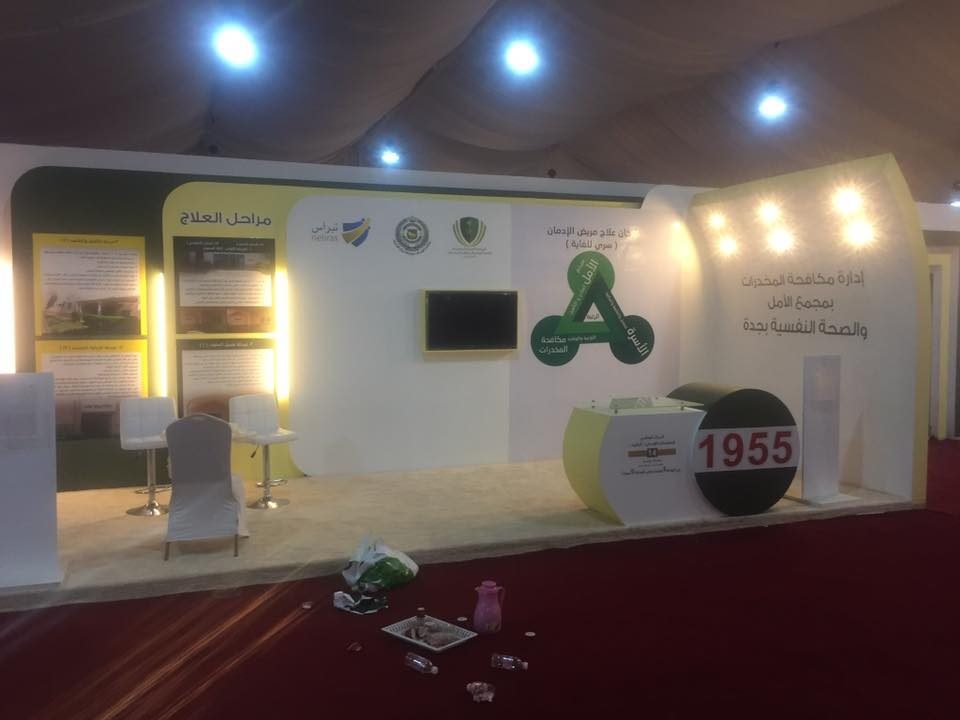
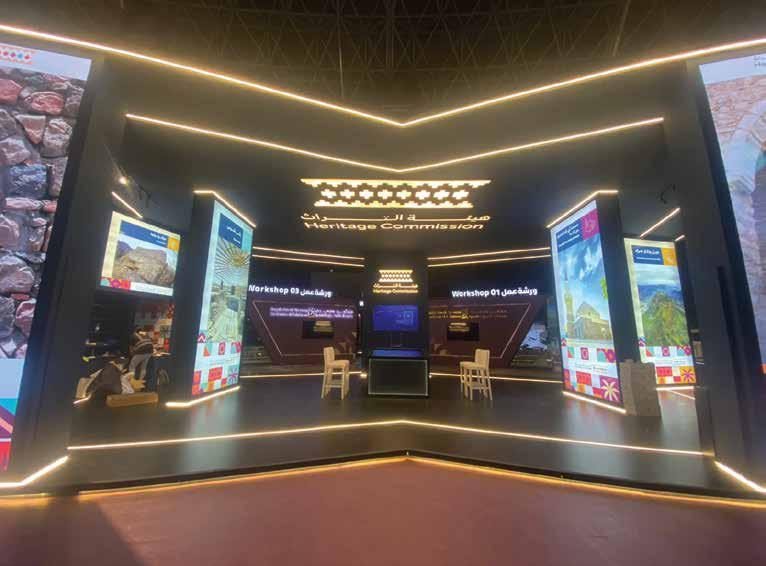
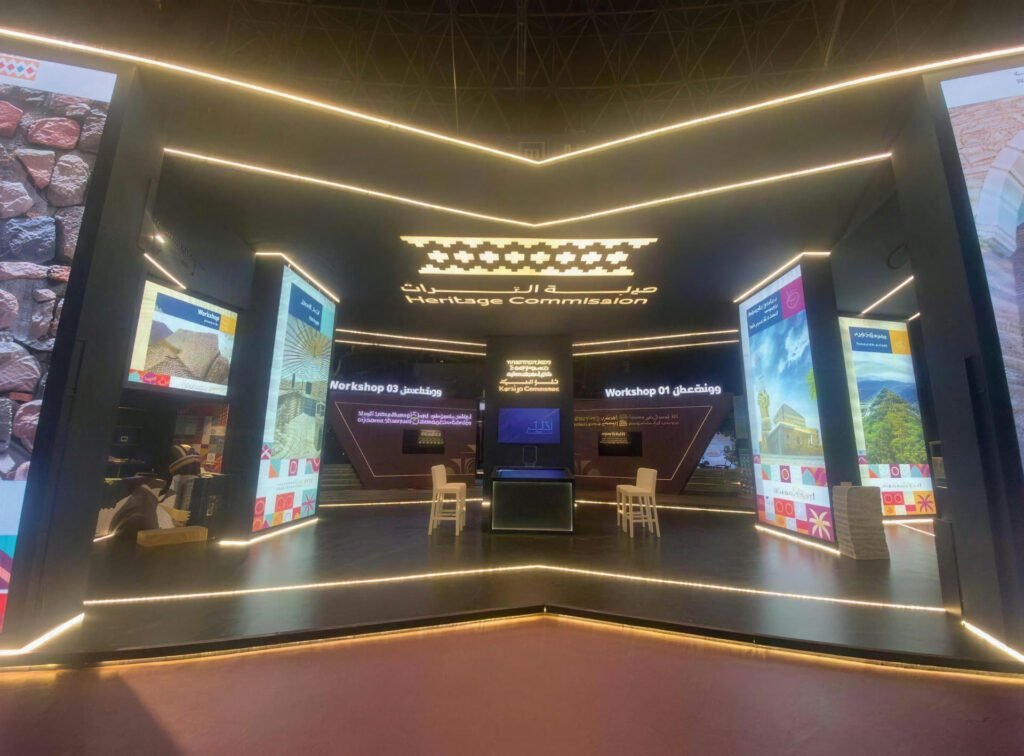
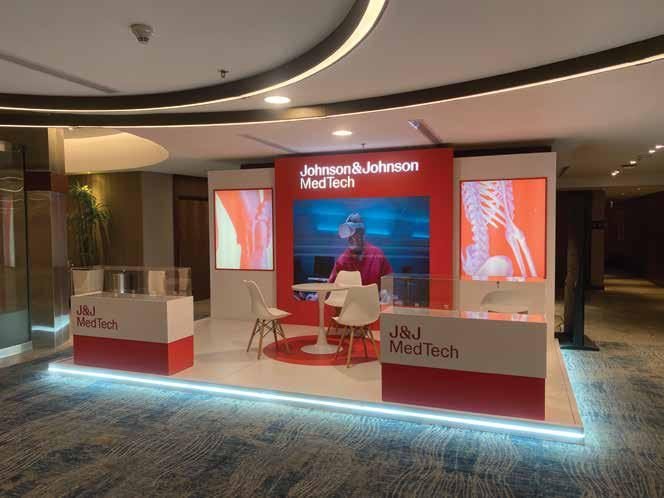
Our stands and displays have stood for Kinan, the Heritage Commission, Saudia Holidays, Johnson & Johnson MedTech and Cartoon Network. We work from more than one location in the Kingdom, and your project is made in our own factory and installed by our own team. In the factory, design, CNC and laser cutting, joinery, paint, acrylic and large format print share one roof, so the platforms, the counters, the printed walls and the acrylic covers of a booth are made together. Every booth is fully test assembled there before it ships. That is the moment to check the floor openings against the service positions you gave us, and to read both languages on the finished panels. On site our team installs, stays for the opening and dismantles after the close. We are an independent builder working for exhibitors on the space they have booked. We are not an official contractor of Global Health Exhibition, of its organiser or of the venue.

Questions About a Global Health Exhibition Stand
Asked by marketing managers, product specialists and distributors preparing for October 2027.
When and where is Global Health Exhibition 2027?
From 25 to 28 October 2027. The organiser's site names the Riyadh Exhibition and Convention Center (Malham) as the venue. Hours are 10 AM to 7 PM on the first three days and 10 AM to 6 PM on the last.
Who organises the show?
The organiser's FAQ states that Global Health Exhibition is organised by Tahaluf and held under the patronage of the Ministry of Health. The site is published by Informa Markets. Space is requested through the enquiry form on the site or by email to its sales team.
What stand options does the organiser sell?
The open site lists no packages and no prices. Its pages refer to space only stands, to a start-up stand booked through a form of its own, and to sponsorship, and the sales team answers an enquiry with availability and pricing. Ask for the contents of any fitted package in writing before the booth is designed.
Where is the exhibitor manual?
The FAQ sends exhibitors to the Customer Centre, a portal holding the forms, badge allocation, technical specifications, key deadlines and onsite services. It opens to contracted exhibitors and is not on the open web. Nothing on this page is quoted from it.
Can we run a medical device or an imaging system on the booth?
It depends on the device. The organiser's manual and the regulator decide what may operate in the hall, and your regulatory team should ask in writing. The part of the booth builder is the floor that carries the device, the services under it and the space around it, all planned from the manufacturer's data sheet.
Can we demonstrate on a visitor or a patient?
Plan on phantoms, simulators and training models. They show the function, they repeat all day, and they raise no question of consent. Anything else needs the organiser's agreement in writing and the approval of your own compliance team before it enters the design.
How much time do we need for an island or a double deck booth?
Allow 8 to 10 weeks from brief to opening, and 6 to 8 weeks for a single level custom booth. With the opening more than eleven months away, the calendar is not the constraint. The equipment list, the space contract and the internal approvals are.
What is the Better Stands Programme, and does it change the design?
It is the organiser's programme against single use stands. A space only stand is graded Bronze, Silver or Gold when 4, 8 or all 10 of the listed construction elements are reused or recycled. A booth designed as a kit, whose walls, floor, counters and lighting store for the next edition, is the way to the higher grades. Ask the organiser how the programme is applied in 2027.
We are a start-up. What can be done with a small space?
A small booth does a great deal with little: a single sentence on the back wall, a screen, a working demonstration and a counter that locks. An upgraded shell scheme takes 2 to 3 weeks. Read the organiser's terms for the start-up stand first, because they define what may be added.
What do you need from us to quote a booth?
The space size and its open sides, the list of devices with their weights and electrical data, the number of screens and seats, whether a closed room is needed, and the Customer Centre documents once you have them. Our itemised quote arrives within 24 hours. Where transport applies it is a named line in the quote.
Exhibiting at Global Health Exhibition 2027?
Tell us the size of your space, which sides are open, and what has to work on the booth. An itemised quote reaches you within 24 hours, together with a first concept and a schedule that runs back from 25 October. Call 0567069088 or message us on WhatsApp.

