
Event AV Production
Event AV Production Run From a Single Cue Sheet
Event AV production is everything technical that an audience hears and sees: the sound, the stage lighting, the screens and what plays on them, the set the speaker stands in front of, and the power that feeds all of it. At most events these come from several suppliers who meet for the first time at load in. This page explains who does what, how a single plan for power, rigging and cables is drawn, what a show caller does on the night and what the quote should list, so you can hand the whole technical side to one supplier and still know what you are paying for.
What a Show Caller Does on the Night
Show calling is the job of running the event from the cue sheet. The show caller operates no desk and instead tells every desk when to act. People often confuse the role with the event director: the director shapes how the evening looks and feels, and the show caller carries it out, one cue after the next.
Calls every cue at its moment
On the desk in front sits the cue sheet, and on the headset is the comms line to the sound engineer, the lighting operator, the video operator and the stage manager. Every event in the evening, from a microphone opening to a film starting to a winner walking up, is a numbered cue spoken on the comms, and no desk moves before it is spoken.
Not the stage manager
The stage manager looks after the stage itself: who waits in the wings, who walks on and when, what is placed on the lectern. The show caller sits at the control position facing the stage and runs the sequence for every department at once. On a small event one person may cover both; on a large one they are separate and share the same comms.
Standby, then go
Each cue is preceded by a standby a few moments before, so every operator puts a hand on the button and answers ready. Then comes go at the exact moment, and the microphone opens, the light changes and the film starts together. That is why a transition on stage looks like a single movement instead of a string of late reactions.
Holds the clock
The clock is kept at the control position: how much time each speech has left, a wrap signal passed through the presenter or a confidence screen, and the timed walk of award winners from seat to stage. If a speaker is late, the next segment comes forward. If a file drops, the still slide goes up, and every desk hears what changed before the room notices.
What Sits Around the Technical Side
The equipment makes the event audible and visible. These parts of the same project come from teams under the same roof.
Printing & Promotional Gifts
Printed backdrop panels, the stage skirt, cue cards for the presenter and the programme left on each seat. Graphics are printed in 1 to 5 working days.
Acrylic & Wood Fabrication
The lectern front, lit logo letters on the set and the award shields carried up at the moment of recognition.
Promoters & Brand Ambassadors
Hostesses who escort winners to the stage on the standby call, and ushers who hold guests at the doors until the hall is ready.
Branding & Creative Studio
Everything that appears on screen: holding slides, speaker names and titles, the opening countdown and the still slide that stands in for a film that will not play.
Digital Solutions
Registration and attendance at the entrance, so the show caller knows when the hall is full enough to begin.
Experiences & Events
The whole event the technical side serves: the venue, the programme, hospitality and the welcome of guests.
Social Media & Content
Photos and short clips from the evening, prepared for your accounts the same night.
Custom Exhibition Stands
When an exhibition floor runs beside the stage, the stands come from the same factory and the same installation team.
Who Does What in Event AV Production
Technical production is a group of departments, each with its own desk and operator. When each comes from a different company, every supplier answers for its own cases and nobody answers for the show. That is why buyers who start by searching for audio visual rental in Saudi Arabia often end up looking for event production instead: one plan that holds all the departments together.
Sound
Speakers sized to the room and its audience, a mixing desk, wireless and wired microphones, and playback for walk in music and the soundtracks of films. The sound engineer opens each microphone a moment before its owner speaks, which is why the engineer needs the run of show as much as the presenter does.
Stage lighting
Light that makes the people on stage visible to the room and to the cameras, plus looks that change the mood between segments: the walk in, the speeches, the reveal of an award. The lighting operator programmes those looks at the rehearsal and fires each one on its cue.
Screens and video playback
An LED wall or a projector, and a playback machine that holds every film, slide deck and holding graphic in the order of the programme. The video operator switches between them, and between the laptop of a speaker and the camera picture of the stage.
Cameras and recording
Cameras that carry the face of the speaker to the screen, to the recording and, when asked for, to a live stream. Each camera needs its own cable route and a position that does not block the stage for a seated guest behind it.
Set and stage
The platform, the backdrop, the lectern, the entrance and the branding are built, not hired. Our own team builds them in our factory and test assembles them before they ship, with the openings for screens, speakers and cable routes in the drawing from the start.
Power, rigging and show control
Every department above runs on power and much of it hangs from something. Power comes from the venue board or a generator, rigging from the ceiling points of the hall or a ground supported truss, and show control from the desks gathered at the control position. All of it is drawn and agreed with the venue before anything is ordered.
From the Technical Rider to the Show Caller's First Cue
Event AV production follows a fixed order. Skipping a step saves no time; it only moves the problem to the night.
The brief and the technical rider
We start from the venue, the date, the size of the audience and the programme. If a performer, a speaker or a band comes with a technical rider, the list of what they need on stage, it is read at this point, because a rider alone can change the sound plan and the power.
The house system and the site visit
Many hotels and halls have a house system: ceiling speakers, a small desk, a projector. We find out what it is, whether it suits your programme and what the venue charges for it, then decide what to use and what comes in from outside. The visit also checks the doors, the ceiling, the floor and the power board.
One plan for power, rigging and cables
A single drawing places the stage, the screens, the speakers, the lighting positions, the rigging points, the power runs and the cable routes, along with the control position (FOH, front of house) where the desks sit facing the stage with a clear view of it. Any cable that crosses a walkway is covered or lifted overhead.
The run of show and the cue sheet
The run of show lists each segment with its time and who is on stage. The cue sheet breaks it into the actions behind it: this microphone opens, this look fires, this film plays, these hostesses move. Every desk works from the same version, and each change is issued as a new dated version.
Technical rehearsal, then dress rehearsal
The technical rehearsal goes through the cues without the full cast: sound levels, lighting looks, files and camera shots, stopped and repeated until each one is right. The dress rehearsal runs the programme in order and at real speed with the presenter, whichever speakers can attend, and the hostesses on their routes.
The show, then load out
On the night the show caller calls the cues from the sheet. After the close the equipment comes down in the hours the venue allows, and the set returns to our storage if it was built to stand again.
How Long Event AV Production Takes
Planning
It depends on the venue, the size of the programme and when the riders and files arrive. The quote states the date each decision is needed by.
The built set
Stage, backdrop and branding follow the build time of their drawing, and the quote names the delivery date.
Print for the stage
Backdrop and stage graphics are printed in 1 to 5 working days once the artwork is approved.
Load in and rehearsal
Set by the access hours the venue grants. The schedule reserves time for the technical and dress rehearsals before the doors open.
What Changes an Event AV Production Quote
We publish no price list, because the same programme costs one thing in a ballroom with a good house system and another in an empty hall. These are the lines that move the total of any event equipment hire.
The room and its audience
A larger audience, a long room or an open air site needs more speakers, clearer screens and more lighting positions to reach the back row. Whether guests sit at round tables or in rows also changes where everything can stand.
What the venue already has
A house system that suits the programme reduces what comes in from outside. A venue that charges for its rigging points, its power or its own technician, or that insists on its own supplier, adds lines that belong in the comparison.
How many segments and cues
A dinner with a single welcome speech is simple work. An awards night with a film for every category, music stings, lighting changes and walks to the stage needs more programming, a longer rehearsal and a busier show caller.
Operators and their hours
We supply the equipment and an operator for each desk as named lines in the quote, and a show caller is provided for the show as a named line. Their hours cover the load in and the rehearsals, not only the evening itself.
Cameras, streaming and recording
Each camera adds an operator and another picture on the desk. A live stream adds a connection the venue must confirm and someone watching it for the whole show. A recording adds editing after the event.
Access hours and load out
Short access the night before, a load in that can only begin after another event ends, or a load out on the same night all need a bigger crew. Where transport applies, it is a named line in the quote.
Send the venue, the date, the audience size and the programme, with any technical rider you hold. An itemised quote for the technical side reaches you within 24 hours. Request a quote or message 0567069088 on WhatsApp. If the event also has an exhibition floor, our guide to exhibition stand cost in Saudi Arabia covers that share of the budget.
Working With the Venue and the Rest of the Event
Every venue sets its own rules for event AV production, written in its event pack or held by its technical manager. Ask for the load in and load out times, the route from the loading bay to the hall, the size of the goods lift, the ceiling rigging points and what each can carry, the power available and where its board sits, the sound limit and the finish time, and whether the hall allows haze or flame effects. Ask too whether the venue requires its own supplier for any department. We prepare the plans and equipment lists the venue asks for, and the approval is theirs. The platform and backdrop as built objects belong to our event stages page, and screens inside an exhibition booth to LED screens for exhibitions. When the technical side serves a gala, see corporate party organisers in Saudi Arabia, and for a day filled with sessions and speakers, conference organisers in Saudi Arabia. The voice at the microphone is on event MC in Saudi Arabia, and the photographs and video of the night on event photography and coverage.
How to Judge an Event Production Supplier
These questions separate a supplier who can run a show from one who delivers cases and leaves.
Ask who calls the show
If the answer is the sound engineer or the event manager, the person calling cues is doing another job at the same time. Ask for the name of the show caller and whether that person attends both the technical and the dress rehearsal.
Ask to see an earlier cue sheet
A sample from a past event, with the client name removed, shows whether the supplier writes numbered cues with a standby and a go for each, or keeps the show in somebody's head.
Ask what the quote includes on the venue side
Fees for rigging points, power and the venue technician, extra access hours, and any supplier the venue imposes: lines that are often missing from a quote and then appear on the invoice. A good quote lists them, or states that they sit with the venue.
Ask what happens when something fails
A good answer names the backup: a spare microphone at the lectern, a backup playback machine running the same files in step with the main one, a still slide ready for each film, and the person who decides to switch.
Ask when the rehearsals happen
A plan that leaves no time between the end of load in and the opening of the doors has no rehearsal in it, whatever the quote says. The schedule should show a reserved block for the technical rehearsal and another for the dress rehearsal.
What Goes Wrong on the Night, and the Backup for Each
Most failures in event AV production are known before they happen. The real question is whether the backup was ready before the doors opened.
A microphone dies mid speech
A battery runs flat or a wireless channel picks up interference. A spare handheld waits at the lectern or with a member of the stage crew, on fresh batteries and already checked, and the sound engineer can open it at once.
A film will not play
A file nobody tested, a format the machine cannot read, a laptop that froze. Files are collected by a deadline and played on the show machine at the technical rehearsal, a backup machine runs in step with the main one, and a still slide is ready for every film so the screen does not go black.
A speaker arrives late
The show caller hears it on the comms before the room knows, brings the next segment forward with the presenter, and tells each desk which cues now come first. The cue sheet marks in advance which segments can move and which are fixed.
Power drops on a circuit
Sound, lighting and screens on the same circuit as a coffee machine are a familiar risk. The plan keeps them apart and puts the most important parts on a supply that catering does not share.
Award walks that drag
A winner hesitates on the way, the photo takes too long, the music runs out. The walk is timed at the dress rehearsal, the music bed can loop, and a hostess meets each winner at the seat on the show caller's standby.
Cables in the guests' path
A cable laid on the floor after the plan was approved ends up under a guest's foot. Every route is drawn in advance, covered with cable ramps where it crosses a walkway, or lifted overhead.
One Run of Show From the Set to the Screen
Design, CNC and laser cutting, joinery, paint, acrylic, large format print and installation sit under one roof with us, so the set that carries the screens and speakers is drawn with them in mind from the first line. The equipment, the operators and the show caller sit in one quote and work from one cue sheet. We have worked for Kinan, the Heritage Commission, Saudia, Saudia Holidays, Johnson & Johnson MedTech and Ganache.
Events We Delivered
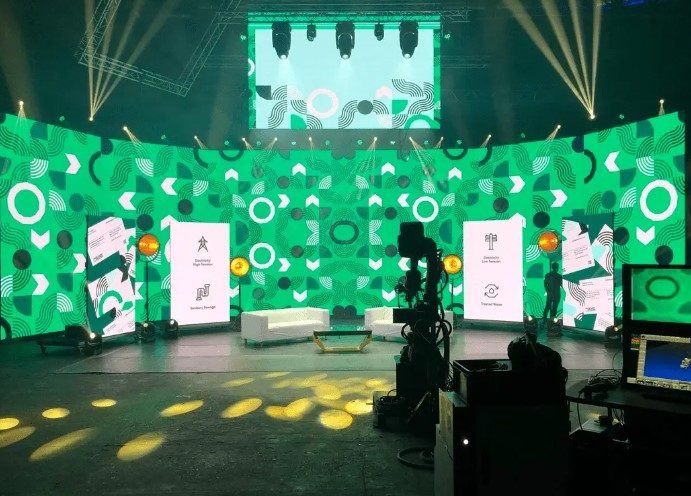
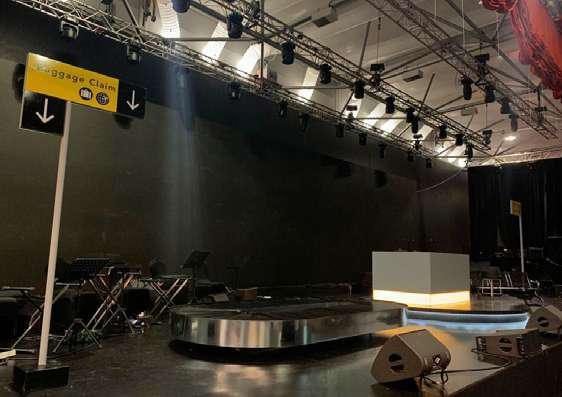
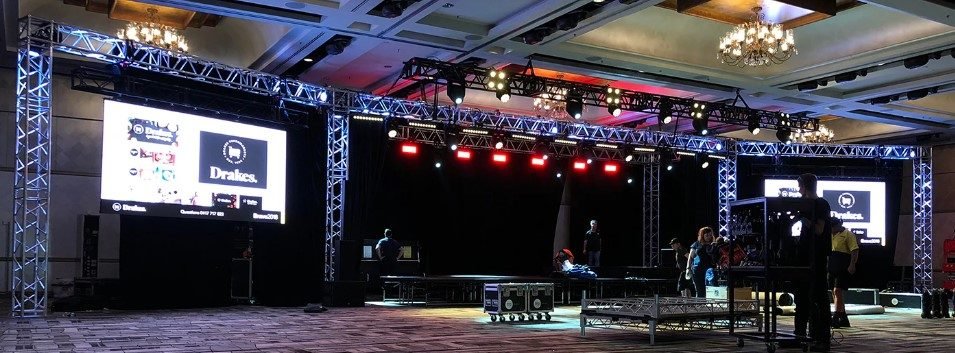
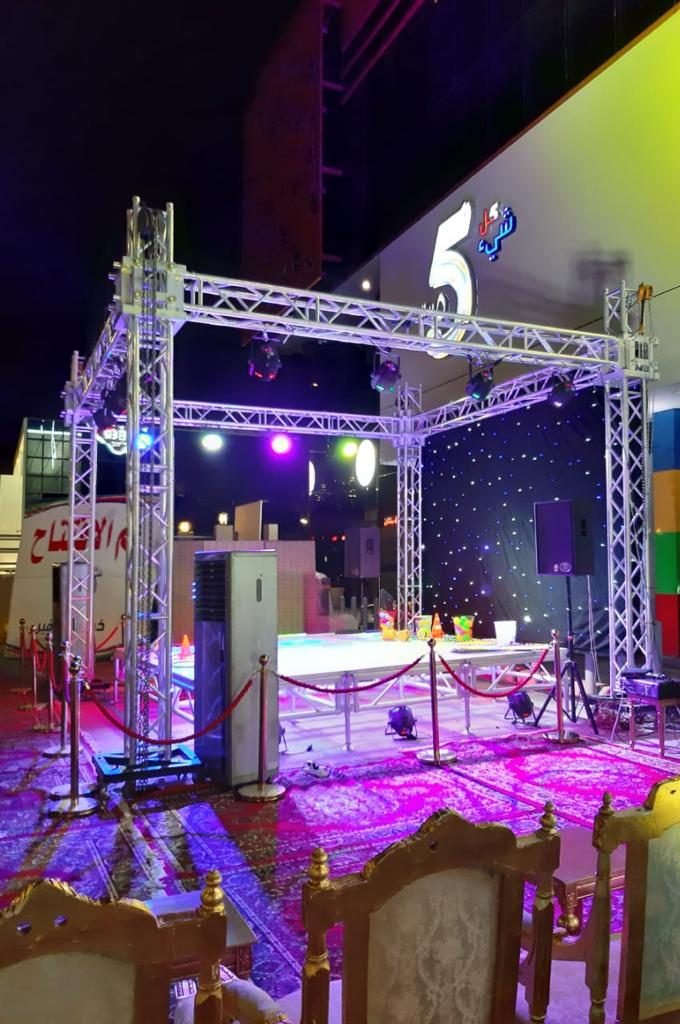
Stages, platforms and event set-ups our team built and ran.

Questions About Event AV Production and the Show Caller
What buyers ask before handing the whole technical side to one supplier.
What does event AV production include?
Sound, stage lighting, screens and video playback, cameras and recording, the power that feeds them and the rigging they hang from, plus the operators who run each desk. With us it also includes the set, the backdrop and the branding, built in our own factory. Each item is a named line in the quote with its type, its quantity and who operates it.
What does a show caller do?
The show caller runs the event from the cue sheet, speaking to each desk over the comms: standby before a cue, go at the moment it happens. That person keeps the programme on time and decides what moves when something changes. A show caller is provided for the show as a named line in the quote.
What is the difference between a show caller and a stage manager?
The stage manager runs the stage itself: who is in the wings, who walks on, what is on the lectern. The show caller runs the sequence for every department at once from the control position. On a small event one person can do both, and on a large one they are separate and talk on the same comms.
Can you use the hotel's house system?
Often, for speeches and quiet background music. We check what the venue has, whether it fits the programme and what it charges, then the quote names what comes from the venue and what comes in from outside.
What is a technical rider?
It is the list a performer, a band or a speaker sends of what they need on stage: microphones, monitor speakers, playback, power, and sometimes a particular desk. Send it with the brief, because a rider on its own can change the sound plan and the power.
Do you supply operators for sound, lighting and video?
Yes. We supply the equipment and an operator for each desk, and each is a named line in the quote. Their hours cover the load in and the technical and dress rehearsals as well as the show.
Can the event be streamed live or recorded?
Yes. Recording and a live stream are planned with the camera positions and the cable routes, and appear as named lines in the quote. A stream depends on a connection the venue must confirm in advance.
What happens if a video fails during the show?
A backup playback machine runs the same files in step, so the operator can switch to it at once. If that also fails, the still slide for that film goes on screen and the show caller moves the presenter on to the next segment, so the room is not left facing a black screen.
Why do we need both a technical rehearsal and a dress rehearsal?
The technical rehearsal sets each cue on its own: the sound level, the lighting look, the file and the camera shot. The dress rehearsal runs the whole programme in order at real speed, so the timing of speeches and award walks is tested. Dropping either one moves the mistakes to the night.
How long does it take, and how do we start?
It depends on the venue, the access hours it grants and the size of the programme, and the quote states the date. We have more than one location in the Kingdom; the set is built in our own factory and installed by our own team. Send the venue, the date and the programme on WhatsApp at 0567069088 or through the quote page, and an itemised quote follows within 24 hours.
One Supplier for the Whole Technical Side?
Send the venue, the date, the audience size and the programme. Within 24 hours you have an itemised quote that names every piece of equipment, every operator and the person who calls your event.
More specific pages on this
If your question is narrower than this page, these are written for one question each.

