
Exhibition Stand Graphics
Exhibition Stand Graphics Planned Surface by Surface
A booth is mostly printed surface: the walls, the fascia, the counter fronts, the lightboxes, the floor and the sign that hangs above it. Exhibition stand graphics are the work of deciding what each of those surfaces says, preparing the artwork at its real size, printing it on the material that suits it and fitting it so that nothing is cut off, stretched or split by a seam. This page follows that work from the first list of sizes to the last panel fitted in the hall, whatever kind of booth you have.
Nobody Prints From a Render
A rendered view shows how the booth will look. It does not say how wide the back wall is once the corner trim is on, or where the door cuts into the picture. Exhibition stand graphics start from a document that does.
The graphics schedule comes first
The schedule is a plain list of every printed surface on the booth. Each line carries a code, the finished size of the panel taken from the build drawings, the material, the way it fixes, and whether it is seen from one side or from both. Designer, printer and fitter work from the same list, so a panel that is missing from it is noticed on paper and not on build night.
A wall is read in bands
Wall artwork is arranged to match. The top band, above the heads of people standing in the aisle, carries the name and a single message. The middle band carries the proof: a product image, a client result, a certification mark. Detail sits at reading height for someone standing an arm away. The strip near the floor carries colour only, because furniture, bags and feet hide it.
Letter size follows distance
The fascia and the top of the wall are read from across the hall, the middle of the wall from the aisle, and the counter front from a step away. The further the reader, the larger and fewer the words. A quick test settles arguments: print a single line of the artwork at full size, tape it to a wall, and walk back to where the visitor will be.
Arabic and English carry equal weight
Both languages get the same visual weight, which usually means setting the Arabic slightly larger, because Arabic letters look smaller than Latin capitals at the same nominal size. Arabic needs a typeface drawn for it, not the default a program substitutes. Diagrams, timelines and arrows in the artwork are mirrored for the Arabic version, and a native reader checks the printed proof, not the screen.
The Teams Behind the Printed Wall
Exhibition stand graphics touch every other trade on a booth. These services work under the same roof, and each has its own page.
Printing & Promotional Gifts
Large format print on fabric, vinyl and rigid board, with the brochures and giveaways for the counter. Graphics are printed in 1 to 5 working days.
Acrylic & Wood Fabrication
Raised acrylic letters and lit logos that sit on top of a printed or painted wall, cut by CNC and laser.
Promoters & Brand Ambassadors
Hosts with a supervisor, briefed on the message the wall carries, so what visitors read and what they hear agree.
Branding & Creative Studio
Logo files, colour references and the layout grid, prepared so every surface of the booth belongs to one identity.
Digital Solutions
Screens set into the graphic wall, with the artwork planned around the opening and the cables.
Experiences & Events
Backdrops, stage sets and photo walls for the launch or the ceremony that runs alongside the show.
Social Media & Content
Photos and short clips of the finished booth, taken while the show is running.
Custom Exhibition Stands
The walls and frames that every printed panel goes on, designed, built and installed as a single job.
Kinds of Exhibition Stand Graphics by Surface
Each surface of a booth is seen from a different distance and takes a different kind of wear, so every panel is matched to a material that suits its place.
Wall graphics on tension fabric
A printed fabric panel with a sewn edge presses into a slim frame and pulls tight, so a long wall reads as a single image with no join. Fabric does not glare under spotlights, folds into a bag and can be cleaned gently. It is the usual choice for the large back wall and for any wall that will stand again at a later show.
Self adhesive vinyl on painted wood and glass
Printed vinyl is applied straight to a finished wall, a counter front or a glass partition, and follows curves and returns that a frame cannot. On a painted wall or panel the paint has to be fully cured first, or trapped solvent lifts the film in bubbles. A matt protective layer over the print stops glare and scuffing. Vinyl is fitted once and is not peeled off for reuse.
Rigid boards for infill and hanging signs
A print mounted on a light rigid board makes each infill panel of a system frame, the fascia, price signs and the faces of a hanging sign. Boards are flat, quick to swap and easy to store. A hanging sign is printed on both faces and kept light, and its suspension points are ordered from the organiser, who approves what hangs from the hall roof.
Backlit fabric and film for lightboxes
Where light comes from behind, the print is made on a translucent fabric or film. Light passing through the ink thins every colour, so backlit artwork is printed with richer, denser colour than the same image on a wall lit from the front, and black areas need the most care. A backlit proof is judged with the light switched on, never on a table.
Floor graphics
A print on the floor needs a top layer made to be walked on, with a textured surface that grips a shoe and edges that stay down under trolley wheels. It works best as a path, a zone marker or a large logo seen from a raised viewpoint, since people standing on it cannot read it. Check the exhibitor manual, as some halls limit what is stuck to their floor.
Cut lettering and one way film
Cut vinyl lettering is solid coloured film cut to the outline of each letter, with no background, used for names, opening hours and short lines on a painted panel or on glass. Very thin strokes and tiny text do not survive it. One way film is a perforated print for glass: the picture shows from the brighter side, and people inside the meeting room still see out.
From the Build Drawings to the Fitted Wall
Good exhibition stand graphics are mostly a matter of order. Each step below removes a cause of reprints before any ink is used.
Write the schedule from the build drawings
Every printed panel and surface is listed with its code, finished size, material and fixing, taken from the build drawings and not from the rendered view. Doors, screens, shelves and sockets are marked on each elevation, because each of them removes part of the picture.
Collect files that survive enlargement
Logos are supplied as vector files, which stay sharp at any size. Photographs are checked at the size of the wall: an image saved from a website turns soft and blocky when it is stretched across a wall, and no setting in the print room repairs it. Where a photograph does not hold, it is replaced, reshot or used smaller in the artwork.
Lay out each surface at real proportions
The artwork is built on a template of each panel, with the reading bands, both languages and the furniture drawn in. Where a wall is wider than the material it is printed on, the positions of the seams are fixed at this step and the design is arranged around them.
Proof a strip at real size
Before the full run, a strip of the artwork is printed at real size on the real material, chosen to pass through the logo, a face and the smallest text. It shows the colour, the sharpness and the reading size at once. The brand owner signs it, and the signed strip becomes the reference for the run.
Print after the structure is measured
Walls built from boards can differ slightly from the drawing, so the print is sized from the cut list of the structure and checked against the built panel. In our factory the graphics are applied to the finished panels, then the whole booth is test assembled with its graphics and lighting before it ships.
Fit on site and hand over
Our own team installs the booth and fits the graphics that travel separately: fabric into its frames, lettering on glass, the floor print last, after the heavy work is done. The schedule doubles as the checklist, panel by panel, followed by a last look with the hall lights on before opening.
How Long the Graphics Take
Graphics for a structure that exists
Printed in 1 to 5 working days once the proof is signed, depending on material and quantity.
A modular stand with new graphics
2 to 4 weeks, including the layout of the artwork for the new space.
An upgraded shell scheme
2 to 3 weeks for the wall graphics, the counter and the lighting together.
A custom stand
6 to 8 weeks from brief to opening, with each panel printed after the structure is measured.
What Moves the Cost of Stand Graphics
We publish no price list for exhibition stand graphics, because the quote is built from the schedule, line by line. These are the factors that raise or lower it.
Printed area
The total area of every printed panel is the first factor. A booth open on several sides has less wall to cover than a row booth of the same floor size, and a wall printed to full height costs more than a band along its top.
Material and reuse
Vinyl costs less to print and is used once. Fabric and rigid boards cost more at the first show and return for the next. The fair comparison is the cost across the shows you plan, not the cost of the first.
Light from behind
A backlit panel needs a translucent material, denser printing and a frame with lighting inside it. It is the most expensive surface for its size and usually the one visitors notice first, so the money is better spent on a single good one.
Design hours
Artwork that arrives print ready, at the sizes in the schedule, needs only a technical check. Artwork that has to be laid out from a logo and a brochure, redrawn from a small original or adapted into a second language is design work, and it is quoted as its own line.
Shapes, openings and lettering
Straight rectangles are quick. A curved wall, a panel cut around a screen, lettering cut letter by letter and a print wrapped around edges each add preparation and fitting time.
Changes after the proof
A correction on the proof costs little. After the run it means a reprint, and after fitting it means a reprint plus the labour of taking the first print off. Spare prints of the panels most likely to be damaged are a small line, and far cheaper than a reprint in the middle of a show.
Send the build drawings or the template of your frame, the show and its dates, and the artwork files you have. An itemised quote for your exhibition stand graphics reaches you within 24 hours. Request a quote or message 0567069088 on WhatsApp. To see where graphics sit in the budget of a whole booth, read our article on exhibition booth prices.
Seams, Colour and Where Each Topic Continues
Two things decide how exhibition stand graphics look from close up: seams and colour. Printing material comes in rolls of a fixed width, and a wall wider than the roll is printed in vertical lengths that meet edge to edge. A seam is hardly seen across flat colour, a texture or the gap between two elements. It is seen at once through a face, a logo or a line of small text, so the artwork keeps those clear of every seam, and the seam positions are marked on the proof. Fabric is made wider than most films and can be sewn into larger pieces, which is why the widest uninterrupted walls are usually fabric. Colour deserves a note as well: one brand colour comes out differently on fabric, on vinyl and on a backlit face, so the pieces of a booth are each proofed on their own material and printed together. A separate guide on this site covers colour matching between screen and print in depth. On an organiser's shell scheme the fixing is chosen from the exhibitor manual, so the rented panels go back unmarked. The print side of this work belongs to our printing and promotional production service, and the factory stages around it are set out under exhibition booth manufacturing. For every kind of booth we build, start at the exhibition booths in Saudi Arabia hub. A structure designed for a single space is on custom exhibition stands, a frame that takes a new skin at each show on modular and portable exhibition stands, and roll ups and pop ups on exhibition display stands. If the logo files and colour references do not exist yet, they come from our branding and creative studio.
Questions to Settle Before Sending Artwork
Most delays in exhibition stand graphics come from artwork that answers the wrong question. Settle these before the designer opens a new document.
Which sizes is the artwork built to?
Ask for the schedule or the template first and build to its finished sizes, with the extra margin it asks for. A file drawn to the floor plan, or to a guess, gets redrawn. If the structure is not built yet, agree which sizes are fixed and which will be confirmed after measuring.
What stands in front of each wall?
Mark the counter, the screen, the shelves, the door and the plants on each elevation. Whatever part of the artwork sits behind them is lost, and a headline that runs behind a screen bracket is a common and avoidable reprint.
Are the logo and the photographs good enough for a wall?
Find the vector logo, in every version the booth needs, and the original photographs, not the copies used on the website. If the originals cannot be found, say so early, while there is still time to redraw a logo or choose another image.
Who approves, and who reads the Arabic?
Name a single person who signs the proof for the brand, and a native Arabic reader who checks spelling, line breaks and direction on the printed strip. Approval by a group over messages is how two versions of the same artwork reach the printer.
Will these graphics stand again?
If the booth returns next season, choose materials that travel, and keep the large panels free of anything with a date. If it is a single show, vinyl on the built walls is the simpler and cheaper answer.
Graphics Mistakes Seen From the Aisle
Each of these is visible to every visitor, and each was decided weeks earlier inside the artwork.
A low resolution logo
A logo copied from an email signature or a website is a small grid of dots. Enlarged to the width of a fascia, its edges turn into steps and its colour into blotches. The cure is the vector original, and where none exists the logo is redrawn before anything else is designed.
Text at ankle height
Contact details, a product list or a legal line placed in the lowest band of a wall end up behind a chair, a bin or a visitor's legs. Nobody crouches to read at a show. Keep words above the height of the counter top and give the bottom of the wall to colour or image.
A seam through a face
A join that runs down a cheek or between the letters of the brand name draws the eye for the whole show, however well the lengths are aligned. Seam positions belong in the artwork from the start, with faces, logos and text moved clear of them.
Colours never proofed
A brand colour approved on a laptop and printed without a proof comes back a little wrong on each material, and the difference shows where two panels meet at a corner. A strip on the real material, signed before the run, is the whole remedy.
Arabic set backwards or in broken letters
A layout program without proper Arabic support reverses the reading order or disconnects the letters, and a designer who does not read Arabic cannot see the fault. The same happens to a process diagram left running from left to right. Use software and a typeface made for Arabic, convert the text to outlines, and have a native reader sign the proof.
Dated content on the biggest wall
An anniversary line, a launch offer, a show hashtag or the photograph of a product about to be replaced ties the main wall to a single season. Put what will change on a small panel that swaps, and let the large surfaces carry only what will still be true at the next show.
Print and Structure From the Same Factory
Design, CNC and laser cutting, joinery, paint, acrylic, large format print and installation are under one roof at The Touch, so the people who print a panel can measure it first. Every stand is fully test assembled in our factory with its graphics before it ships. Our stands and displays have stood for Kinan, the Heritage Commission, Saudia Holidays, Johnson & Johnson MedTech and Cartoon Network.
Graphics From Our Work
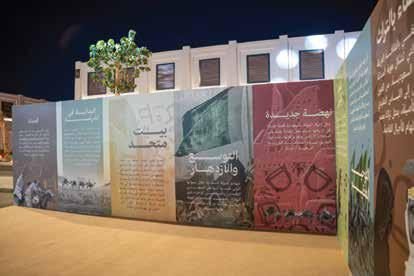
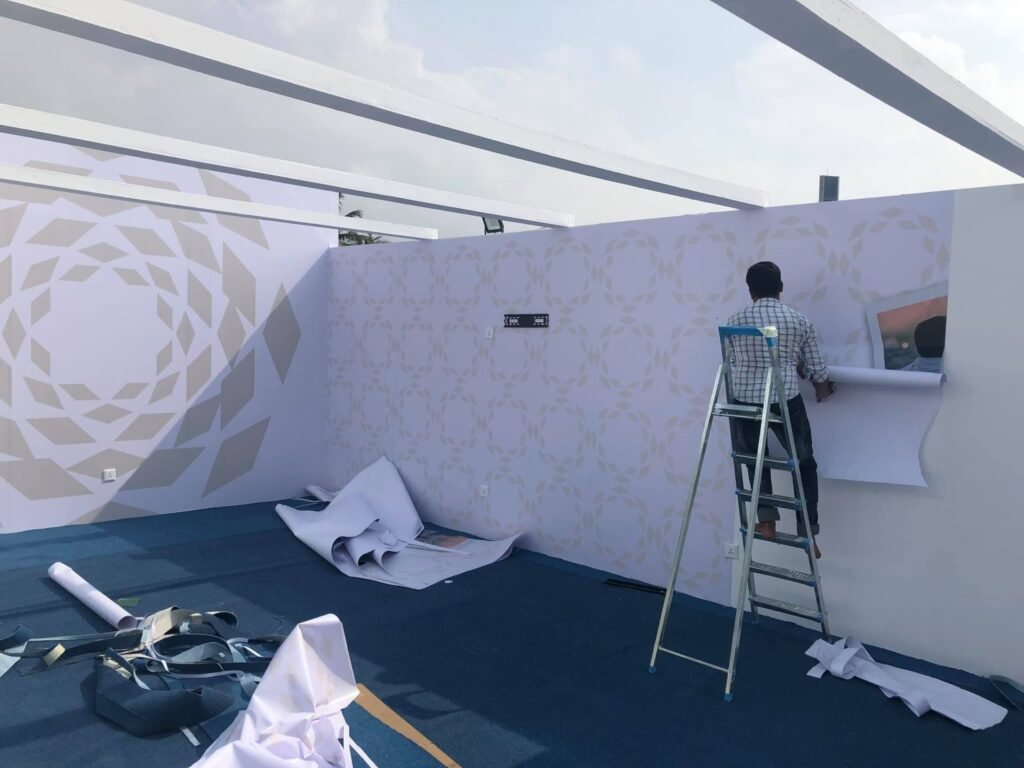
Walls, windows and stands we dressed with graphics we printed and installed.


Questions About Exhibition Stand Graphics
What marketing teams ask between the approved design and the print run.
What do exhibition stand graphics include?
Every printed surface of the booth: wall graphics, the fascia, counter fronts, lightbox faces, floor prints, hanging signs, and lettering and film on glass. The work covers the artwork for each surface, the proof, the print and the fitting. Brochures and giveaways are printed as a separate order.
Can you design the artwork, or only print it?
Both. Send print ready files and we check them technically, or our team lays out the artwork from your brand identity and the booth drawings. Either way you approve a proof before the run.
Fabric or vinyl for the main wall?
Fabric on a tension frame gives a wide wall with no join, does not glare and travels to the next show. Vinyl suits painted built walls, curves and glass, and is used once. Many booths use both: fabric for the large wall, vinyl for the counter and the details.
Why does a lightbox need different artwork?
Light from behind passes through the ink and thins it, so a file prepared for a wall lit from the front looks pale in a lightbox. The backlit version is printed with denser colour on a translucent material and proofed with the light on. Small white text on a dark ground also glows wider than it was drawn, so it is set larger and never in a thin weight.
How do Arabic and English share a wall?
With equal weight and a clear order. On a narrow surface the two are stacked, and on a wide wall each takes a side, with Arabic on the right, where its reader starts. Each language keeps its own typeface from a matched pair, and diagrams are mirrored on the Arabic side.
How long do exhibition stand graphics take?
Graphics are printed in 1 to 5 working days after the proof is signed, depending on material and quantity. A modular stand with new graphics takes 2 to 4 weeks and an upgraded shell scheme 2 to 3 weeks. Layout time before the proof depends on how complete the artwork files are, and the quote states the dates.
What happens if a panel is damaged during the show?
Plan for it before the show. Ask for a spare print of the most exposed surface, usually a counter front or the wall end beside the aisle, to travel with the spare parts that accompany the booth. For anything else the approved file is kept on record with us, and a single panel is reprinted without a new layout or a new proof.
Can we keep the structure and change only the graphics?
Yes, and it is the most economical way to exhibit often. A modular frame, or a built booth designed to return, takes a new set of graphics for each show while the walls, counter and lighting stay. Fabric and rigid panels come off cleanly. Vinyl on paint is removed, and the wall is repainted or covered again.
How should graphics be stored between shows?
Clean, dry and labelled with their code from the schedule. Fabric is folded loosely with the print inside, or rolled, and its fold marks relax once it is back under tension. Printed film is rolled around a wide core and never folded, while rigid panels lie flat with a soft sheet between their faces. Heat is the enemy of all of them, and the set can rest in our storage until the next date.
What should we send to start?
The build drawings or the template of your frame, the show and its dates, and your artwork: a print ready PDF or the designer's document with its linked images, and the logo as a vector. We work from more than one location in the Kingdom, and the graphics are produced in our own factory and fitted by our own team. Send them on WhatsApp at 0567069088 or through the quote page, and an itemised quote follows within 24 hours.
Blank Walls and a Show Date Coming?
Send the drawings, the dates and the files you have. Within 24 hours you have an itemised quote that names every panel, its material and its fixing.
More specific pages on this
If your question is narrower than this page, these are written for one question each.

