
Sustainable Exhibition Stands: Materials That Come Back and When They Save Money

The word “sustainable” is in most briefs now, and few of them say what it means. On the show floor it has one practical meaning: how much of this stand goes back to the warehouse on dismantling night, and how much goes into the skip. A stand that half comes back saves your next show half the build cost. A stand that nothing comes back from, recycling logo on the fascia or not, is not sustainable by any measure.
This guide says, from inside the factory, what sustainable exhibition stands actually are: what comes back and what never does, which materials look green and which survive a second and third show, when the choice saves real money, and when it costs more than it is worth.
Three layers of sustainability on the show floor
Sustainable exhibition stands are built in three layers, and the order matters, because most of the conversation starts at the last one:
- Reuse first. A stand that is dismantled, stored and rebuilt at the next show saves more than any recycled material. A square metre that is not made again is not bought, not shipped and not thrown away.
- Then materials that go back into the loop. Whatever cannot be reused is chosen so it can be sorted and recycled: aluminium, honeycomb card, polyester fabric, carpet tiles returned to the supplier.
- Then as little waste as possible on dismantling night. What is left is measured by the skip, and some venues and the larger organisers now ask for that figure.
Start at the third layer and you get a stand that is thrown away in full but “sorted”. Start at the first and you get a stand with little to throw away at all.
What comes back, and what never does
After years of dismantling nights the list is clear. These go back to the warehouse and come out in good shape at the next show:
- Aluminium frames and modular systems. Taken apart with one key, numbered, and rebuilt at a different size on a different space.
- Lighting. LED spots, arms and edge strips, if they are unclipped with care instead of having their cables cut in a hurry.
- Counters and shelving. If they are freestanding pieces with legs that come off, not parts glued to a wall.
- Furniture and screens. Rented or owned, either way they go back.
- Flooring. Carpet tiles and raised floor panels come back; carpet glued to the hall floor does not.
And these never come back, whatever the brief says:
- One-off graphics printed on PVC. Sized to this stand and this message, and at the next show both are different.
- Painted MDF structures. Cut, glued and painted to the hall’s dimensions. Taking them apart breaks them, storing them warps them.
- Foam letters and carved shapes. Light, cheap, and bound for the skip on night one.
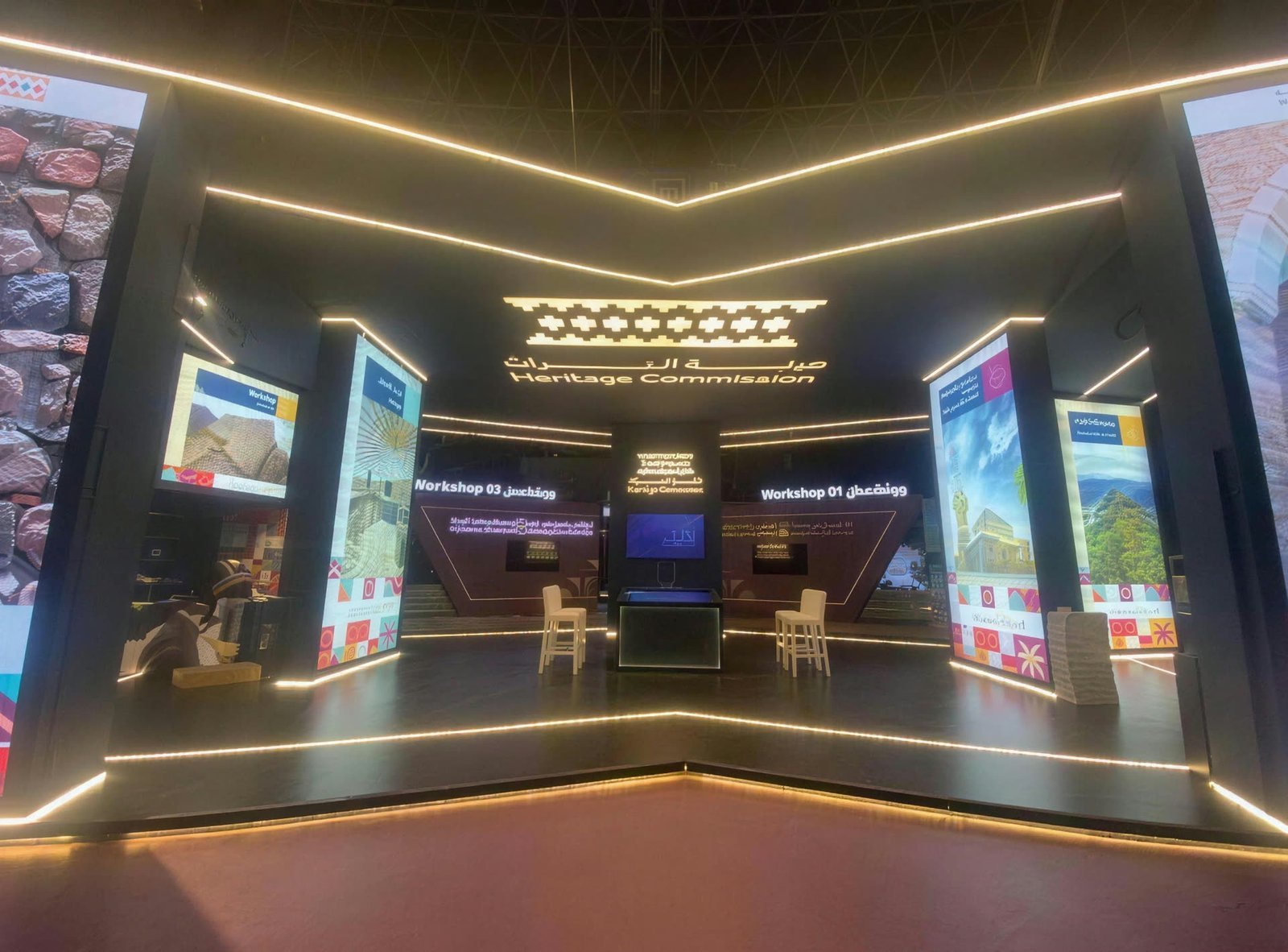
The simple test before approving any design: put a finger on every element in the 3D view and ask “does it come back?”. The stand that answers yes for most of its elements is what we mean by sustainable exhibition stands, whatever its colours.
Materials: what they look like and what they actually do
The difference between a “green” material and one that belongs in sustainable exhibition stands is that the second survives a second show. These comparisons come from the factory, not the catalogue:
| Material | How many shows it lasts | When it pays | Caution |
|---|---|---|---|
| Modular aluminium system | Years, and dozens of shows | From the second show on, and on roadshows | Needs dry storage and numbering from the first dismantling |
| Birch plywood | Three to five shows if designed to come apart | Counters, shelving and fascias built as separate pieces | Costs more than MDF to buy, less by the third show |
| Painted MDF | One show | Free forms and curves on a stand that will not be reused | Does not come apart, and is not easily recycled |
| Tension fabric graphics | Printed per stand, the frame is reused | Large walls and backlit back walls | Washable and foldable, tires after several shows |
| Printed rigid panels | Usually one show | Fixed messages that do not change | Heavy to ship and scratched in storage |
| Honeycomb card | One show, then fully recycled | Kiosks, temporary shapes and light shelving | Dislikes humidity and heavy loads |
| LED lighting | Years | Every stand, without exception | Halogen draws several times the power and heats the stand |
| Carpet tiles | Reused or returned to the supplier | The alternative to glued carpet | Check that the supplier really takes them back |
Water-based paints instead of solvent-based ones are a small line that does not change the invoice and does change the air in the factory and the hall. Rented furniture feels like the less “owned” choice, but it is the most sustainable item on the list, because the same piece serves dozens of exhibitors.
When sustainable exhibition stands actually save money
The honest answer: not at the first show. A stand designed to come back costs a little more at the first build, because the frame is stronger, the joints unbolt instead of being glued, and the parts are numbered and packed in cases. The saving starts at the second show and multiplies in these cases:
- You exhibit twice a year or more. The frame, lighting and counter come back, and the second show costs graphics, transport and installation only. The numbers for each line are in our article on exhibition stand cost in Saudi Arabia.
- A roadshow across several cities. One system installed in Riyadh, then Jeddah, then Dammam, with the same graphics and a day between cities. Read about modular and portable stands before building from scratch.
- Refreshing the message, not the stand. When the product or the campaign changes, new graphics go onto the same frame. Printing the graphics takes days; building a new frame takes weeks.
- Storage planned from the start. Whoever knows where the stand sleeps between shows, and at what cost, saves. Whoever finds out on dismantling night pays for ad hoc storage and throws the stand away a year later.
And it does not save in these cases, which someone should tell you plainly:
- A large island for one occasion. A product launch or a single appearance in the year, with free forms, curves and special heights. A custom stand that is mostly thrown away may be the cheaper choice here, and the task becomes reducing the waste, not avoiding the build.
- Shapes that will not repeat. A design built around one curve or one sculpture that fits no other space brings little back, whatever the material.
- Storage dearer than the build. A very large stand that needs a warehouse for a full year can cost more to store than a new modular build. Count it before the decision, not after.
A working rule: ask for the cost of the second show, not the first. A quote that gives you only the first build price tells you nothing about sustainability. A quote that separates “what comes back” from “what is printed again” is the one you can do the sums on.
What organisers and venues now ask
Sustainable exhibition stands are no longer only a line in the company’s annual letter. The international organisers behind Riyadh’s largest shows publish exhibitor guidance on materials and waste, and some venues ask for waste to be sorted on dismantling night and charge for whatever is left in the hall. The national context is clear: the Saudi Green Initiative and Vision 2030 have led many government bodies and large companies to write sustainability into their procurement rules, and the stand is part of those rules.
What this year’s exhibitor manuals ask in practice: fire certificates for materials, where the timber comes from, aluminium, card and fabric sorted into separate containers, and at some shows a form asking how much of the stand will be reused. Read each show’s manual before the design, not after, and the opening dates in our Saudi exhibitions calendar for 2026 and 2027 tell you when to start.
A “green” brief that can be built
“We want a sustainable stand” gives the factory nothing to work with. A brief for sustainable exhibition stands that works says:
- “We exhibit at two shows this year and one next year, and the stand must serve all three at 6 by 6 and 3 by 6 metres.”
- “The frame, lighting and counter come back. The graphics are printed for each show.”
- “No painted MDF in the main structure, and the furniture is rented.”
- “We want a list of what will be thrown away on dismantling night before we approve the design.”
- “You store it between shows, and the price is a line in the quote.”
Five lines, and the factory knows what to build. It is what we build in the exhibition stands for clients who come back every year: a frame numbered at the first dismantling, and cases labelled with the parts of each wall.
The greenwashing traps
What harms sustainable exhibition stands most is the stands that only claim to be. Four traps repeat:
- A recycling logo on a stand that goes in the skip on night one. The visitor does not see the skip, but the organiser and the crew taking it down do.
- “Natural wood” made of painted MDF. The look is timber and the destination is the skip. Real plywood with a natural veneer comes apart and comes back.
- Live plants thrown away with the stand. A living green wall looks sustainable and dies in the hall without light or water. Rented plants go back to the nursery.
- A modular frame fixed with nails and glue. Bought to be reused, then installed in a way that cannot be undone. The dry assembly in the factory catches this before the hall does.
Designed to come apart: the details that decide the outcome
A stand’s fate is decided at the design table, not on dismantling night. What we do for every stand that is meant to come back:
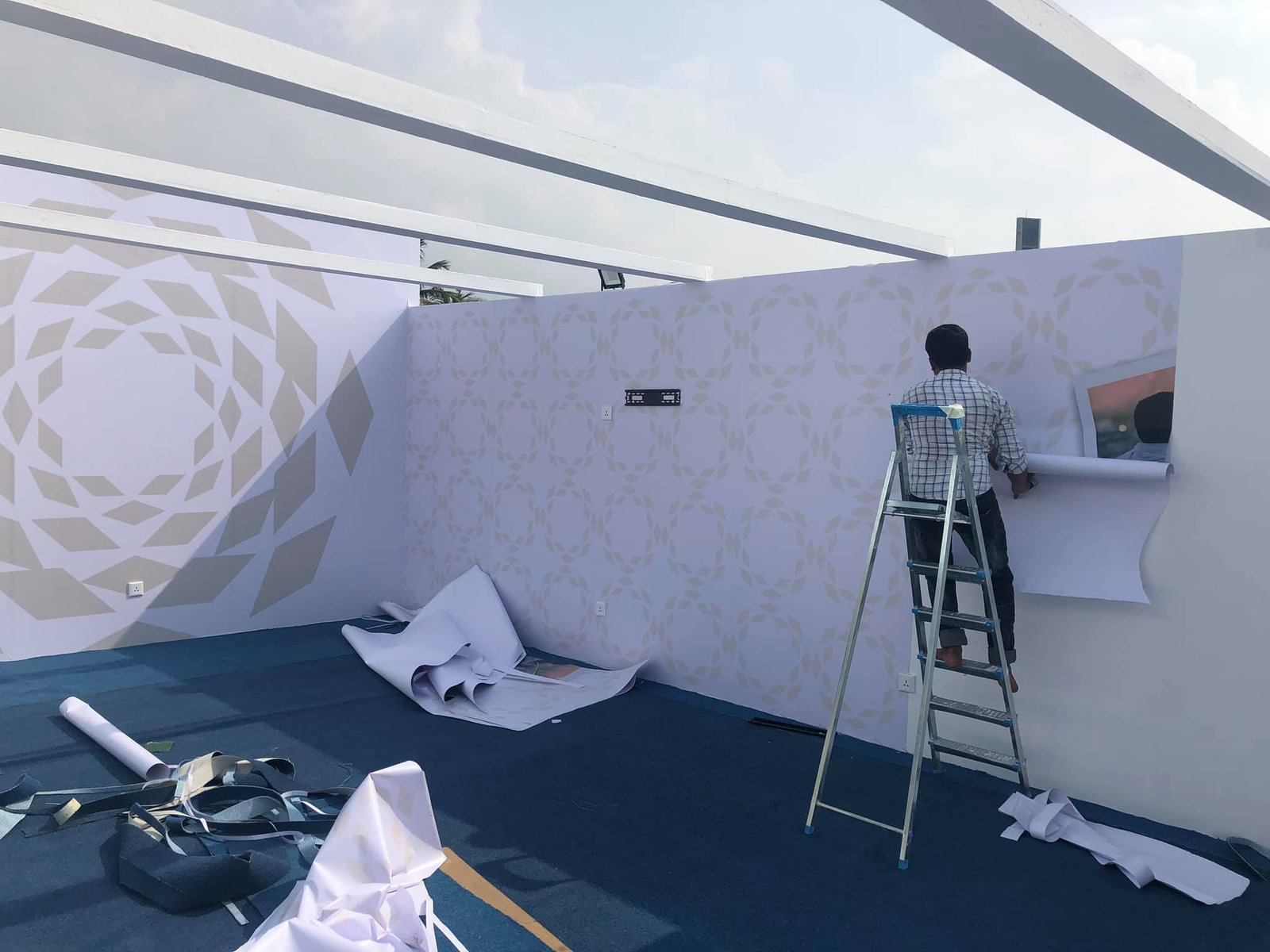
- Joints that undo, not break. Bolts, clips and cam locks instead of glue and nails, at every meeting point.
- Pieces sized to the door and the truck. The wall that leaves the hall door in one piece and stands upright in the truck is the wall that comes back intact.
- Numbering and cases from the first dismantling. Every part with a number, every case with a list, and a photo of the stand assembled before it comes down. It is what makes the second build faster than the first.
- Graphics on their own frames. The fabric is swapped and the frame stays, so the wall itself is never touched.
- A written storage plan. Where, for how many months, at what cost, and who inspects the parts before the next show. The whole order is in our article on dismantling, transport and storage after the exhibition.
The city changes the sums a little. For exhibition stands in Riyadh, transport, where it applies, is a named line in the quote, so a frame that comes back and goes straight on to a second show close by saves that line too. Exhibition stands in Dammam for the industrial shows are often heavy with equipment and samples, so a light stand that comes apart leaves room in the truck for the product itself. Across the Kingdom the sum is the same for an event management company in Saudi Arabia that owns its factory: what goes back to the warehouse is not paid for twice.
The global association of the exhibition industry, UFI, has published sustainability guidance for exhibitors and organisers for years, and most of it starts where we started: reuse before you recycle.
Frequently asked questions
Are sustainable exhibition stands more expensive?
A little more at the first show, because the frame is stronger, the joints undo and the parts are numbered and packed. From the second show they are cheaper, because you pay for graphics, transport and installation only. Always ask for the cost of the second show.
Which material is most worth the investment?
A modular aluminium system with LED lighting. It lasts for years, comes apart with one key and is reconfigured for different spaces. Next comes real plywood for counters and shelving, built as separate pieces.
Can a custom stand be sustainable?
Yes, if it is designed to come apart: mechanical joints, pieces sized to the truck, graphics on their own frames, and a storage plan. A custom stand glued and painted to the hall’s dimensions does not come back, whatever it is made of.
What do I do with the stand between two shows?
It is dismantled, numbered, packed in cases and stored somewhere dry, then inspected before the next show. Storage is a line in our quote, and the period and the price are agreed before the first show, not after it.
Do venues in Saudi Arabia ask for anything specific?
It varies from show to show. What repeats in exhibitor manuals: fire certificates, sorted waste on dismantling night, and sometimes a question about how much of the stand will be reused. Read your show’s manual before the design.
What is the quickest change that makes my stand more sustainable?
Three decisions that do not change the design: LED instead of halogen, rented furniture instead of bought, and tension fabric graphics on frames instead of glued PVC panels. Then the fourth and biggest: a frame that comes back instead of one that is thrown away.
From Our Factory to the Show Floor
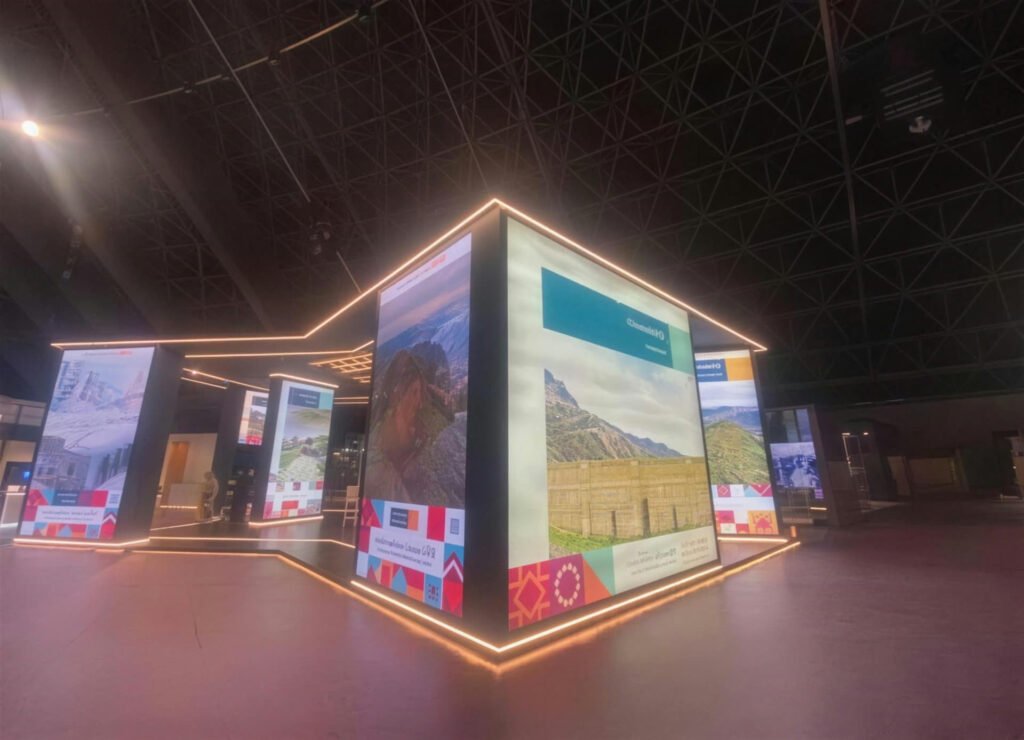
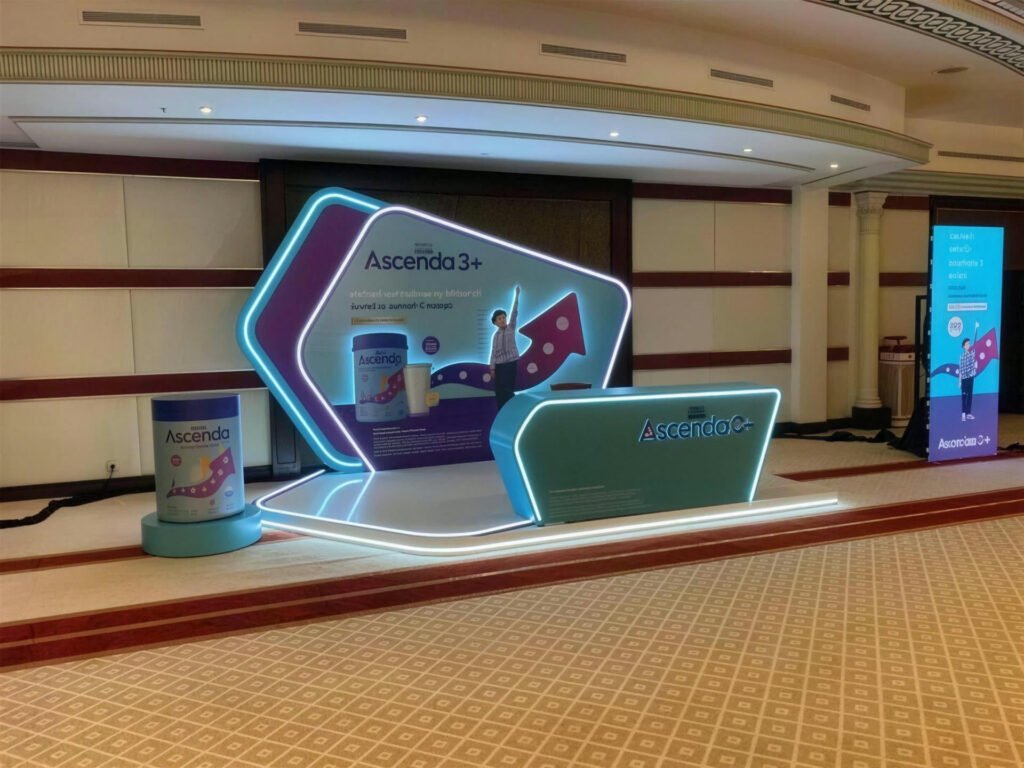
Photographed on site after handover, no renders.


Have a project and want a real number?
Send the area, the date and the city, and we come back with an itemised quote within 24 hours. No commitment, and no vague all-in price.

