
Die Cut Stickers
Die Cut Stickers Cut to the Shape of Your Brand
Die cut stickers are stickers cut to the outline of the design itself, so a coffee cup logo arrives as a coffee cup and not as a white square with a picture in the middle. For a brand, that outline is the whole point: it is the seal on a paper bag, the sticker dropped into an event pack, the logo a guest puts on a laptop or a water bottle, and the clear mark on a glass jar that looks printed on. This page explains what die cut means, how it differs from kiss cut, which styles suit which surface and how artwork should be prepared so the cut lands where you expect, so the quote you ask for describes the sticker you actually have in mind.
What Die Cut Means, and Why the Outline Matters
The words get used loosely. A printer may say contour cut, laser cut, custom shape or die cut and mean the same sticker, or mean quite different ones. What matters in the end is where the blade travels and what you are holding once the cutting is done.
Die cut: through to the backing
A die cut sticker is cut through both of its layers, the printed vinyl and the paper backing behind it, along the outline of the design. Each sticker comes away as its own piece, with a backing the same shape as the front. This is the sticker you hand out one at a time, drop into a bag or leave in a bowl on a counter, and it looks finished even before anyone peels it.
Kiss cut: the face only
A kiss cut goes through the sticker layer and stops at the backing, which stays whole. That lets many stickers share one sheet or one roll and peel off one after another, or lets a single shaped sticker sit on a neat square of backing that can carry a printed message. Staff sealing bags all day want kiss cut; guests picking up a single sticker want die cut.
Outline, offset and border
The cut line follows the art at a small distance, and that gap becomes a border around the design, usually white on a white sticker. A tight cut hugs the logo closely; a wider border smooths spikes, thin strokes and the gaps between letters into one solid shape that peels cleanly. Most logos look better with a border than their owners expect, and the border also frames the logo on a busy surface.
Decals, cut lettering and the word laser
People also search for die cut decals and laser cut stickers. Decal is an older word for the same thing, often used for stickers on bottles, laptops and boxes. Cut lettering is something else again: letters and shapes cut from coloured vinyl with no background at all, lifted onto a surface with clear transfer tape. Whatever the machine is called, judge the result by its edge and its outline.
What Comes With Your Stickers
Stickers usually travel with something else: a pack, a launch, a stand. These services work under the same roof and from the same approved logo file.
Printing & Promotional Gifts
The bags, boxes, cards and giveaways your stickers seal or sit inside, printed from the same artwork so the colours agree.
Acrylic & Wood Fabrication
Counter dishes and acrylic stands that hold stickers for guests to take, made in our own factory.
Promoters & Brand Ambassadors
Hosts who hand out stickers and event packs at a launch or a sampling table, with a supervisor on site.
Branding & Creative Studio
Turning a logo into a clean cut file, designing a sheet of icons for a set, or drawing a sticker series for a campaign.
Digital Solutions
A QR code inside the sticker design that opens a menu, an offer or a registration page, tested before printing.
Experiences & Events
A launch or a conference where every guest pack carries the event sticker, the name badge and the giveaway.
Social Media & Content
Photographs and short videos of the new stickers on your packs and products, ready for the launch day posts.
Custom Exhibition Stands
A stand at a show, its graphics and the stickers your team hands out, all from one team.
Styles of Die Cut Stickers and Where Each One Belongs
The cut gives a sticker its shape; the material and the ink decide where it looks right. These are the styles brands ask for most often, described by what they do rather than by any trade name.
White vinyl in full colour
The everyday logo sticker: a white film printed in full colour and cut to shape, with or without a white border. It is opaque, so it looks the same on a brown kraft bag, a black box or a silver laptop, and it is the safest choice when you cannot know every surface it will meet once it leaves your hands.
Clear stickers
A clear film with no background, so only the printed design shows and the jar, the bottle or the box shows through around it. The effect is a logo that looks printed on the pack itself. On clear film, colours are slightly see through unless a layer of white is printed behind them, so the artwork marks which parts must stay solid. This is what most people mean when they ask for clear die cut stickers or clear sticker printing.
White ink on clear
Some designs look best in white alone: a white logo on a dark bottle, a black coffee bag or a tinted jar. The white layer is printed on clear film and the sticker is cut close to the design, so from a step away the mark simply sits on the surface with no visible edge around it.
Paper and kraft seals
For bags and boxes that are sealed once and opened once, a paper or kraft sticker does the job and feels natural on paper packaging. It tears cleanly as the pack is opened. It is the wrong choice for anything wet, chilled or handled for a long time.
Matte, gloss or laminated
A gloss finish makes colours look deeper and suits bright logos and photographs. Matte reads calmer and more premium and does not catch the light. A laminate on top protects the print from scratches, wiping and hands, which matters for stickers on laptops, bottles and phones that live in bags and get handled every day.
A sheet of many designs
A kiss cut sheet can carry a whole set: a logo, icons, a mascot and words in Arabic and English, each cut to its own outline on one backing. Sheets work well for launch kits, children's activities at events and staff welcome packs, where the set itself is the gift and the person receiving it sees a collection rather than a single logo.
Preparing Artwork So the Cut Lands Where You Expect
Most die cut problems begin as artwork problems. These stages, taken in order, keep the edge clean and the design safely inside it.
A vector logo and a cut line
Cutting follows a drawn path, so the logo should come as vector artwork, not a screenshot or a photo of an old sticker. The cut line sits on its own layer and is clearly named. If all you have is a flat image, our studio redraws the logo and builds the cut line before anything else happens, and you see the result on the proof.
Bleed beyond, safe area inside
The background colour runs a little beyond the cut line, so a cut that shifts slightly still lands on colour and not on a white sliver. Text and fine detail stay a little inside it, away from the edge. Both distances are set in the template we send, so nobody has to guess and the file arrives ready for cutting.
Detail the blade can follow
A blade follows smooth curves well and struggles with hairline strokes, tiny gaps between letters, sharp inner points and small islands of colour. Where a logo has them, we either add a border that joins them into one shape or suggest a simpler outline, and you see both options side by side on the proof before choosing.
A proof with the cut shown
You approve a proof that shows the art, the cut line, the border and the size of each sticker. For a clear sticker or a surface we have not used before, a short sample on the real jar, box or bottle tells you more than any screen can, especially about how a clear film reads against the product behind it.
Printing, finishing and cutting
The stickers are printed, laminated where needed and cut. Short runs of die cut stickers and first orders are usually cut digitally along the outline, while a design that will be reordered can have a cutting shape made once and kept for every later run. Printed items are ready in 1 to 5 working days once the artwork is approved.
Counting and packing
Single die cut pieces are counted and bagged, kiss cut sheets are stacked and small rolls are wound for hand use. Where stickers go into event packs or out to branches, they are packed to your list, so each pack or branch receives its own share ready to use rather than a box that someone has to sort.
How Long Die Cut Stickers Take
Printed stickers
Ready in 1 to 5 working days once the artwork is approved.
A logo that needs redrawing
Redrawing the logo and building the cut line come before approval, and the quote names them.
A new cutting shape
Making a cutting shape for a repeating design adds preparation the first time only, and the quote states the date.
Your quote
An itemised quote within 24 hours of receiving the design, the quantity and where the stickers will go.
What Sets the Price of Custom Die Cut Stickers
We publish no price list, because a shaped sticker is priced from its outline, its material and how many designs share the run. These are the lines that move the number, so you can compare quotes for die cut stickers on the same basis, whoever they come from.
The outline
A circle, a square or a rounded rectangle is cut with standard tools. An outline that follows a logo needs its own cut path, and a design that will be reordered may justify its own cutting shape, made once and used again for every reorder.
Die cut or kiss cut
Single loose pieces are cut all the way through and then handled one by one. A kiss cut sheet or roll keeps the backing whole, which changes how many stickers fit on a sheet and how they are packed, so the format you need is named in the quote.
The material
White vinyl is the usual choice. Clear film, a white ink layer under or instead of colour, kraft paper and special films each change the cost, and each earns it only where the surface or the look of the pack calls for it.
Finish and lamination
Matte or gloss lamination is an extra step. A sticker that will be handled, wiped or carried around in a bag earns it; a seal on a box that is opened the same day usually does not.
Quantity and number of designs
Setup is shared across the run, so the cost per sticker falls as the quantity rises. Many designs in small numbers cost more than the same total in a single design, because each design is prepared, proofed and checked on its own.
Packing and kits
Counting stickers into event packs, bagging them per branch or winding them on rolls for staff are separate lines. Delivery, where it applies, is also named in the quote, so nothing appears later as a surprise.
Send the logo or design, the quantity, the surface the stickers will go on and whether you want single pieces, sheets or rolls. An itemised quote reaches you within 24 hours. Request a quote or message 0567069088 on WhatsApp. If your stickers are part of a show budget, our guide to exhibition stand cost in Saudi Arabia shows how that budget is built line by line.
Where Die Cut Stickers Work: Packs, Giveaways and Launch Kits
Die cut stickers earn their place where people touch them. On packaging they seal a paper bag, close a gift box or mark a takeaway cup with a logo that looks deliberate rather than stuck on. In giveaways they are the pieces guests keep: dropped into an event pack, handed over at a counter, or stuck on a laptop, a phone case or a water bottle by staff and visitors who chose to carry your brand around with them. In a launch kit one sits beside the product as a small extra, and on glass jars, candle holders and clear boxes a clear sticker makes the logo look printed on. Labels that carry ingredients, barcodes and batch numbers, and roll labels for a filling line, are a different job covered on our sticker and label printing page. Stickers and shelf strips that go out with a retail campaign to many stores are part of POSM production, stickers that close and decorate gift boxes for clients and staff belong with corporate gifts in Saudi Arabia, and the printed boxes, cups and bags they seal are covered under restaurant packaging.
Single Pieces, Sheets or Rolls: Choosing the Format
The same design can be delivered in several ways. The right one depends on who peels the sticker, how many at a time and where they are standing when they do it.
Is it handed out one at a time?
Giveaways, stickers in event packs and stickers left in a dish on a counter should be single die cut pieces. Each one looks finished in the hand, carries its own shape on the back and needs no scissors, so it travels well in a bag or a pocket without curling or tearing.
Does someone apply many in a row?
A barista sealing cups or a packer closing bags all day needs speed. Kiss cut stickers on a sheet or a small roll let them peel one after another without fiddling with loose pieces, and a roll can sit in a simple dispenser beside the counter where it is always within reach.
Is the set itself the gift?
When several designs belong together, a kiss cut sheet keeps them as one item: easy to pack, easy to photograph and clear to the person who receives it that it is a collection. It also keeps a set complete, where loose pieces tend to go missing between the packing table and the guest.
Tight to the logo, or with a border?
A tight cut suits bold, solid shapes. Fine scripts, thin rays and detached dots need a border that joins them into one shape, or they tear as they are peeled. The border also adds a frame that helps the logo stand out on a busy or patterned surface such as a printed bag.
What surface will it meet?
A flat box, a curved bottle, a textured bag and a cold glass jar each behave differently. Tell us the surface and we choose a film flexible enough for curves and a glue suited to the material, then test it on a sample wherever the surface is new to us.
Die Cut Mistakes That Show in the Hand
A sticker is small and held close to the eye, so every flaw is visible. Each of these mistakes is avoided with one decision taken at the artwork stage.
Thin parts that tear when peeled
A spike, a thin stroke or a loose dot cut on its own tears or stays behind on the backing. A border or a simplified outline turns the design into one shape that comes away whole every time.
A white sliver along the edge
Without bleed, any small shift in cutting shows as a thin white line along one side. The background must run beyond the cut line, and the proof shows that it does.
A clear sticker that vanishes
Colour printed on clear film with no white behind it turns pale on a dark jar or a brown bag. Marking which parts need a solid white layer keeps the logo strong on any surface.
Stickers that will not lift
Small round stickers packed tightly on a kiss cut sheet can be hard to start. A little space between them, a corner in the shape or a slit in the backing gives a fingernail somewhere to begin.
Edges rising on a curved bottle
A stiff film on a tight curve springs back at its edges. Curved bottles, tumblers and tubes need a softer, more conformable film and a shape that does not fight the curve.
A reorder with a different outline
If a new cut file is drawn each time, the shape drifts between batches. The approved cut line and any cutting shape are kept on record, so every reorder matches the first.
Stickers Made Beside Everything Else You Print
Design, print, cutting, fabrication in our own factory and packing for events sit under one roof, so the sticker in the guest pack, the seal on the box and the graphics on the stand all come from the same approved file. We have worked for Cartoon Network, Ganache, Swarovski, Gucci Flora and Saudia Holidays.
Stickers and Labels From Our Press
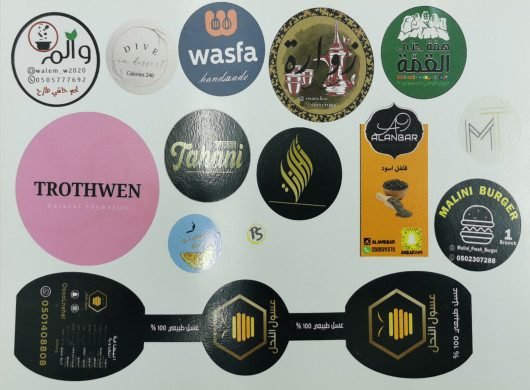
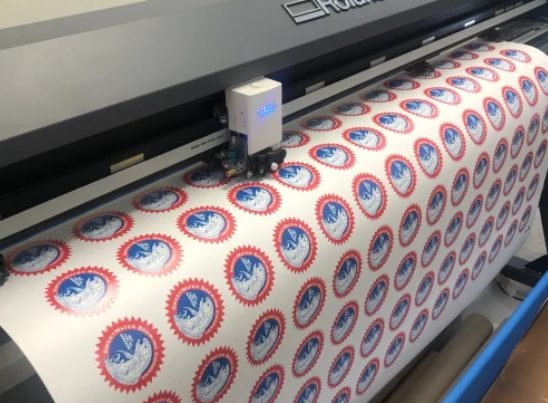
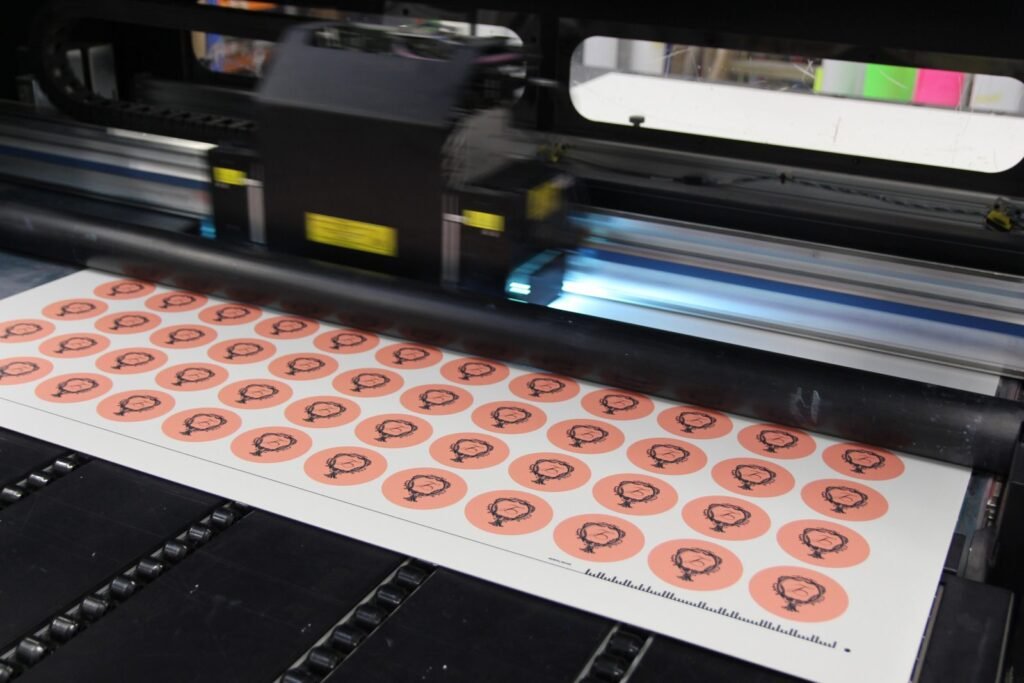
Product labels, vinyl and graphics we printed and cut in our own factory.


Questions About Die Cut Stickers
What brands and event teams ask before ordering stickers cut to shape.
What does die cut mean?
Die cut means the sticker is cut all the way through, vinyl and backing together, along the outline of the design. Each sticker becomes its own piece with a backing the same shape. The name comes from the steel cutting shape, called a die, that was traditionally pressed through the material.
What is the difference between die cut and kiss cut?
A die cut goes through the sticker and its backing, giving single loose pieces. A kiss cut goes through the sticker only and leaves the backing whole, so many stickers sit on one sheet or roll and peel off one by one. Choose die cut for giveaways and kiss cut for anyone applying stickers in quantity.
Are laser cut stickers different from die cut stickers?
For the buyer, usually not. Laser cut, contour cut and die cut all describe a sticker cut to the shape of its design, and the names refer to how the cut is made. What you should check is a clean edge, a sensible border and a shape that matches the proof you approved.
What are clear stickers, and will the colours show?
Clear stickers are printed on a transparent film, so only the design shows and the surface shows through around it. Colours on clear film are slightly transparent, so a white layer is printed behind any part that must stay solid. On dark surfaces, a design printed in white alone often looks best.
Do I need a white border around my die cut sticker?
Not always. Bold, solid logos can be cut tight to their edge. Logos with fine lines, separate letters or small dots usually need a border that joins them into one shape, so the sticker peels without tearing. The proof shows both options whenever the difference matters.
What file should I send?
A vector file of the logo or design is best, because the cut follows a path drawn from it. If you only have an image, send it anyway: our studio redraws the logo, adds the cut line and the bleed, and sends you a proof for approval before anything is printed.
Should my die cut stickers be matte or gloss?
Gloss makes colours brighter and suits playful logos and photographs. Matte looks calmer and does not reflect light. If the stickers will live on laptops, bottles or phones, a laminate on top protects the print from scratches and wiping in either finish.
Do we pay for a new cutting shape every time we reorder?
No. A cutting shape made for a repeating design is kept and reused for every reorder of that design. Short runs and first orders are often cut digitally along the outline with no cutting shape at all, and the quote explains which applies to your order.
How long does an order of die cut stickers take?
Printed stickers are ready in 1 to 5 working days once the artwork is approved. Redrawing a logo or making a new cutting shape comes before that, and packing into event kits is planned into the date written in the quote.
How do we start an order?
Send the logo or design, the quantity, the surface the stickers will go on and whether you want single pieces, sheets or rolls, on WhatsApp at 0567069088 or through the quote page. An itemised quote follows within 24 hours, and one team follows the order from artwork to packing.
Die Cut Stickers for Your Next Launch or Event?
Send the logo, the quantity and where the stickers will go. Within 24 hours you have an itemised quote that names the cut, the material, the finish and whether the stickers arrive as single pieces, sheets or rolls.
More specific pages on this
If your question is narrower than this page, these are written for one question each.

