
Printed Paper Bags With Your Logo
Printed Paper Bags Chosen by What Goes Inside
Printed paper bags are the last thing a customer touches in your shop and the first thing other people see of it in the street, the mall corridor or the office lift. A bakery needs a bag that holds warm pastry without a grease mark, a boutique wants rope handles and a matt laminated finish, a café wants kraft that matches its cups, and an exhibitor wants a bag big enough for a brochure that visitors carry round the hall. This page explains how to choose the paper, the handle type, the base and the print for what will go inside, what a sample should prove before the full run, and how to keep reorders looking the same.
Why the Bag Is Part of the Sale
A plain bag ends the sale. Printed paper bags keep working after the customer leaves, as long as they survive the walk home.
It carries your brand past the door
A customer walking through a mall with your bag shows your logo to everyone on the way to the car park. A bag that is kept and used again, for lunch, gym clothes or a gift, carries it for weeks. A weak bag that splits on the first trip is thrown away and takes the impression with it.
It tells people what kind of shop you are
Brown kraft with a logo in a single ink says natural, baked today or made by hand. Bright white in full colour says modern and confident. A laminated bag with rope handles and a gold foil logo says that what is inside cost something. Pick the bag that fits the price and mood of what you sell, not the first one in a catalogue.
It protects what you sold
Pastry needs paper that holds back grease, perfume boxes need a bag that does not sag under the weight of glass, and clothes need a bag that does not crush them. Paper, base and handle type are chosen for the product, which is why the first question is always what goes inside.
It matches the rest of your brand
When the bag, the box, the seal sticker and the shop graphics come from one artwork and one colour reference, the brand looks deliberate at every step, from the counter to the customer's kitchen table.
What Comes With the Bags From the Same Teams
Printed paper bags rarely leave the factory on their own. These are the pieces that usually go with them.
Printing & Promotional Gifts
Seals for the bag top, wrapping tissue, thank you cards, boxes and giveaways sharing the bag's artwork. Shop and event graphics take 1 to 5 working days.
Acrylic & Wood Fabrication
Counter units and shelving that keep folded bags out of sight at the till, made on our factory's CNC and laser cutters.
Promoters & Brand Ambassadors
Promoters giving out branded bags with samples at a launch, in a mall or on a stand, while a supervisor tracks what is left.
Branding & Creative Studio
The bag design itself: where the logo sits on the front, back and gussets, the bilingual copy, and the colour references the print is matched to.
Digital Solutions
A QR code on the gusset that opens your menu, your online store or a reorder page.
Experiences & Events
Openings and launches where the printed bag is the gift guests leave with.
Social Media & Content
Photographs of the finished bags with your product, for your online shop and social accounts.
Custom Exhibition Stands
Stands built in our own factory, with room in the counter for the bags handed to visitors.
Printed Paper Bags: Types and Where Each Fits
Most shops settle on two or three styles: an everyday bag for the counter, a better one for gifts, and a food bag if they sell anything warm or oily.
Kraft bags with twisted handles
Brown or white kraft paper, with a twisted paper cord handle glued inside a folded top hem. This is the everyday bag of cafés, pharmacies, bookshops and fashion chains: light, strong for its weight and familiar to customers. Kraft takes a logo in a single ink, or a simple design in two, very well, and suits a natural, unfussy brand.
White bags with flat handles
Bleached white paper printed in full colour, with flat paper strips glued inside the top edge to carry it. Flat handles cost less than twisted ones and suit light loads such as takeaway, cosmetics or documents. White paper shows photographs and bright brand colours the way they were designed.
Boutique bags with rope or ribbon handles
Heavier paper, usually coated, with holes punched through a reinforced top, threaded with cotton rope, polyester cord or satin ribbon knotted inside. These bags stand up by themselves on the counter and are kept long after the purchase, which is why boutiques, perfume and oud shops and jewellers choose them.
Laminated luxury bags
Printed paper covered with a thin matt or gloss film, then folded and assembled largely by hand, with card stiffeners in the base and under the top fold. The film deepens dark colours, resists scuffs and spills, and gives foil and embossing a clean surface to sit on.
Food bags: bakery, grease resistant and window
Bags with no handle and a flat square base that opens by itself, for bread, pastry, sweets and sandwiches. Grease resistant paper stops oil from showing on the outside, and a window of clear film shows the product while keeping it covered. Anything that touches food needs paper meant for food contact.
Bags for events and exhibitions
A bag handed out at a stand, a conference or a launch has to take a brochure lying flat, a sample and a gift without tearing. Large bags with strong handles and a logo on both faces turn into moving signs around the hall, and the gusset can carry the web address or the brand account.
From Load to Delivery: How Printed Paper Bags Are Made
Most problems with bags come from choosing the look before knowing the load. These steps put the load first.
What goes inside, and how heavy it is
Tell us the heaviest and the bulkiest thing a customer will carry in the bag, and whether it is warm, oily, fragile or already wrapped. A bag for a single pastry box and a bag for several bottles of perfume look alike in a drawing and behave very differently on the walk to the car.
Paper, handles and size
From the load we settle the paper and how heavy it should be, the handle type, the width, the height, the depth of the gusset, and whether the base needs a card stiffener. We size the bag from the product, so a box or a folded garment sits inside without gaping and without forcing the sides.
Artwork on the flat layout
A bag is printed flat before it is folded, so the artwork goes on a layout that shows the front, the back, both gussets, the base and the top fold. Our studio places the logo where no fold cuts through it and no handle hides it, and marks what is printed on each face.
Proof and sample
You sign off a printed proof that settles the colour and each line of Arabic and English text, then a sample bag that you fill with your real product and carry. Check that the handles hold, the base stays flat and the colour on kraft or white is the one you expected.
Printing, finishing and assembly
The paper is printed, then laminated, foiled or embossed where the design asks for it, then folded, glued and given its carrying cords. Rope and ribbon handles are threaded through their holes and knotted once the bag has its shape.
Packed flat and delivered
Bags travel flat in cartons marked with the design and the count, so they take little room behind the counter. Where transport applies, it is a named line in the quote.
What Sets the Date for Printed Paper Bags
Your quote
Itemised, and with you within 24 hours once we know what the bag carries, the look you want and roughly how many.
The sample
Depends on the paper and the handle type. A plain kraft bag with twisted handles can be sampled sooner than a laminated bag with ribbon and foil.
The production run
Depends on the paper, the finishes, the handle type and the quantity, and the quote states the delivery date.
Shop and opening graphics
Window graphics, posters and counter cards around the bags take 1 to 5 working days to print after artwork approval.
Where the Money Goes in a Printed Bag
There is no fixed price list for bags, because each one is priced from its paper, handles, print and quantity. The lines below are what separate two quotes for bags that look alike.
Paper and its weight
Kraft, white, coated and specialty papers each carry their own cost, and heavier paper costs more per bag. Paper heavier than the load needs is money that buys nothing, while paper too light for it comes back to you as torn bags.
Handles
Flat paper strips are the economical end, twisted paper cord sits in the middle, and rope or ribbon threaded through a reinforced top costs the most, because they add material and hand work to every bag.
Colours and ink coverage
A logo in a single ink on kraft is the simplest job. Full colour on white, a solid background covering the whole bag, or print on the inside each add ink and press time.
Lamination and finishes
Matt or gloss lamination adds a film and a step. Foil and embossing each need a metal die cut to your logo, paid for with the first order and kept for the next.
Base card, reinforcement and window
A card stiffener in the base, a reinforcement strip at the top hem, a window of clear film and grease resistant paper are each a line of their own, and each earns its cost only where the product needs it.
Quantity and sizes
Plates, tools and making the press ready are paid once per run whatever its length, so a longer run spreads them thinner and each bag costs less. Extra sizes reuse the artwork, but each needs its own press preparation and is counted separately.
Tell us what goes in the bag and the style you like, and send a photo of the product with the quantity you expect for the first order and for reorders. An itemised quote for your printed paper bags reaches you within 24 hours. Request a quote or message 0567069088 on WhatsApp. If the bags are for visitors to your stand at a show, our guide to exhibition stand cost in Saudi Arabia breaks down the rest of that stand budget.
Bags, Boxes and Stickers From One Artwork
Printed paper bags are one piece of a set. The box inside the bag, the sticker that closes it and the shop it leaves from should all read as the same brand. When the product travels in packaging of its own, start from custom printed boxes, so the box size decides the bag size and not the other way round. Seal stickers for the bag top, labels for takeaway orders and logo stickers for plain kraft bags are on the sticker and label printing page. A new branch needs its bags from the first morning, and the opening day itself, with its guests and gifts, is covered under grand opening events, while the counters, shelving and space behind the till where bags are kept belong to retail fit-out. Bags that hold gifts for clients and staff, rather than purchases, are part of corporate gifts in Saudi Arabia. Bags handed out with samples in malls and supermarkets go with product sampling in Saudi Arabia, and bags designed as part of the look of a conference or a launch sit with event branding.
Kraft or White, Twisted or Rope Handles
Answer these and most decisions are made before design starts. A careful bag printer will ask them before anything else.
What is the heaviest thing it will carry?
Light items such as a sandwich, a cosmetic or a shirt sit well in a bag with flat handles. Bottles, jars, shoes and boxed sets want twisted or rope handles, a heavier paper and a card in the base. When in doubt, load the sample with the heaviest order you sell and carry it for a few minutes.
Kraft or white paper?
Kraft is strong, looks natural and hides handling marks, but every ink printed on it comes out darker and less bright, and pale colours almost vanish into it. White paper shows brand colours and photographs as designed. If your logo depends on a light colour, test it on a kraft sample before you commit.
A single ink or full colour?
A logo in a single ink on kraft is economical, reads clearly from a distance and suits cafés and bakeries. Full colour on white allows patterns, photographs and seasonal designs, and is the usual choice for fashion and gifts. A solid colour that covers the whole bag is striking but shows every scuff, so lamination often follows.
Laminated or natural paper?
Matt lamination gives a soft, rich surface and protects dark colours, and gloss makes colours brighter. Both make the bag tougher against spills, and both add a film to the paper, which matters if you plan to call the bag recyclable. Natural uncoated paper is the simpler choice for an everyday bag.
Does it touch food?
Bread, pastry, sweets and sandwiches placed straight in the bag need paper meant for food contact, and oily food needs grease resistant paper. The food business confirms that the paper suits its use and keeps the supplier documents, and the bag is printed on the paper it approves.
Bag Problems Customers Notice First
Each of these problems with printed paper bags shows up at the counter or on the pavement, and each is far cheaper to fix at the sample than after the run.
Handles that pull out
A heavy load hanging from a thin top tears the paper where the cords are glued. A folded top hem, a reinforcement strip and a paper suited to the load prevent it, and carrying the loaded sample shows the weakness before the whole order is printed.
Grease coming through
Untreated kraft shows oil within minutes of a warm pastry going in, and the stain spreads across your logo. Bags for anything oily need grease resistant paper, and the design keeps the logo away from where the product sits.
A logo darker than expected
A brand colour approved on a white screen looks heavier and duller on brown kraft. Ask for the proof on the actual paper, and if the colour matters, move to white paper or adjust the ink before you find out on delivery day.
Print across folds and under handles
A logo placed too close to the top is cut by the folded hem or hidden where the cords are fixed, and text on the gusset crease breaks when the bag is folded flat. The layout marks the safe area on every face.
A bag the product does not suit
A box that forces the sides out tears the gusset, and a bag far bigger than its contents looks empty and wastes paper. Size the bag from the item you sell most, and add a second size rather than stretching one to fit everything.
Bags spoiled in storage
Paper bags kept near a damp wall, in direct sun or in a hot store room curl, fade and lose their stiffness, and the glue holding the cords can weaken. Keep the cartons flat, dry, off the floor and out of the heat, and rotate stock so the oldest cartons go out first.
Bags, Boxes and Print From One Factory
Our own factory holds the studio, the print, the laser and CNC machines, acrylic and joinery, and paper bags, boxes, stickers and cards are printed there. That is why the bag at the till, the box inside it and the graphics on the shop window are printed from a single approved design matched to a single colour reference. Among the brands we have worked for are Oceanera, Ganache, Gucci Flora, Swarovski, Saudia, Kinan and Johnson & Johnson MedTech.
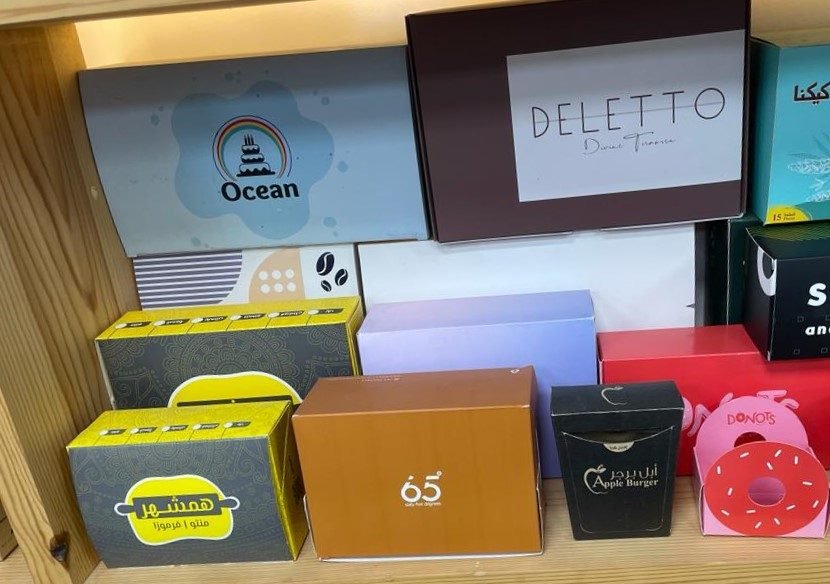
Boxes and Packaging From Our Factory
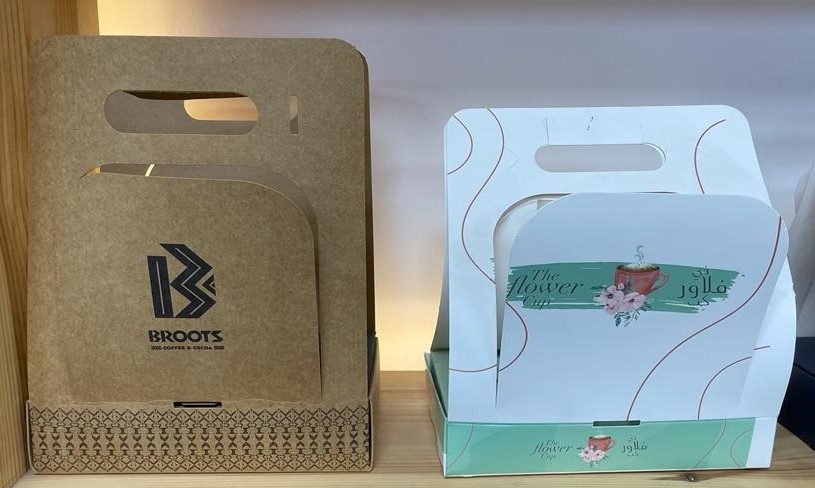
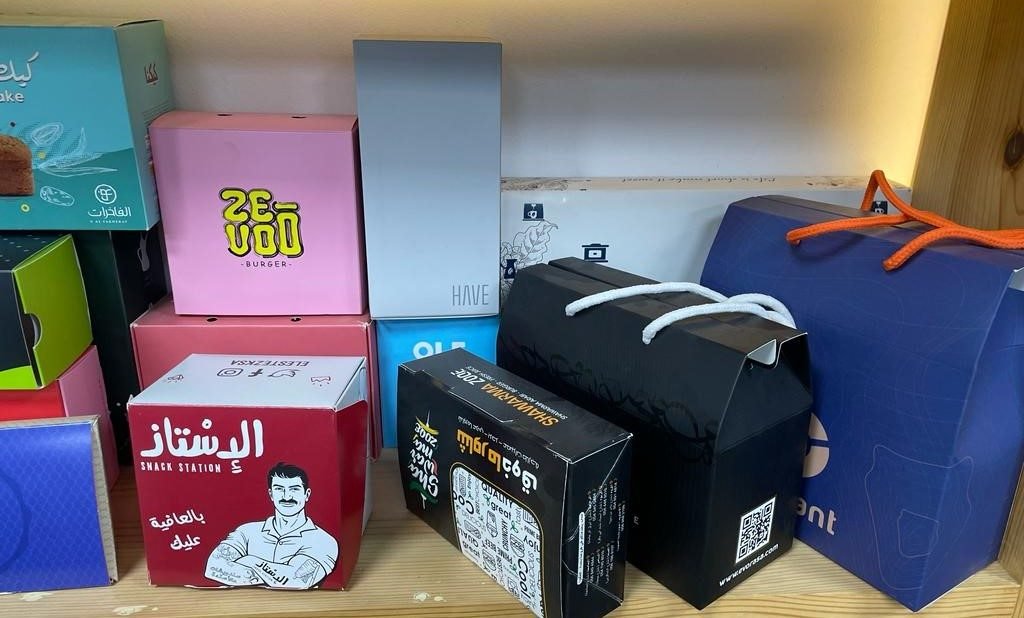
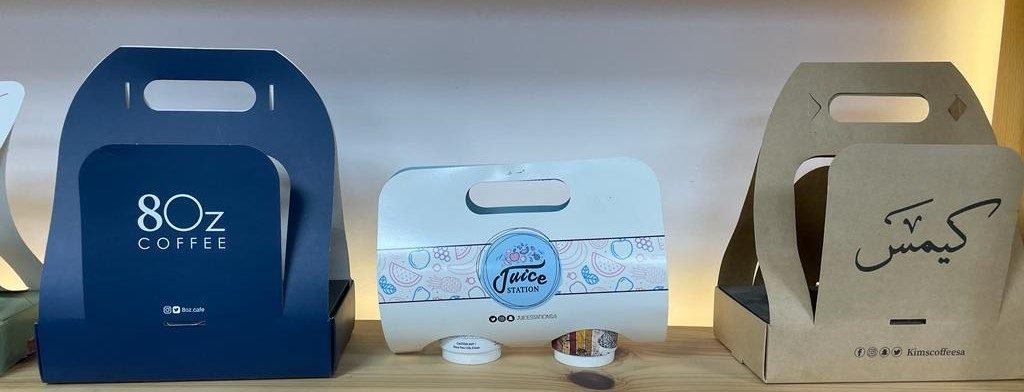
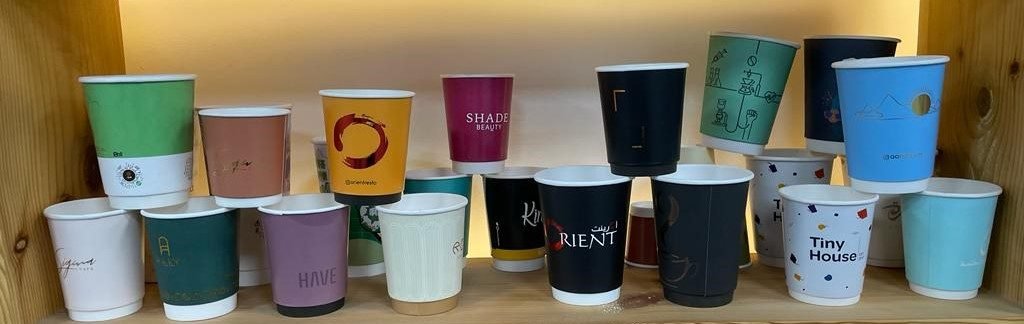
Product and gift boxes we designed, printed and finished for our clients.
Questions About Printed Paper Bags
What shop owners, café managers and brand teams want to know before ordering bags.
Which handles should we choose?
Flat paper strips for light items, twisted paper cord for everyday shopping, and rope or ribbon for boutique and gift bags that carry weight and are meant to be kept. Bakery and sandwich bags often have no handles at all. The weight of the product decides more than the look.
Can you print in colour on kraft paper?
Yes, but kraft is brown, so every ink comes out darker and less vivid than on white, and light colours sink into the paper. A single strong colour or a dark logo reads best. For bright brand colours or photographs, white paper is the safer choice.
What finishes can a bag have?
Matt or gloss lamination over the whole bag, a foil logo in gold, silver or a colour, and embossing that raises the logo from the paper. A single finish placed well tends to look richer than a crowd of them competing on one face.
Can you print food bags for bakeries and restaurants?
Yes, including bakery bags with a square base, grease resistant bags for oily food and bags with a clear window. The paper must be meant for food contact, and the food business confirms that it suits its products and keeps the supplier documents.
Can the bag say it is recycled or recyclable?
Only when the paper supplier's certificate supports it, and only in the words that certificate backs. Lamination and some coatings change how a bag is recycled, so settle the finish before you settle the wording.
Is there a sample before we commit to the whole order?
Yes. First a printed proof to settle colour and wording, then a sample bag that you fill with your real product and walk around with. The run is printed only after you have signed off on both.
What is the smallest quantity we can order?
It depends on the paper, the handle type and the finish. Plates, tools and set up are fixed costs, so a very short run costs more per bag. Share the first order and how often you expect to reorder, and the quote shows the price at each level.
Will reorders match the first batch?
A reorder uses the artwork, colour references and paper you approved the first time, and is compared with your signed proof. Switching paper or finish between orders is what usually makes a new batch look different, so hold both steady.
How should we store printed bags?
Flat in their cartons, in a dry and shaded place, off the floor and away from damp walls and heat. Humidity curls paper and heat can weaken the glue that holds the cords. Use the oldest cartons first so nothing sits for a whole season.
Where are the bags printed, and how do we start?
We have more than one location in the Kingdom, and your bags are printed in our own factory. Message 0567069088 on WhatsApp or use the quote page with what goes inside, a product photo, the look you like and roughly how many, and your itemised quote arrives within 24 hours.
New Bags for Your Shop or Event?
Tell us what your customers will carry and how heavy it is. Within 24 hours an itemised quote for your printed paper bags lists the paper, the handles, the finish and when they arrive.
More specific pages on this
If your question is narrower than this page, these are written for one question each.

