
Custom Printed Boxes
Custom Printed Boxes Drawn Around Your Product
Custom printed boxes are ordered by brands that sell something you hold in your hand: a box of dates or chocolate, a bag of coffee, a bottle of perfume or oud oil, a cream, a charger, a parcel leaving an online store. The box has three jobs at once. It protects the product, it tells the shopper what is inside, and it carries your brand to the shelf, the doorstep and the photo the customer posts. This page explains the box styles and when each fits, the board and finish choices, the dieline drawn from your product, the sample and proof before the run, and what to settle for the launch order and for repeat orders.
Why the Box Starts From the Product
A stock box chosen first and filled second always shows it: a product that rattles, a lid that bulges, a label sitting on a fold. Custom printed boxes reverse the order, and this is what changes.
A fit you can feel
The inner size is taken from the product itself, with its cap, pump, lid or cable, plus the insert that holds it. A bottle that does not move, a lid that closes with slight resistance and a tray that lifts out cleanly tell the customer someone thought about the product before they did.
Protection matched to the journey
A box that stays on a shelf needs stiffness and a clean face for print. One that rides in a delivery van needs corrugated walls, a closure that does not open on the way and an insert that keeps glass away from the sides. Knowing the route of the packaging decides the board before the artwork begins.
Information where the eye lands
Ingredients, the barcode, the batch and expiry area, usage notes and the product name in Arabic and English each get a panel on the dieline. Planned on the drawing, nothing runs over a fold or under a flap, and the barcode keeps the clear space a scanner needs around it.
One look across the range
Once the structure and the colour references are fixed, every flavour, size or scent shares one family look with its own accent colour. A reorder months later matches the first run, because it is printed from the same approved files and references.
What Comes With the Box From the Same Teams
Custom printed boxes are part of a whole launch, and this work comes from under the same roof.
Printing & Promotional Gifts
Seal stickers, thank you cards, printed tissue and the leaflet that goes inside the box, all from the same artwork as the packaging.
Acrylic & Wood Fabrication
Acrylic or wooden trays and inserts for premium sets, cut on the CNC and laser machines in our factory.
Promoters & Brand Ambassadors
Hosts who hand out boxed samples at a launch, a mall or a stand, with a supervisor keeping count of the stock.
Branding & Creative Studio
The packaging design itself: artwork laid on the dieline, bilingual copy, colour references and the family look of the range.
Digital Solutions
A QR code on the box that opens a usage video, a warranty page or a reorder link.
Experiences & Events
A launch event where the new packaging is revealed, with boxes stacked, opened and photographed on the day.
Social Media & Content
Product and unboxing photography of the finished boxes, ready for the store listing and the brand account.
Custom Exhibition Stands
Stands for food, beauty or electronics shows, where the packed range sits on shelving built for it.
Custom Printed Boxes: Styles and When Each Fits
Most brands need more than one style: a retail box for the shelf, a shipper for delivery and sometimes a premium box for the top of the range. These styles cover almost every product that needs custom printed boxes.
Folding cartons
Printed board that is cut, creased and glued, then delivered flat and folded into shape on your packing line or table. It is the usual box for cosmetics, coffee, sweets, supplements and small electronics. A tuck end suits a light product, and a lock bottom that snaps into place carries a heavier one without tape.
Rigid boxes
A thick greyboard shell wrapped in printed or textured paper, delivered already formed. Lift off lids, drawer boxes and book style boxes with a magnetic flap belong to this family. Perfume and oud boxes are usually rigid, with a lining and an insert shaped to the bottle or the oud container, and we make them in our own factory.
Mailer and shipping boxes
Corrugated board has a fluted middle layer that gives strength for its weight and soaks up knocks. A mailer folds from one sheet with a tuck front and side flaps, closes without tape, and can be printed outside for the doorstep and inside for the moment the lid lifts, which is where online packaging is judged.
Sleeves and belly bands
A printed band that slides over a plain box, a tray or a tin. A sleeve changes the look for a season, a flavour or a market without printing a new box, and it is often the economical way to give one structure many versions.
Inserts and trays
What holds the product inside: folded board with cut outs, moulded pulp, foam, or a cut wooden or acrylic tray for premium sets. The insert decides whether a set of bottles arrives intact and whether the opening looks arranged or jumbled.
Paper bags and food boxes
Carrier bags with rope or twisted paper handles, date and sweet boxes with windows, cake and pastry boxes, burger and meal boxes for restaurants and delivery. Surfaces that touch food need board and coatings meant for food contact, a decision the food brand makes with its food safety adviser.
From Dieline to Delivery: How Custom Printed Boxes Are Made
Packaging fails when the artwork is approved before the structure is proven, so these steps put the structure first.
The product, not only its measurements
Send a real sample of the product, or several if the range comes in different sizes. A drawing can miss a cap wider than the bottle or a cable that will not fold flat. Tell us where the packaging is going: a shelf, a courier, a hospitality table, or all of them.
The dieline drawn from the product
The dieline is the flat drawing of the box: cut lines, fold lines, glue flaps and the panels where artwork sits. It is drawn from the product with room for the insert and the board thickness, so the box you approve on paper is the box that closes.
A plain structural sample
Before any colour, a white or kraft sample is cut from the dieline and folded by hand. Put the product in it, shake it, close it, stack a few. The sample is the cheapest moment to change a flap, an opening or the depth of an insert.
Artwork on the dieline and a printed proof
Our studio lays the artwork on the approved dieline: front, sides, top, base and the inside if it is printed. You approve a printed proof for colour and for every word in Arabic and English, and production starts only after that approval.
Print, finishes, cutting and gluing
The sheets are printed and the finishes applied, then a cutting die made from the dieline cuts and creases each box, and folding cartons are glued at their side seam. Rigid boxes are wrapped and formed, and inserts are cut and fitted.
Packed flat, counted and delivered
Folding cartons and mailers travel flat in shipping cartons labelled with the design, the version and the count, so your warehouse stores them in a small part of the space they fill once folded. Rigid boxes travel formed and take more room. Where transport applies, it is a named line in the quote.
What Sets the Date for Custom Printed Boxes
Your quote
An itemised quote within 24 hours of receiving the brief and the product details.
The structural sample
Depends on the style and the insert. A folding carton is quicker to sample than a rigid box with a shaped insert.
The production run
Depends on the board, the finishes, the quantity and the number of versions, and the quote states the delivery date.
Shelf and launch graphics
Posters, wobblers and stand graphics for the launch are printed in 1 to 5 working days once the artwork is approved.
What Moves the Price of Custom Printed Boxes
We publish no price list, because custom printed boxes are priced from their structure, their board and their quantity. These are the lines that explain the difference between two quotes for what looks like the same packaging.
Structure
A tuck end carton is the simplest to make. A lock bottom, a window, a hanging tab, a drawer, a magnetic flap or a rigid shell each adds material and handling. Rigid boxes are largely wrapped by hand, which is why they sit at the top of the range.
Board and paper
Coated white board, kraft board, corrugated board in different flutes, textured wrapping papers: each has its own price, and a heavier board than the product needs is money spent for nothing.
Colours and ink coverage
Process colour printing covers most designs. A brand colour that must match exactly may need a spot ink of its own, and printing the inside of the box as well as the outside adds another pass through the press.
Finishes
Foil, embossing, spot gloss and soft touch lamination each add a step, and some need a tool made for your design, such as a foil die or an embossing die. One finish in the right place usually does more than several crowded onto the same panel.
Inserts and hand assembly
A plain carton goes straight to you. A box with a fitted insert, a ribbon, a lining or a set of products packed inside needs hand work on every unit, and that is a line of its own.
Quantity and versions
The cutting die, the foil die and the press set up cost the same for a small run and a large one, so the price per box falls as the quantity rises. Many flavours or sizes in one order share the structure, but each version has its own set up and its own count.
Send photos and measurements of the product, the box style you have in mind, the launch quantity and the reorders you expect, and an itemised quote for your packaging reaches you within 24 hours. Request a quote or message 0567069088 on WhatsApp. If the new packaging launches on your stand at a show, our guide to exhibition stand cost in Saudi Arabia shows how the rest of that budget is built.
Where the Box Meets the Rest of the Brand
A box rarely travels alone. The leaflet inside it, the sticker that seals it, the display that holds it and the launch around it all come from the same artwork. The printed pieces around your packaging are on our printing and promotional production page, and the packaging design and the family look of a range sit with the branding and creative studio. Boxes ordered as gifts rather than as product packaging, with pieces chosen for clients and staff, belong to corporate gifts in Saudi Arabia, and seasonal boxes of dates, coffee and oud for the holy month are covered under Ramadan corporate gifts. Once the boxes reach a store they need somewhere to stand: the floor units and counter displays that carry them are on the POSM production page, and clear risers and trays that show perfume, cosmetics or electronics at the counter are on acrylic display stands.
Board, Material and Finish Choices
These questions settle most of the packaging material decisions before the artwork begins, and they are the first things a serious box printer asks.
Does the box sit on a shelf or travel with a courier?
A shelf box needs a smooth, stiff board that prints sharply, usually coated white board for a folding carton. A box that ships on its own needs corrugated board. A retail carton that ships inside a mailer can stay light, because the mailer takes the knocks for it.
White, kraft or a textured paper?
Coated white board gives the brightest colours and the cleanest photographs. Kraft reads natural and suits coffee, bakery and handmade products, but it darkens every colour printed on it, so pale tones and fine text are tested on the sample. Textured and coloured papers belong to rigid boxes, where a foil logo looks its best.
Foil or embossing?
Foil lays a metallic or coloured film onto the board with heat and pressure: gold, silver or another colour, with a mirror shine or a brushed look. Embossing raises the logo from the surface, debossing presses it in, and either can be combined with foil on the same mark. Both need clean vector artwork and lines that are not so fine they get lost.
Spot gloss or soft touch?
Soft touch lamination gives the whole box a velvety matt surface that feels rich in the hand, but it marks with handling and scuffs at the corners in transit. Spot gloss is a clear, slightly raised varnish on chosen areas, a logo or a pattern, that catches the light against a matt background.
Does anything touch food?
Dates, chocolate, pastries and meals in direct contact with the box need board and coatings meant for food, sometimes with a grease barrier. The food brand decides what its product requires and is responsible for compliance, so ask the supplier for the material details your food safety adviser needs.
Packaging Mistakes That Show Up After the Run
Each of these is cheap to prevent at the dieline or the sample, and expensive once a full quantity is printed.
A box that does not fit the product
Measuring a bottle without its cap or a jar without its lid gives a box that will not close or a product that rattles inside it. A structural sample with the real product catches this before anything is printed.
Colour that drifts between reorders
The new run looks a shade lighter or darker than the last, and on a shelf the two stand side by side. Approved colour references, a kept proof and a record of the board and finish for every design are what hold the colour across reprints.
Text on a fold or under a flap
Ingredients, a barcode or a web address that crosses a crease cracks or disappears when the carton is folded. The safe area of every panel is marked on the dieline, and important text stays clear of folds and glue flaps.
Foil and dark colours cracking at the folds
Heavy ink and foil that run across a crease can crack and show white board underneath when the carton is folded. Either the design moves the foil off the fold or the crease is planned for it, and the sample shows this early.
Retail boxes damaged in delivery
A box made for a shelf goes straight into a courier bag and arrives dented and scuffed. Orders from a marketplace or a delivery app need shipping packaging: a mailer or a shipping carton around the retail box, and the product photo on the listing should match what actually arrives.
Flat stock stored badly
Flat cartons leaning on a wall, left in the sun or on a damp floor bow and take in moisture, then jam the packing line or fold unevenly. Keep them flat on pallets, wrapped, off the floor and away from heat, and use the oldest stock first.
Packaging, Print and Display Under One Roof
Design, large format print, CNC and laser cutting, acrylic and joinery all sit under one roof with us, and boxes, perfume and oud boxes, cards and sleeves are produced in our own factory. That is why custom printed boxes, the shelf display and the launch stand can share one approved artwork and one colour reference. We have worked for Ganache, Swarovski, Gucci Flora, Saudia, Oceanera and Johnson & Johnson MedTech.
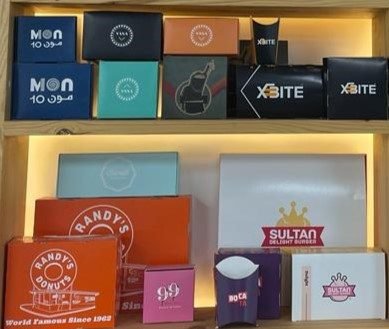
Boxes and Packaging From Our Factory
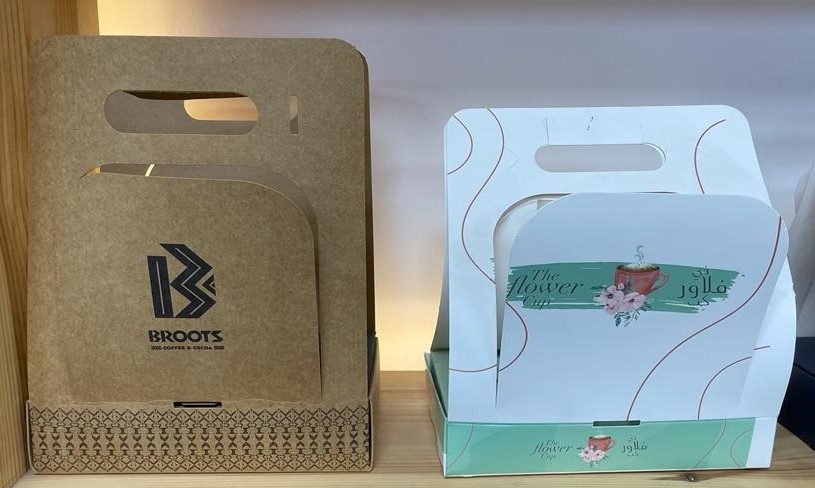
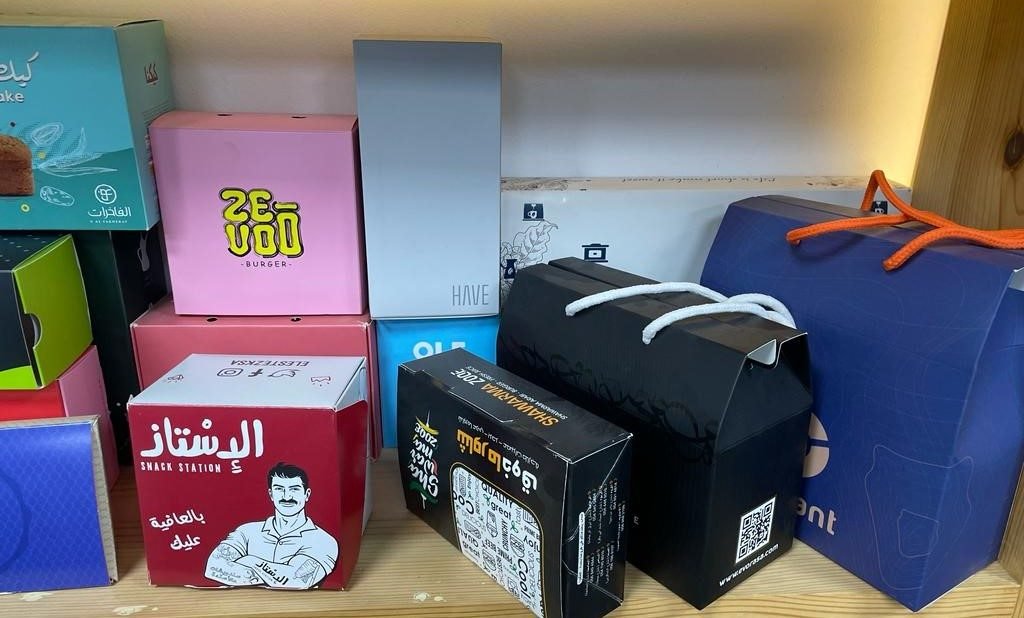
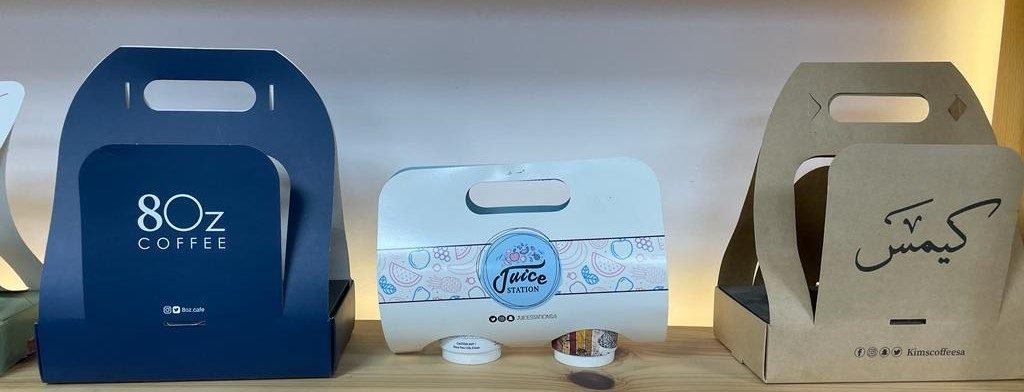
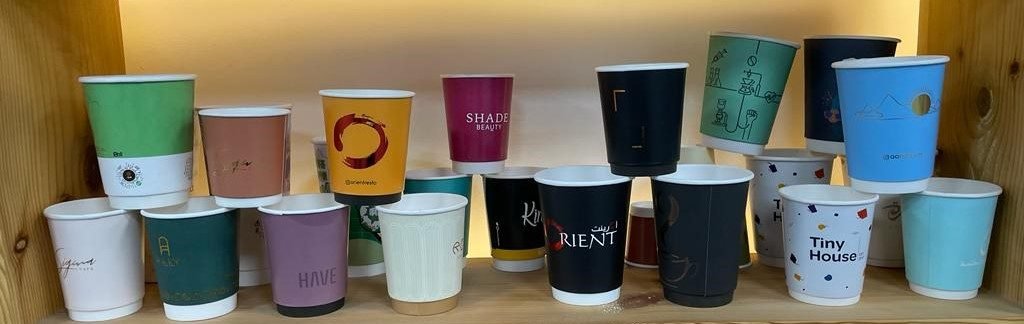
Product and gift boxes we designed, printed and finished for our clients.
Questions About Custom Printed Boxes
What brands ask before they order packaging.
What is a dieline, and who draws it?
A dieline is the flat drawing of a box with its cut lines, folds, glue flaps and artwork panels. Our studio draws it from your product and the box style you choose, and the print, the cutting die and the finishes are all built from that one drawing.
Can we see a sample before the full run?
Yes. A plain structural sample comes first, so you can test the fit with the real product, then a printed proof for colour and text. Production starts only after you approve both.
What quantity of custom printed boxes can we order?
It depends on the structure and the print. A run spreads fixed costs such as the cutting die and the press set up, so very small quantities cost more per box. Tell us the launch quantity and the reorders you expect, and the quote prices both.
Do you make perfume and oud boxes?
Yes. Perfume and oud boxes are made in our own factory, usually as rigid boxes with a lining and an insert shaped to the bottle or the oud container, with foil or embossing on the lid.
Can you print food boxes for sweets, dates and restaurants?
Yes, including date and sweet boxes, cake boxes, meal boxes and paper bags. Where the box touches the food, the board and coating are chosen for food contact. The food brand decides what its label must carry and is responsible for compliance, and we print the content it approves.
Will the colour match when we reorder?
Reorders are printed from the same approved files, colour references and board, and checked against the proof you signed. Changing the board or the finish between runs is the most common reason a reorder looks different, so keep those fixed from the start.
How are the boxes delivered and stored?
Folding cartons and mailers arrive flat, packed in labelled shipping cartons by design and version, and are folded when you pack. Rigid boxes arrive formed. Store flat packaging on pallets, off the floor, away from heat and damp.
What packaging works for online stores and delivery apps?
A mailer box that closes without tape and opens neatly, or a retail box inside a shipping carton, with an insert that stops movement. Printing the inside of the mailer gives the customer something to see when it opens, and a QR code can lead to a reorder page.
Do you design the packaging, or do we send the artwork?
Either works. Our studio can design the packaging from your brand guidelines, or lay your designer's artwork on our dieline and prepare it for print. In both cases you approve a printed proof before production.
Where are the boxes made, and how do we start?
We have more than one location in the Kingdom, and your boxes are made in our own factory. Send photos and measurements of the product, the style and the quantity on WhatsApp at 0567069088 or through the quote page, and an itemised quote follows within 24 hours.
New Packaging for Your Next Product?
Send the product, the box style and the quantity for the launch and the reorders. Within 24 hours you have an itemised quote for your custom printed boxes that names the board, the finishes, the inserts and the delivery date.
More specific pages on this
If your question is narrower than this page, these are written for one question each.

