
Riyadh Industry Week Exhibition Stand
Riyadh Industry Week Exhibition Stand 2027: Print and Pack, Plastics and Petrochem, Smart Logistics
Riyadh International Industry Week is the name Riyadh Exhibitions Company gives to its yearly gathering of industrial trade shows, and the next one runs from 26 to 29 April 2027 at the Riyadh International Convention and Exhibition Center. Three shows share the venue and the dates: Saudi Plastics and Petrochem, Saudi Print and Pack, and Saudi Smart Logistics. A Riyadh Industry Week exhibition stand is therefore rarely a rack of brochures. Visitors come to watch a press print, a line fill and seal, a moulding machine drop part after part, or a robot pick and stack. The booth is planned around that machine: its weight, its power and compressed air, the day it enters the hall and the distance at which people can stand and watch safely. From mid November 2026 to opening day is a little over five months, so every type of booth is still possible. Below are the facts the organiser has published, the questions a running machine raises with it, the booth formats that suit each of the three industries, and a schedule worked back from opening day.
Riyadh International Industry Week 2027 at a Glance
The dates and the venue are read from the organiser's own pages: the site of the week, the sites of the three shows and the corporate site of Riyadh Exhibitions Company all give 26 to 29 April 2027. A few blocks on those pages still carry details of earlier editions, and where we met one the table says so. Each entry in our Saudi exhibitions calendar is checked against its official page in the same way.
Riyadh International Industry Week: Saudi Plastics and Petrochem, Saudi Print and Pack, Saudi Smart Logistics
| Dates | 26 to 29 April 2027 |
|---|---|
| Venue | Riyadh International Convention and Exhibition Center |
| City | Riyadh |
| Organiser | Riyadh Exhibitions Company |
| Sector | Industry, print, packaging and logistics |
| Official page | riyadhiiw.com |
| Official name | Riyadh International Industry Week, shortened to RIIW on the organiser's pages |
|---|---|
| Shows in the 2027 week | Saudi Plastics and Petrochem, Saudi Print and Pack, and Saudi Smart Logistics, each with a site and a list of exhibit categories of its own |
| Edition numbers | The 22nd edition of Saudi Plastics and Petrochem and of Saudi Print and Pack, and the 5th edition of Saudi Smart Logistics, as their sites state |
| Opening hours | The FAQ pages of the shows give 1:30 PM to 9:30 PM for 26 to 29 April 2027. The home page of the week shows 4:00 PM to 9:30 PM for the first day, in a block that still names the 2026 dates, so confirm day one with the organiser |
| Booth space on the booking form | Inside space only, or inside space with the organiser's stand fitting, in sizes from 9 to 27 square metres and then more than 27 |
| Partner named on the sites | Messe Düsseldorf. The plastics show is presented alongside its K fair, and the print and pack show alongside drupa and interpack |
| Scale the organiser gives | The home page of the week speaks of more than 16,000 regional and international industry leaders. The show sites display 14,500+ square metres of exhibition space, 342 exhibitors, 17 countries and 24,300+ visitors, without saying which edition those figures describe |
| Previous edition | Held from 21 to 24 June 2026, according to the programme pages still on the site, so the 2027 week comes earlier in the year |
| Hall numbering | Stand numbers in the 2026 exhibitor list carry a hall prefix from 1 to 5. A hall plan by show for 2027 is not on the open pages |
| Conference and workshops | Held alongside the three shows. The FAQ pages say the sessions are free to attend and need pre-registration |
| Admission and access | Visitors under the age of 16 are not admitted. The show sites direct visitors to the Red line of Riyadh Metro, or by car to King Abdullah Road |
Official sources we read: Riyadh International Industry Week, organiser home page, Saudi Plastics and Petrochem, Saudi Print and Pack, Saudi Smart Logistics, Show FAQ page with the opening hours, Book your space form, Smart Logistics exhibit categories, Print and Pack exhibit categories, Plastics and Petrochem exhibit categories, Exhibitor list of the 2026 week, Riyadh Exhibitions Company. Sources last checked: 13 November 2026.
What the Organiser Decides When a Machine Runs on the Booth
We did not find the exhibitor manual, the service order forms or any build regulations on the open pages of the week or of its three shows. The booking form asks for the show, the kind of space and its size, and the sales team takes it from there. So nothing below is quoted as a rule. These are the points that shape a booth with a working machine on it, and the exhibitor manual from the organiser is the document that states each of them for 2027. Send it with your brief and the booth drawing follows it.
Power sized for the machine, not the lights
A press, an extruder or a filling line usually needs a three phase supply of its own, far above what lighting and screens draw. The order goes to the organiser as a load taken from the data plate of the machine, with the feed point marked on the booth plan. Ask for the order deadline first: a supply requested late is priced, or refused, as the organiser sees fit.
Compressed air and cooling water
Pneumatic clamps, grippers and blow moulding need air at a stated pressure and flow, and a mould or an extrusion line may need chilled water as well. Some halls sell an air connection and others expect the exhibitor to bring a compressor or a closed loop chiller. Ask which applies, and where your own unit may stand, because it adds noise, heat and a second electrical load.
Floor loading and point loads
A machine stands on a handful of levelling pads, so its weight lands on small patches of floor. Send the organiser the total weight, the footprint and the number of support points, and ask in writing for the permitted floor loading in your hall. The answer decides whether spreader plates are needed and whether a raised floor may pass under the machine at all.
The machine arrives before the walls
Heavy equipment is rolled or lifted onto its marks while the plot is still empty. Ask when heavy exhibits may enter, who is allowed to drive a forklift inside the hall, how a lifting slot is reserved and what the door on your route measures. The booth build is then scheduled behind that slot, not ahead of it.
Guards, barriers and the emergency stop
Moving parts within reach of visitors fall under the safety rules of the organiser and the venue. Expect to be asked for fixed guards or clear screens, a set distance between the aisle and the machine, and an emergency stop your staff can reach. Show the demonstration on the drawing you submit, so it is approved together with the booth and not questioned on opening day.
Noise, heat and fumes
A granulator, a chiller fan or a hot melt unit is louder and warmer in an exhibition hall than on a factory floor. Organisers normally keep the right to stop a demonstration that disturbs the neighbours, and may restrict solvents, fumes and open heat. Ask for the limits, then plan the run times and the direction the machine faces.
Raw material, waste and samples
A running line turns resin, film, board or ink into product and scrap. Ask how much raw material may be kept on the booth, where waste goes during show hours and whether samples may be handed to visitors. Flammable liquids are commonly limited to small quantities, stored in closed containers.
Space only, or space with stand fitting
The booking form lists inside space only and inside space with the organiser's stand fitting. A working machine almost always needs the first. If you take the fitted option, ask for its contents in writing, walls, fascia, carpet, sockets and lights, and whether anything may be fixed to the panels, before an upgrade is designed around it.
The booth drawings and technical sheets requested by the organiser and the venue are prepared by us, and the electrical load is worked out from your machine list. Placing the orders stays with the exhibitor, and granting approval stays with the organiser and the venue. The forms and dates of the last month are laid out in our exhibitor checklist.
Booth Types That Suit a Machinery and Process Week
Here the format follows from one question: does something run on the booth? These are the six we would put in front of an exhibitor at any of the three shows, from the heaviest to the lightest.
Raw space with a machine island
Space only, with the machine in the middle on a floor chosen for its load and open on the sides visitors approach from. A tall branded back wall or tower carries the name above the machine, and the store and the electrical board sit behind it. The booth plan starts from the machine drawing, never from the walls.
Custom booth with a demo line
For a packaging line or a print and converting sequence shown from end to end: infeed on one side, finished packs on the other, and a raised viewing edge along the aisle. Allow 6 to 8 weeks between the brief and opening day, or 8 to 10 when the plot is an island.
Sample wall booth for printers and converters
A carton maker, a label printer or a flexible packaging converter sells finished work, not a machine. The booth is a lit wall of packs arranged by the buyer's sector, a counter where they can be handled and a table for the quotation. It sits comfortably on 18 or 36 square metres.
Gallery booth for materials and moulded parts
Resin producers, compounders and moulders show granules in clear acrylic columns, moulded parts on lit shelves and the process as one large diagram. Nothing runs, so the budget goes into light, acrylic and a meeting room with a door.
Modular booth for a distributor or a software firm
An agent for several machine makers, or a logistics software company, needs screens, a counter and brand panels that change every year. A reusable frame takes new graphics in 2 to 4 weeks and rests in our storage between shows.
Upgraded shell scheme for a first time exhibitor
The fitted space from the organiser, given printed wall graphics, a reception counter, sample shelves and stronger light, all free standing so the system panels stay untouched. It is ready in 2 to 3 weeks and makes a sensible first booth for a company testing the Saudi market before it ships a machine.
Riyadh Industry Week Exhibition Stand: the Countdown to 26 April 2027
Every row is worked out backwards from 26 April. As of mid November 2026 none of the stages has passed, so a custom booth, a machine island and a modular kit can all be planned on the normal schedule. Two things make a machinery project start earlier than the first row suggests. The machine has its own shipping and customs clock, and its drawing has to reach us before the design is approved, because the booth is drawn around it. And Ramadan and Eid al-Fitr are expected in February and March 2027, inside the briefing and approval weeks, when decisions and deliveries slow down. What happens in each of those stages is described in how long an exhibition stand takes.
Riyadh International Industry Week: Saudi Plastics and Petrochem, Saudi Print and Pack, Saudi Smart Logistics · 26 to 29 April 2027
| Date | Stage | Status |
|---|---|---|
| 1 March 2027 | The brief, the space contract and the exhibitor manual in hand: a custom stand starts here | Ahead |
| 15 March 2027 | Design approved, and drawings sent to the organiser where it asks for them | Ahead |
| 29 March 2027 | Last sensible start for a modular stand with new graphics | Ahead |
| 5 April 2027 | Graphics go to print on the final panel sizes | Ahead |
| 12 April 2027 | Full test assembly in the factory, and the last start for a rental kit from stock | Ahead |
| 19 April 2027 | Transport booked for the build window the organiser sets | Ahead |
| · | Installation in the hall, inside the hours written in the exhibitor manual | Per the exhibitor manual |
| 26 April 2027 | Opening day | Ahead |
| 29 April 2027 | Closing, then dismantling in the organiser's window | Ahead |
What is still realistic for this edition · 165 days to openingThere is time for a custom stand on the normal schedule, provided the design is approved on its date.
Status worked out on 12 November 2026.
What Works on the Industry Week Floor
The people in these halls own factories, run production, buy packaging or manage warehouses. They want to see the thing work, take a sample away and then sit down over a price. A booth that offers all three, in that order, does its job.
A raised viewing edge
People watch a machine from one side at a time. A low step along that side, with a rail and a clear screen where the guard calls for one, lets the second row see over the first and keeps everyone at the same distance from the moving parts. The step needs a marked border, and a ramp wherever the organiser asks for one.
Run to a timetable
A machine that runs all evening wears out its operator, fills the waste bin and tires the neighbours. Post the run times at the aisle, keep each run short and use the pauses for questions. Visitors return for a time they have read.
A sample table at the outfeed
What comes off the machine is the proof. Put a table where the product leaves the line, with someone who labels each sample with the material, the machine setting and the date, and bags it. The sample that lands on a buyer's desk the following week is your follow up.
A meeting corner that is truly quiet
A price cannot be discussed beside a running extruder. Place the meeting corner on the side of the booth farthest from the machine, behind a solid wall, with a ceiling if the rules allow one, and give it a door. A small room that is quiet is worth more than a large open lounge.
Print and pack: a wall of packs
Printers and converters should show finished work as a wall: cartons, pouches, labels and sleeves on shallow lit shelves, grouped as food, pharmaceutical, cosmetic and industrial. Keep a loose piece of each within reach, so it can be opened, folded and felt.
Plastics and petrochem: granules, parts and one diagram
Raw material is hard to display and easy to explain. Stand clear columns of granules by grade, place a moulded part cut in section beside each, and draw a single diagram from feedstock to finished product on the main wall. A buyer should trace his part back to your grade without asking.
Logistics: live screens and a scaled model
A warehouse or fleet system is shown on a few large screens with data moving, each with a person beside it, mounted so a standing visitor reads without looking up. Racking, sorters and vehicle fleets are too large to bring onto a booth, so a scaled model on a plinth under a clear cover lets a visitor point at the dock or the aisle he is asking about. Brief the model maker when the space is booked.
A conveyor or a robot in motion
A short conveyor loop, a palletising arm or a mobile robot on a marked path brings movement to a booth without a production line. It still needs a fenced zone, a floor with no thresholds across its path, a power point of its own and the organiser's approval for anything that moves by itself.
When your product crosses two shows
A labelling machine sits naturally in Saudi Print and Pack, yet Saudi Smart Logistics also lists labelling systems, pallet wrappers and packaging machinery among its categories, and plastic packaging can be read as plastics or as pack. Choose by the visitor who signs the order: a plant or production manager, a brand owner's packaging buyer, or the head of a warehouse and supply chain.
Read Next, Before the Brief
The week is held in Riyadh, and what it takes to build in the capital, hall access and install crew included, is covered on our page about exhibition stand builders in Riyadh. The other industrial dates of the season, each read from its organiser, are in the Saudi exhibitions calendar for 2026 and 2027. A machine changes the budget more than the walls do, and the lines to expect are set out in exhibition stand cost in Saudi Arabia. A distributor or a software company can start from modular and portable stands, and a demo line or a machine island from custom exhibition booths. Samples and packs need light of their own, which is the subject of exhibition stand lighting.
Mistakes Machinery Exhibitors Make Before the Hall Opens
Each of these is settled on paper months ahead, or on the hall floor the night before opening.
Drawing the booth, then asking about the machine
Walls, floor and counters are designed, and then the machine drawing arrives with its service side facing the back wall. Start from the machine: its footprint, the swing of its doors, the side the operator works from and the side the product leaves from.
Guessing the electrical load
A figure copied from last year's booth trips the breaker the first time the heaters and the drive start together. Take the load from the data plate and the start up current from the maker, then add the booth lighting and the screens on top.
Forgetting the compressor
The air supply is remembered on site, when the grippers refuse to close. Decide months ahead whether air comes from the hall or from your own unit, and where that unit will hide.
A machine only one person can run
The whole demonstration hangs on a single technician who is also wanted in every meeting, or whose travel is confirmed late. Train a second operator, and lay out the booth so the operator stands inside the guard and the salesperson outside it.
No plan for scrap
Purgings, trimmed film, misprints and start up rejects pile up beside the machine by the second evening. Give waste a closed bin inside the booth and a route out before the doors open each day, and keep it out of the photographs.
A header only an engineer understands
The week brings plastics processors, printers, brand owners and warehouse managers through the same doors. A fascia that carries only the model number tells most of them nothing. Say what the machine makes and for which industry, in words that can be read from the aisle.
Drawn Around Your Machine, Test Assembled in Our Factory
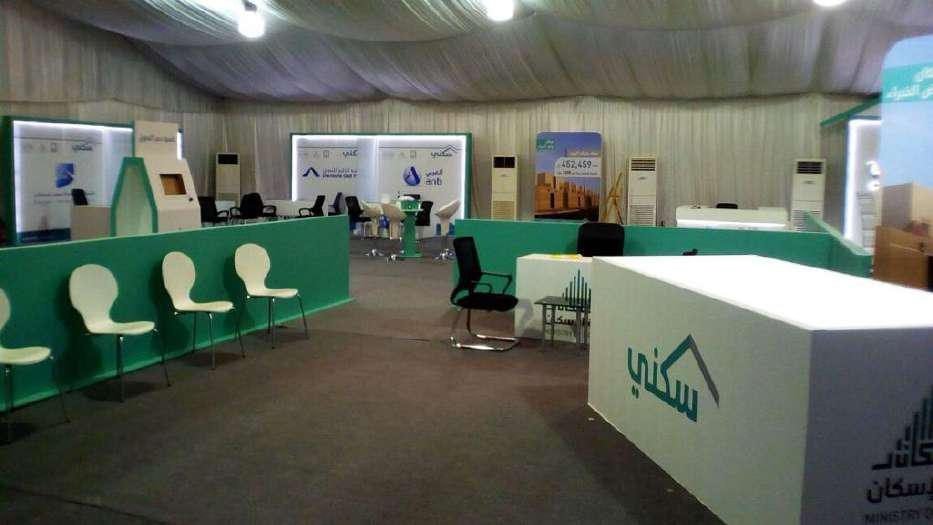
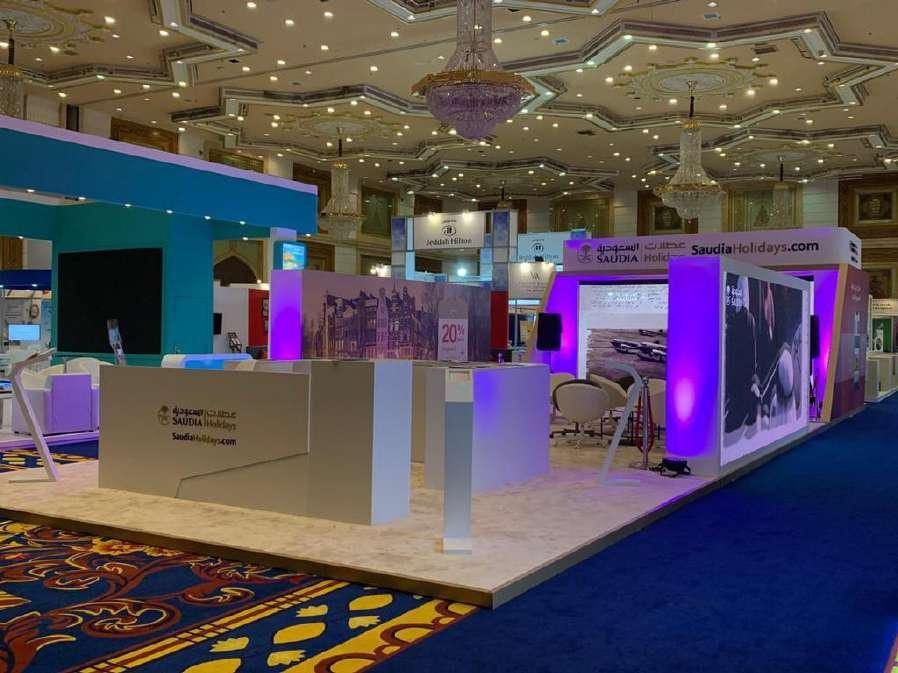
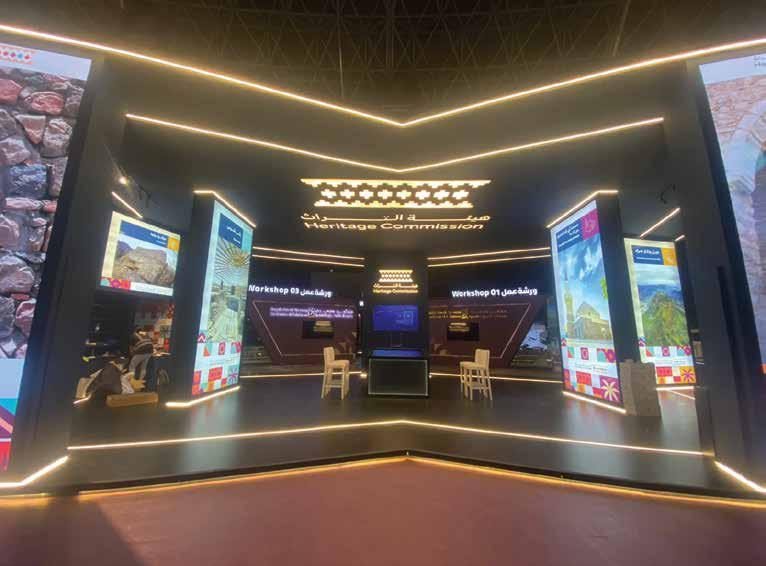
Our stands and displays have stood for Kinan, the Heritage Commission, Saudia Holidays, Johnson & Johnson MedTech and Cartoon Network. Design, CNC and laser cutting, joinery, paint, acrylic and large format print are all done under one roof, which means the viewing step, the clear screens, the sample shelves and the lit sign of one booth come from a single team. The footprint, the weight and the service side of your machine go on the booth drawing from the first day. Before it ships, each booth is fully test assembled in our own factory, and the same team installs it in the hall, stays for the opening and dismantles it after the close. We have more than one location in the Kingdom. We work for exhibitors, on the space they have booked, as an independent builder. We are not an official contractor of Riyadh International Industry Week, of its organiser or of the venue, and permits and approvals remain theirs to give.

Questions About a Riyadh Industry Week Exhibition Stand
Asked by machine makers, converters, material suppliers and logistics firms preparing for April 2027.
When and where is Riyadh International Industry Week 2027?
From 26 to 29 April 2027 at the Riyadh International Convention and Exhibition Center, according to the organiser's site and the sites of the three shows. The show FAQ pages give the hours as 1:30 PM to 9:30 PM. The home page of the week shows a 4:00 PM start on the first day, in a block that still carries the 2026 dates, so check day one with the organiser.
Which shows make up the week in 2027?
Saudi Plastics and Petrochem, Saudi Print and Pack, and Saudi Smart Logistics, all organised by Riyadh Exhibitions Company. Some older lines on the official pages still speak of four shows or name Saudi Smart Manufacturing. The organiser's corporate site now lists that sector separately, as Industrial Transformation Saudi Arabia, with its own dates later in 2027.
Our product fits two of the shows. Which one do we book?
Book the show your buyer walks first. Machinery, moulds and raw materials for processors belong in Saudi Plastics and Petrochem, printing, converting and packaging machines in Saudi Print and Pack, and storage, handling, automation and fleet systems in Saudi Smart Logistics. One form covers the plastics and the print and pack shows, and the logistics show takes bookings on its own site, so tell the sales team which neighbours you want.
Can a machine run on the booth?
In most cases yes, on conditions the organiser sets: guarding, a distance from the aisle, limits on noise and fumes, and a demonstration shown on the approved drawing. The exhibitor manual for 2027 states what applies, and nothing on this page is quoted from it. We design the clear screens and the viewing edge to that document.
Who orders power and compressed air, and when?
The exhibitor orders them from the organiser, on its forms and by its deadline. We work out the load from your machine list and mark the feed point on the booth drawing, so the order matches what will be plugged in. Ask the organiser whether compressed air is supplied in your hall or whether you bring a compressor.
Is the exhibitor manual public?
We did not find it on the open pages of the week or of the three shows, and no build heights, deadlines or build hours are published there either. It comes from the organiser once the space is contracted. Send us your copy with the brief: the booth is drawn to its heights and its dates.
Is there still time for a custom booth with a machine?
Yes. Brief to opening is 6 to 8 weeks for a custom booth and 8 to 10 for an island, against a little over five months left in mid November 2026. The machine is the tighter clock: confirm its shipping date, send its drawing with the brief, and allow for Ramadan and Eid al-Fitr, expected in February and March 2027.
What size of booth does a machine need?
Start from the footprint, then add the service clearance the maker asks for, the guard distance the organiser sets and room for people to watch. The booking form offers sizes from 9 to 27 square metres and above. An exhibitor with samples only can work on 18, while a running line usually needs 36 or more.
We sell software or services. Do we need a custom build?
Usually not. A modular booth with screens, a counter and a small meeting table does the work, takes 2 to 4 weeks with new graphics and can be stored with us for the next show. An upgraded shell scheme takes 2 to 3 weeks, and a rental kit from stock 5 to 10 working days.
What do you need from us to quote?
The show and the space size with its open sides, the machine drawing with weight, footprint and services, a note of what must run and what is only displayed, and the manual when you have it. The itemised quote is with you within 24 hours, and where transport applies it is a named line in the quote.
Exhibiting at Riyadh International Industry Week 2027?
Tell us which of the three shows you booked, the space size and its open sides, and send the drawing of the machine or the list of what goes on display. An itemised quote, a first concept for the booth and a schedule counted back from 26 April reach you within 24 hours. Phone 0567069088, or message us on WhatsApp.

