
Corporate Stationery Printing
Corporate Stationery Printing for an Office That Speaks With One Voice
Corporate stationery printing covers every sheet that carries your company name: the letterhead a manager signs, the envelope that carries it, the invoice book at the cashier, the delivery note a driver hands over, the folder on a client's desk and the calendar that stays there all year. When each piece is ordered from a different printer at a different time, the logo colour drifts, the phone numbers disagree and the tax number is wrong on one of them. This page explains how a full set is planned, laid out in Arabic and English, printed and kept ready for the next order, so a new company or a refreshed brand gets its paper right from the start.
What a Planned Set Gives a Company
Most offices collect their paper piece by piece, as each department runs out of something. When corporate stationery printing is treated as one set from the beginning, both what clients see and what your team deals with change.
One identity on every sheet
The logo sits in the same position, at the same proportion to the page and in the same colour on the letterhead, the envelope flap, the folder cover and the receipt book. A client who receives a quotation, an invoice and a delivery note from you in the same week sees one company, not a different supplier behind each sheet with its own reading of your brand.
Arabic and English that agree
A bilingual letterhead is a layout question before it is a translation question. Arabic reads from the right and English from the left, so the two blocks usually mirror each other across the page. The name, address and contact lines say the same thing in both languages, with one style of numerals used throughout: Eastern Arabic or Western digits, never a mix of the two.
Registration lines checked in one place
The commercial registration number, the tax registration number, the national address and the phone lines appear on almost every piece. They are collected in a single details sheet that your finance or admin team confirms, and every file takes its text from that sheet, so a mistyped digit is caught before printing rather than found on a full carton of envelopes afterwards.
Paper and screen that match
Most letters now leave the office as a PDF attached to an email. When the digital letterhead template is built from the same artwork as the printed sheet, the letter emailed today and the letter posted tomorrow look alike, down to the margins and the order of the footer.
Printed and Made Alongside Your Stationery
Corporate stationery printing is often the opening step of a new identity, and these services work from the same approved files.
Printing & Promotional Gifts
Notebooks, mugs and bags for the reception desk and for visitors, carrying the logo from the same files as your stationery.
Acrylic & Wood Fabrication
The logo on the reception wall, door and desk signs and award plaques, cut in acrylic in our own factory to match the printed identity.
Promoters & Brand Ambassadors
Hosts with a supervisor for an opening or an open day, handing guests folders and printed material in the new identity.
Branding & Creative Studio
The logo, colour references and layout rules that every stationery file follows, settled before the first piece is printed.
Digital Solutions
Email signatures, a digital letterhead and document templates that match the printed set, and a QR code on the folder that opens your website.
Experiences & Events
The launch day of a new identity, with stationery, signs and giveaways ready together when the doors open.
Social Media & Content
Photographs of the new stationery set for the announcement of your refreshed identity.
Custom Exhibition Stands
When the company exhibits at a show, the stand, its graphics and the folders handed to visitors come from one team.
What Corporate Stationery Printing Usually Includes
No two companies need exactly the same list, but these are the pieces asked for most, grouped by the job each one does.
Letterheads and compliment slips
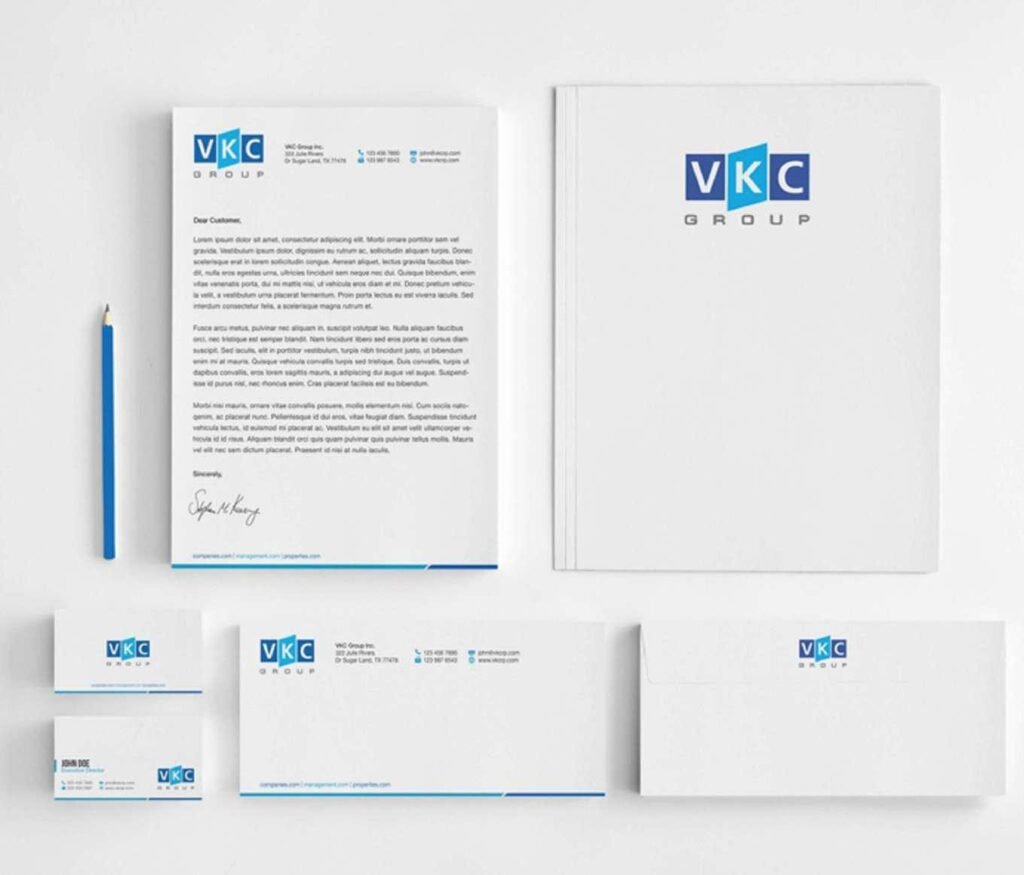
The letterhead carries the logo at the top and the registration and contact lines in the footer, with the middle of the page left clear for the letter itself. The compliment slip is its short relative: a strip with the logo and a line of greeting that goes into a parcel or is clipped to a returned document when a full letter would be too much.
Envelopes in several formats
A long envelope takes a folded letter, a flat envelope takes a document that must not be folded, and a large pocket envelope with expanding sides carries a thick tender file. Each comes with or without a window, opens on the long or the short side, and closes with a peel and seal strip or a gummed flap. The logo and return address go on the front or on the flap.
Invoice, receipt and delivery books
Invoice books, receipt vouchers, payment vouchers, delivery notes and purchase orders are printed as numbered books, usually on carbonless paper, also called NCR, so that writing on the top sheet appears on the sheets beneath without a separate carbon. The original goes to the customer, and the tinted copies stay in the book or go to accounts.
Folders and presentation folders
A folder with an inside pocket holds a quotation, a contract or a set of brochures, and keeps loose sheets together on the way to a meeting. A presentation folder is the heavier version for tenders and board meetings, sometimes with a spine that takes a thicker stack of documents.
Notepads, calendars and the new starter pack
Branded notepads sit in meeting rooms and at reception and end up in visitors' bags. A desk calendar stays on a client's desk for a whole year, and a wall calendar in a site office or a warehouse. The pack for a new employee gathers an ID card, a notepad, a folder and a welcome letter on company paper, ready before the first day.
Certificates, ID cards and seal stickers
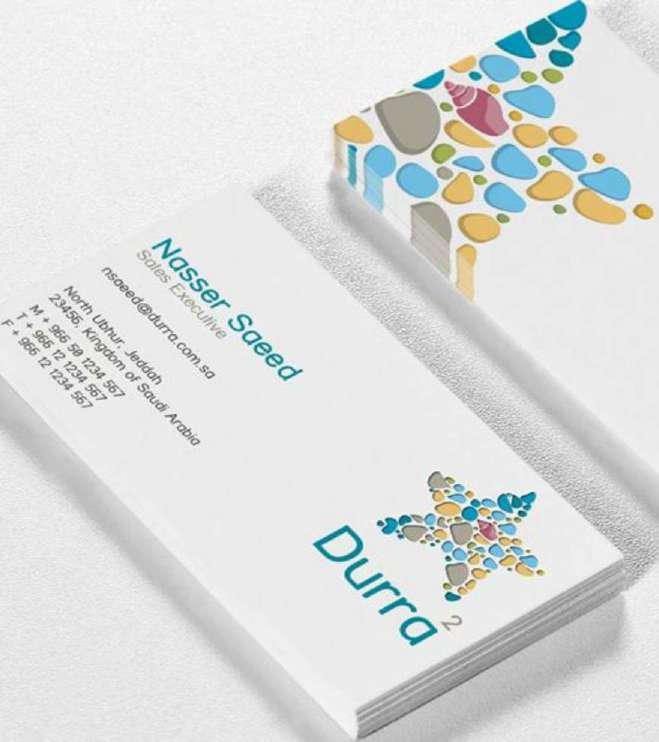
Training and recognition certificates, staff ID and access cards with each person's name and photograph, and printed or foil seal stickers that close an envelope or mark an official certificate. Business cards belong to the same set and have their own page within our print service.
How a Stationery Set Goes From Details Sheet to Departments
The press run is the short part of corporate stationery printing. The order of the decisions before it is what keeps a full set consistent.
A list of pieces and a details sheet
We start with the pieces each department really uses and a single details sheet: the company name in Arabic and English, the commercial registration number, the tax registration number, the national address, the phones, the email, the website and any branch or department lines. Your finance or admin team confirms the sheet before any design begins.
One layout system for both languages
The letterhead is designed first, because every later piece follows its grid: where the logo sits, how the Arabic and English blocks mirror each other, the typeface for each language and the order of the footer. Envelopes, folders and books then take their positions from it.
Paper, colour and finish from samples
Paper is chosen by touch, not from a name on a list. We agree the letter paper, the folder board and the finishes from physical samples, and match the logo colour on the papers actually chosen, because one colour looks different on uncoated and on coated stock.
A proof for every piece
You approve a proof of each piece showing every line of text, the fold and window positions and, for books, the numbering, the copy colours and where the perforation falls. A letter printed from your own office printer onto a proof sheet shows whether the template and the paper agree.
Printing, numbering and binding in our own factory
The set is printed in our own factory, then numbered, collated into carbonless sets, perforated, bound into books, creased and folded as each piece requires. Printed pieces from an approved file are ready in 1 to 5 working days, and numbered books take as long as their numbering and binding need.
Packed per department, files kept
Each department or branch receives its own carton, marked with its name from the distribution list you send. The approved files, the colour references and the last number used in each book series are kept, so the next order starts exactly where this one ended.
How Long a Stationery Order Takes
Letterheads, envelopes and slips
Printed in 1 to 5 working days once the artwork is approved.
Numbered carbonless books
Depends on the copies in each set, the numbering and the binding. The quote states the date.
A full set with a new design
Depends on how quickly the details sheet and the layouts are approved, and the quote dates each stage.
Your quote
An itemised quote within 24 hours of receiving the list of pieces and your logo.
What Sets the Price of Corporate Stationery Printing
We publish no price list, because each set is priced from its pieces, papers and finishes. These are the lines that move the number, so offers can be compared on the same terms.
Pieces and versions
Each piece is prepared for press once, so the cost per sheet falls as the run grows. A letterhead in a single version costs less per sheet than the same total split into a version per branch or per department, because each version needs its own file, check and setup.
Paper and board
Plain uncoated paper is the economical end. Textured, cotton or tinted papers for letters and heavier board for folders and certificates cost more, and they earn it on the pieces clients hold in their hands.
Colours on the sheet
Full colour suits a logo with photographs or gradients. A logo in a single brand colour can be printed as a matched spot colour, which holds its shade more steadily across long runs and reorders.
Copies, numbering and binding
In invoice and receipt books, the copies in each set, the sequential numbering, the perforation line and the type of binding each add a step, and they are priced per book.
Finishes
Foil, embossing, spot gloss and soft touch lamination each add a step, and some need a die made for your logo. One finish on the folder cover or the certificate usually does more than several spread over the whole set.
Names and packing
Names on ID cards and certificates, a version per branch and packing per department are named lines. Where transport applies, it is a named line in the quote.
Send your logo, the list of pieces each department uses and a photo of any stationery you have now. An itemised quote reaches you within 24 hours. Request a quote or message 0567069088 on WhatsApp. If the new folders and letterheads are going to a trade show with you, our guide to exhibition stand cost in Saudi Arabia shows how the rest of that budget is built.
Tax Numbers and Invoice Books: Who Decides What They Say
Corporate stationery printing puts on paper details that someone in the company answers for. The commercial registration number, the tax registration number and the national address come from the company itself, and what a tax invoice must show is set by the Zakat, Tax and Customs Authority, not by the printer. Many companies registered for tax now issue their invoices from an electronic invoicing system, so before ordering printed invoice books, ask your accountant which documents still belong on paper; receipt vouchers, delivery notes and payment vouchers often do. We print the wording and numbering you approve exactly as approved and check that the numbers agree across every piece, but the content of a tax document is your accountant's decision. The printed company profile that goes inside your folders is designed under company profile design, and the labels on your products come from sticker and label printing. Shipping cartons and product boxes in the same identity are on custom printed boxes, and a welcome box for new staff, with their stationery inside, is part of corporate gifts in Saudi Arabia. When the company hosts a conference or a launch, the event takes its look from event branding, and the outdoor and hall banners from banner printing.
Printed Letterhead or Digital Template, Books or a System
Not every sheet needs printing in bulk, and good corporate stationery printing starts by deciding what does. These questions separate what goes to press from what stays a file on the computer.
Do your letters leave as paper or as PDF?
If most letters are emailed, a digital letterhead template and a smaller printed run for signed originals are enough. If letters are printed and stamped every day, pre-printed letterheads show the logo more crisply than an office printer can, and the template then prints only the text in the clear area.
Which documents need numbered books?
Where a document is written by hand at a counter, in a delivery van or on a site, a numbered carbonless book still does the job well. Where it comes out of an accounting or invoicing system, printing books for it only creates a second series that someone has to reconcile.
One version or one per branch?
If branches differ only in address and phone, a shared letterhead that lists every branch in the footer keeps the set simple. If each branch issues its own documents, each needs its own book series and its own version, so that numbers never overlap between branches.
How much should we order?
Order for a period you can see clearly. A company about to move offices, change a phone line or update its registration details should order a smaller run now and the main run after the change, instead of throwing away cartons of envelopes printed with the old address.
Which finish is worth paying for?
Put the finish where hands and eyes go: foil or embossing on the folder cover and on certificates. Keep the letterhead plain enough to run through a laser printer and to take a pen and a stamp.
Mistakes That Show Only After the Cartons Arrive
Each of these mistakes in corporate stationery printing is caught at the proof stage, and each costs a full reprint when it is not.
An address that misses the window
The address block on the letter template and the window on the envelope are often designed separately, and every office folds a letter slightly differently. The window position, the fold marks and the address area are drawn together, then tested by folding a printed proof into a sample envelope.
A wrong digit in the tax number
A registration or tax number typed from memory, or copied from an old document, ends up on every piece of the set. Numbers are taken only from the confirmed details sheet and read back against the original certificate at the proof.
Glossy paper that refuses a pen
A coated gloss letterhead looks rich, then smears under a signature and leaves the company stamp wet. Letterheads, invoice books and anything that is signed or stamped are printed on uncoated paper.
Numbering that repeats on a reorder
A new batch of receipt books that starts from the same number as the last batch gives two documents one number. The last number in each series is recorded with the files, and every reorder begins after it.
Arabic and English that disagree
The English block shows the new phone number while the Arabic still has the old one, or the numeral style changes from one piece to the next. Both blocks are proofread together, line by line, against the same details sheet.
A calendar with the wrong dates
A desk calendar shows Hijri and Gregorian dates side by side, and it goes to print before the year begins. Dates are checked against the official Umm al-Qura calendar, and holidays are shown as announced, since some depend on the sighting of the moon.
Design and Print Under One Roof
Design, large format print, acrylic, CNC and laser cutting, joinery and installation sit under one roof with us, so the colour you approve on the letter paper is the colour on the folder, the reception sign and your stand at the next show. Companies we have worked for include Kinan, Ganache, Oceanera, Al Khaleej Al Gharbiya, Saudia and Johnson & Johnson MedTech.
Print Work From Our Factory
Print jobs we delivered: offset, digital, boxes and labels.


Questions About Corporate Stationery Printing
What companies ask before they order their paper.
What does a corporate stationery set include?
Usually a letterhead, envelopes in a few formats, compliment slips, folders and numbered books for invoices, receipts or deliveries. Many companies add notepads, a desk calendar, certificates, staff ID cards and a pack for new employees. We start from the pieces your departments really use, so nothing is printed only to sit in a store room.
Can the letterhead be in Arabic and English?
Yes, and most companies in the Kingdom use both. The two blocks usually mirror each other, Arabic on the right and English on the left, and both are proofread against one details sheet. The numeral style is chosen once and used on every piece.
Which details should appear on our letterhead?
The name, logo, address, phones, email and website are the usual base, and many companies add the commercial registration and tax numbers in the footer. Which lines a particular document must carry is a question for your accountant and the relevant authority. You send the details, and we place them in a fixed position on every piece.
What is carbonless paper in an invoice book?
It is paper coated so that the pressure of a pen on the top sheet writes the same text onto the sheets beneath, without a separate carbon sheet. The copies are usually in different tints so each is easy to route: the original to the customer, a copy to accounts and a copy that stays in the book. A card slipped under the set stops the writing reaching the next one.
Can you number invoice and receipt books?
Yes. Each set carries a printed sequential number, and you choose the starting number. The last number of each order is recorded, so the next books continue after it with no gap and no repeat.
Do you make a digital letterhead that matches the print?
Yes. The digital template is built from the same artwork, so letters sent as PDF look like the printed ones. Where pre-printed paper is used, a version of the template without the logo and footer prints only the text in the clear area.
Which envelope formats should we order?
Most offices need a long envelope for folded letters, a flat envelope for documents that must stay unfolded and a large pocket envelope for files and tenders. A window envelope saves writing an address each time, but it only works when the letter template places the address exactly behind the window.
Can we reorder later without a new design?
Yes. The approved files, colour references and the numbering record are kept, so a reorder needs only the piece and the quantity. If a detail has changed, such as a phone number or an address, it is updated in the details sheet first and a new proof is sent.
How long does corporate stationery printing take?
Letterheads, envelopes and compliment slips from an approved file are printed in 1 to 5 working days. Numbered carbonless books and pieces with foil or embossing take longer, depending on the copies, the numbering and the finish, and the quote states the date.
Where is it printed, and how do we start?
We have more than one location in the Kingdom, and your stationery is printed in our own factory and packed separately for each department. Send your logo and the list of pieces on WhatsApp at 0567069088 or through the quote page, and an itemised quote follows within 24 hours.
Your Company's Paper, Planned as One Set
Send your logo, the list of pieces and the details sheet if you have one ready. Within 24 hours you receive an itemised quote that names each piece, its paper, its finish and its packing.
More specific pages on this
If your question is narrower than this page, these are written for one question each.

