
Truss Rental
Truss Rental Sized From What It Will Carry
Truss rental comes up before almost every opening, show and ceremony: a gate at the entrance, a roof over the stage, a light bridge above the audience, a frame that holds a banner or a screen. Truss is aluminium tube joined into sections that lock together. It looks simple, but the choice of section, whether the structure stands on the floor or hangs from the roof, and how it is held down outdoors all have consequences. We supply truss for the event as a named line in the quote, and the skins, branding, gates and frames that dress it are built in our own factory and installed by our own team. This page covers what you should know before you ask for a price.
What Truss Is, in Plain Words
Before you compare truss rental quotes it helps to know the parts of the structure, because their names appear in the quote and on the drawings the venue asks for.
The section: triangle, box or ladder
Truss is a set of main tubes along the edges tied together by smaller diagonal tubes, which makes it light and stiff at once. A triangle section is lighter and enough for banners and light fixtures. A square box section is stronger and is the one asked for under roofs and for any long bridge loaded with equipment. A flat ladder section is used for light frames and decoration.
The joints: spigots or bolted plates
Sections lock together in one of two ways. A conical spigot slides into the end of the tube and is held with a pin and a safety clip, which is the quicker system to build. The other system welds a plate to each end and joins the plates with bolts and nuts. The two are never mixed in one structure, and an original pin is never replaced with a bolt from a hardware shop.
Corners and junctions
A corner turns the truss, and a junction block is where several directions meet at one point, as when a stage roof meets its legs. Curved sections make arches and hanging circles. Each of these parts has its own limits in the maker load tables and is checked just as carefully as the straight lengths.
Bases and towers
Every upright stands on a steel base plate that spreads its weight over the floor, and outdoors ballast or ground anchors are added. For a large roof, towers carry a sleeve block that slides up them, so the roof is assembled at floor level and lifted whole instead of being built by crew working in the air.
What Dresses the Truss and Works Around It
Truss is bare metal. What your guests see is what gets made and fixed onto it, by teams working under one roof.
Printing & Promotional Gifts
Printed fabric sleeves sewn to the size of each section, banners laced to frames, and perforated mesh for outdoors. Graphics are printed in 1 to 5 working days.
Acrylic & Wood Fabrication
A lit logo or raised letters hung on the face of a gate or the middle of a bridge, cut on CNC and laser machines.
Promoters & Brand Ambassadors
Hosts at the gate who greet and direct guests, with a supervisor watching the flow at the door.
Branding & Creative Studio
The skin designed on the truss drawing itself, so the logo sits in the centre and no corner or joint cuts through it.
Digital Solutions
Guest registration at the entrance, and the programme screen on the frame beside the stage.
Experiences & Events
The parent service: where each structure sits on the event site plan, and when it goes up and comes down.
Social Media & Content
Photos of the gate and the stage before the doors open and during the show, ready to publish the same day.
Custom Exhibition Stands
Stands with a truss ceiling or a hanging sign above them, from the same factory that made their skins.
Where Truss Is Used at Events and Exhibitions
The same tubes take many shapes. What changes from one shape to the next is the load, how the structure stands and what covers it.
Entrance gates and arches
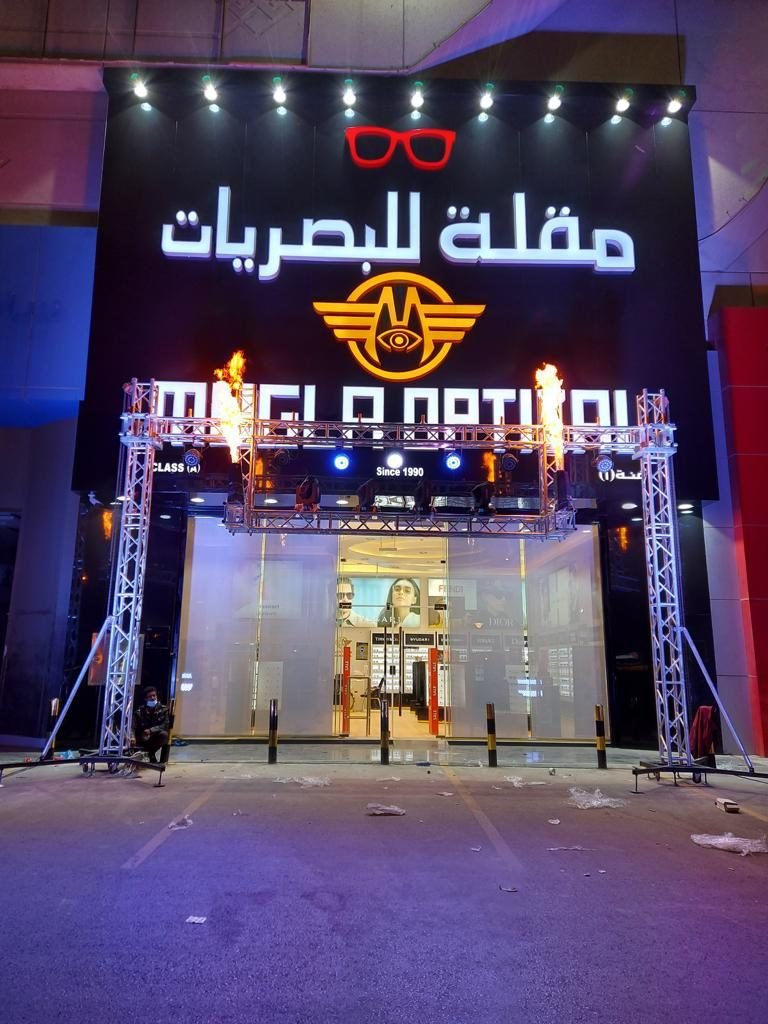
A goal post or a curved arch at the entrance of a show, a bazaar or a shop opening, skinned with print on both faces. It stands on ballasted bases and gets wider or narrower by adding or removing a section, so the same frame suits more than one site.
Stage truss and stage roofs
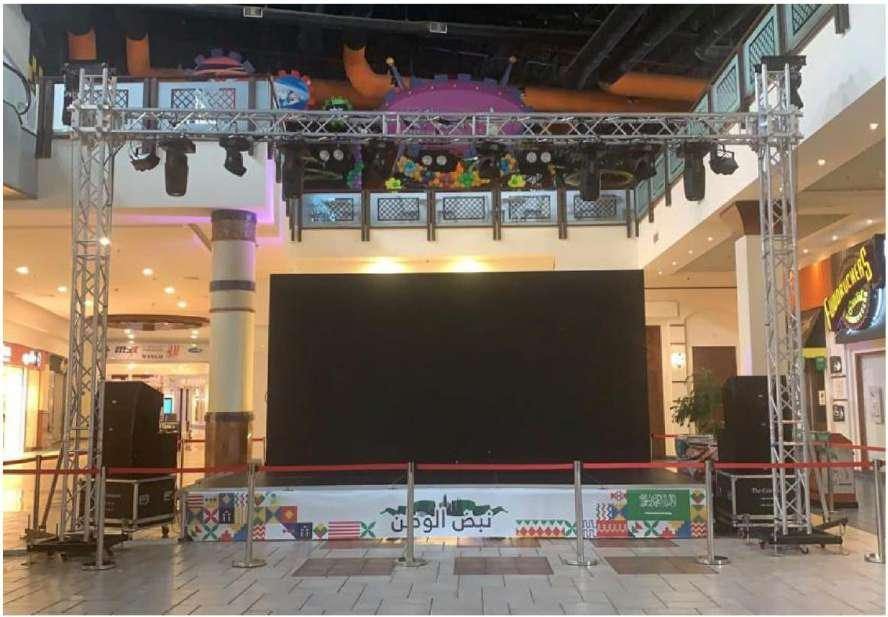
A goal post is a pair of legs either side of the stage with a beam across the top that carries lights and a header banner. A full stage roof is a grid of truss on towers at the corners, carrying lights and speakers, and outdoors a cover is stretched over it against sun and rain.
Light bridges for concerts and ceremonies
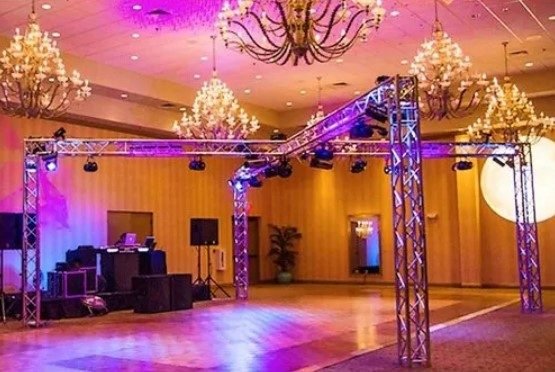
A horizontal bridge across the audience or in front of the stage, carrying spotlights and moving heads where they hit faces at a good angle. It stands on towers or hangs from the hall roof, and the fixtures the structure will carry decide its section.
Frames for banners and screens
An upright frame that holds a large banner behind or beside a stage, or a structure that carries a screen next to it. A screen is heavier than it looks and outdoors it meets the wind with its whole face, so its frame is worked out from its weight and its face area together.
Booth ceilings and hanging signs
At a show a truss frame on its own legs can sit over a stand to carry lights and a brand band, or a sign with the exhibitor logo can hang from the hall roof so it is seen from the far end of the aisle. Hanging from the roof needs the organiser approval and the rigging crew the organiser names.
Photo frames and outdoor structures
A frame guests stand in for photos in front of a printed backdrop, towers that carry signs across a festival square, light canopies over a walkway or a waiting area. Anything that stands outdoors is treated as a structure exposed to wind, not as a piece of decoration.
How Truss Rental Runs From Brief to Dismantling
Truss arrives as identical looking sections. What makes it suitable and safe is decided before the truck turns up.
What hangs, and where
It starts with a list of what the structure will carry: spotlights, speakers, a screen, banners, skins and cables, each with its weight from its datasheet. With it comes the site, inside a hall or in the open air, and the dates for building and taking down.
Rigging points and venue rules
The hall, the mall or the organiser is asked which rigging points exist in the roof and what each one takes, what the floor can bear, the access hours and who is allowed to rig. Those answers decide whether the structure stands on the floor or hangs.
The section from the load tables
The truss supplier picks the section and the distance between legs from the load tables published by the truss maker, using the first list and where each load sits on the bridge. A point load at mid span is not the same as a load spread along the length, and neither is judged by eye.
Drawings for approval
We prepare the plan, the elevations, the load schedule and the method of building, with the maker load tables attached when they are asked for, so they can go to the venue, the organiser or the authority. The approval is theirs, and any change they ask for is made on paper before build day.
Skins made in our factory
Printed skins, a lit logo, letters and a gate facade are made in our own factory to the size of the approved drawing, test assembled before they leave, and checked against the truss sections piece by piece, so nobody finds on site that the fabric is shorter than the frame.
Build, inspection and dismantling
On site every part is inspected before assembly, the lifting area is fenced off with barriers, and nobody stands under a raised load. Our own team installs the skins and branding, stays for the opening, and takes down what it installed when the event closes.
How Long Truss Rental Takes
The quote
Within 24 hours of a clear brief naming the site, the date and what the structure will carry.
Printed skins
Printed in 1 to 5 working days once the artwork is approved on the truss drawing.
The truss itself
The date depends on the shape, the venue or organiser approval and the access hours allowed. The quote states it.
Built pieces
A lit logo, raised letters or a built gate facade take time according to their design, and the quote gives their date.
What Changes a Truss Quote
We publish no price per metre, because length alone does not set the cost. These are the lines that make two truss rental quotes for the same shape differ, so ask for each by name.
Span and height
The longer the distance between legs, or the higher the structure, the stronger the section it needs, or the more legs, or towers with hoists instead of lifting by hand.
What the bridge carries
A bridge holding a fabric banner is not a bridge holding a full lighting rig, a screen and speakers. A heavier load means a heavier section, wider bases and more hands on the build.
Floor standing or hung
Hanging from the roof adds hoists and the rigging crew the venue requires, and many halls charge for each rigging point. Venue charges appear in the quote as paid to the venue.
Outdoors
Ballast or ground anchors, perforated mesh instead of solid fabric, a wind check, and earthing when the truss carries power: none of these lines appear indoors.
Skins and branding
Bare truss in its aluminium finish, printed fabric skins, or a built facade with a lit logo. Each level is its own line in the quote.
Time and access
A night build in a mall after closing, days on site, a standby crew during the event and a dismantle in a single night. Where transport applies, it is a named line in the quote.
Send the site, the date, a photo or sketch of what you want and the list of what will hang if you have it. Within 24 hours you receive an itemised quote for your truss rental, with the truss as a named line showing its type, its parts and who installs it. Request a quote or message 0567069088 on WhatsApp. When the truss sits over an exhibition stand, our guide to exhibition stand cost in Saudi Arabia shows where it fits in the budget.
Venue Approval and Rigging Points
Every structure that enters a hotel ballroom, an exhibition hall, a mall or a public square passes the people who own the space or run the event, and a truss rental request is not complete until you know what the site allows. The hall decides which rigging points exist in its roof and what each one may carry, and many halls let nobody but their own crew, or a crew they approve, climb to the roof and attach hoists. The organiser usually wants the plan, the elevations, the load schedule and the method of building before a deadline set in the exhibitor manual. A mall will normally ask for a safety plan, the night working hours and how its floor will be protected. We prepare those drawings and papers, and the approval and any permit stay with the venue, the organiser or the authority. What sits around the truss has pages of its own: the platform speakers stand on and the backdrop behind them are on event stages, printed fabric and banners on exhibition stand graphics, and the logos and sculpted pieces that hang from the structure on 3D letters and props. The look of the whole event, from the entrance to the stage, is on event branding. If the bridge or the gate is part of an event inside a mall, start at mall activation in Saudi Arabia, and for open festival grounds see festival organisers in Saudi Arabia.
Which Truss Suits Your Event
No truss is the best in general. These questions narrow the choice before you compare truss rental offers.
Standing on the floor or hung?
If the hall roof has no approved rigging points, or the event is outdoors or in a mall, the structure stands on its own legs. If the hall allows hanging and has its own crew, rigging clears the floor of legs and opens the view for the audience.
Triangle or box?
Triangle suits banners, frames and a short bridge with few fixtures. Box is for a long span, a heavy load or a full roof. The truss supplier settles it from the load tables, not from the look.
Silver or black?
Silver aluminium suits showrooms and openings where the truss is part of the design. Black disappears against a stage backdrop and at a night show, so guests see only the light.
Bare or dressed?
Bare truss is fine above the lights and backstage. Anything guests see up close, such as a gate, a photo frame or the edges of a stage, deserves a printed skin or stretched fabric that hides the tubes and the joints.
Truss or a built piece?
Truss goes up fast and changes shape from one event to the next. When the brief calls for a shape straight tubes cannot make, a solid facade with a lit logo, or a piece that returns every season, joinery from our factory fits better, or a mix that dresses the truss with a built face.
What Goes Wrong on Build Day
Each of these delays an opening, and each is avoidable on paper before the truck arrives.
A bridge that sags in the middle
A screen or speakers that were not on the list are added to the bridge at the last minute, and the load is now more than it was worked out for. Any addition after the drawing is approved is checked against the load tables before it goes up.
A missing pin and a stand in bolt
The sections arrive short of pins or safety clips, and someone makes up the gap with ordinary bolts. A joint that is incomplete is not built into the structure, and a section with a dented tube or a cracked weld is set aside, never repaired on site.
Fabric that turns into a sail
Outdoors a solid skin catches the wind and pulls the whole truss with it. Perforated mesh lets the air through, ballast is worked out for the worst wind expected, and the wind at which skins come down and the area under the structure is cleared is agreed in advance.
The hall refuses rigging on build night
The crew arrives with a drawing that relies on roof points the hall never approved. Rigging points are requested in writing before the design is drawn, not after, together with the name of whoever will climb to them.
Fixtures without a safety wire
Every light or device hung on truss needs a safety wire as well as its clamp, and cables are tied along the bridge so they neither dangle nor pull on a joint. This is checked before the bridge is lifted, not once it is up.
A night window shorter than the work
A mall allows building after closing and up to a fixed time before opening. If the work is not split across those hours, part of the structure is still bare in the morning in front of shoppers. Skins prepared in advance and parts loaded in the order they are built solve most of it.
Truss for the Event, Skins From Our Factory
Our factory brings design together with CNC and laser cutting, joinery, paint, acrylic and large format print, and the installation team comes out of the same building, so the skin of a structure is drawn on its plan and fitted by the people who made it. Among those we have worked for are Kinan, the Heritage Commission, Saudia Holidays, Johnson & Johnson MedTech and Cartoon Network.
Events We Delivered
Stages, platforms and event set-ups our team built and ran.


Questions About Truss Rental
What event organisers and marketing managers ask before they order.
Do you supply and install truss for events?
Yes. For a truss rental we supply truss for the event as a named line in the quote, with its type, its parts and who installs it. The skins, branding, gates and frames that dress it are built in our own factory, and our own team installs them and takes them down after the event.
What is the difference between triangle and box truss?
Triangle is lighter and suits banners, frames and light fixtures. Box is stronger and is chosen for roofs and for a long bridge that carries a lot of equipment. The choice between them comes from the load tables, not from appearance.
What is stage truss?
It is the structure above a stage that carries lights and a header banner, and sometimes a screen and speakers, either as a goal post on side legs or as a full roof on towers. The platform the speakers stand on is a separate thing built underneath it.
What is a light bridge, and who runs the lights?
A light bridge is a horizontal length of truss carrying spotlights over the audience or in front of the stage. We coordinate the fixtures with your audio visual supplier or with ours, each fixture is a line in the quote with its type and quantity, and an operator for each desk is a named line of its own.
How much weight can truss carry?
There is no single figure that fits every case. Capacity changes with the section, the span, where the load sits and whether the truss stands or hangs, and it is read from the load tables the truss maker publishes, never estimated. That is why the list of what will hang comes before the section is chosen.
Can truss hang from the hall roof?
If the hall has approved rigging points and allows it, yes. The rigging is usually done by the hall crew or a crew it approves, once it has accepted the drawing and the load schedule. If it does not allow it, the structure stands on its own legs or towers.
How is truss held down outdoors?
With ballast on the bases or anchors in the ground, with perforated mesh instead of solid fabric, and with a known wind limit at which skins come down. The ground is checked before the build, because sand, grass and paving do not hold a base in the same way.
Do you prepare the drawings an organiser or a mall asks for?
Yes. We prepare the plan, the elevations, the load schedule and the method of building, and attach the truss maker load tables when they are requested. The approval and any permit belong to the organiser, the mall or the authority.
Can you build in a mall at night?
Yes, when the mall sets it that way. The work is planned around the hours after closing, and the skins and built pieces are prepared in our factory beforehand so that only assembly and fixing are left on site, and the area is handed back tidy before opening.
How do we start a truss rental, and where are the skins made?
We have more than one location in the Kingdom. Whatever is made for your structure comes out of our own factory and is installed by our own team. Send the site, the date and what you need on WhatsApp at 0567069088 or through the quote page, and an itemised quote follows within 24 hours.
Truss Rental for Your Next Event?
Send the site, the date and what the structure will carry. Within 24 hours you have a quote that names the truss, its skins, the build and the dismantle, each as a line of its own.
More specific pages on this
If your question is narrower than this page, these are written for one question each.

