
Banner Printing
Banner Printing Matched to Where It Hangs
Banner printing is easy to order and easy to get wrong. The same artwork can go on flex vinyl over a shop front, on mesh along a construction fence, on fabric behind a stage, on a banner hanging in a mall atrium, across a wall as a mural, or on a feather flag beside a road. Each of those places asks for its own material, its own edges and its own way of fixing. This page explains how to choose, how to prepare the file, who has to approve the fixing, and what happens to the banner after the campaign.
Banner Printing Starts at the Site
Before the artwork, a few questions about the place decide the material, the edges and the price. Answer them first and the rest of the order follows, because good banner printing is settled on site, not on the screen.
Wind
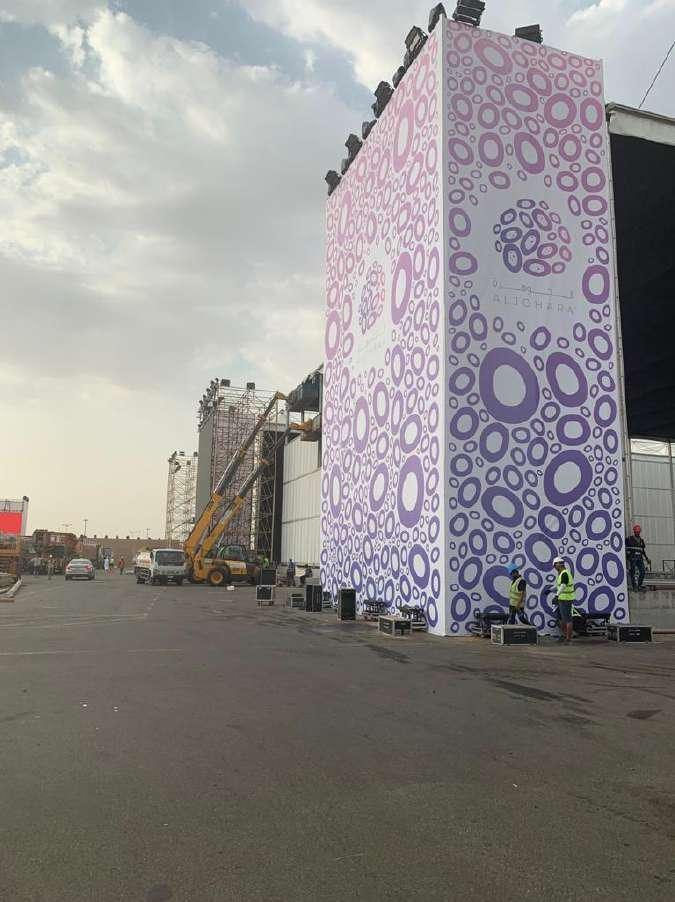
A solid banner on a fence or a scaffold behaves like a sail. On an open plot, a rooftop or a coastal road, the wind pulls at every fixing point until an eyelet tears or the fence itself leans. Mesh lets part of the wind through, and for a large outdoor face it is usually the safer choice.
Sun and heat
Months of direct sun fade ink, and in the hottest hours flex vinyl softens and slackens, so a banner that was tight in the morning ripples by the afternoon. Outdoor work needs ink and material rated for sunlight, and tension that is checked again after the first hot day.
Reading distance
A banner on a bridge or a building is read from a moving car in a glance, so it holds only a few words in large letters, a logo and one clear image. A fabric banner beside a registration desk is read from close by and can carry more detail. Distance sets the letter size, and the letter size sets how much you can say.
What it is fixed to
A steel fence, scaffold tubes, a concrete wall, a lamp post, a truss in a hall or the ceiling of a mall each takes a different fixing. The surface decides how the edges are finished, and it also decides whose permission you need before anything is tied, drilled or hung.
What Comes With the Banners
Banner printing is rarely ordered on its own. These services work under the same roof as our large format print.
Printing & Promotional Gifts
Flex, mesh, fabric, wall vinyl and flags, with the leaflets and giveaways for the same campaign. Graphics are printed in 1 to 5 working days.
Acrylic & Wood Fabrication
Timber frames that hold a fabric banner tight, and acrylic signs for the places where a banner would look temporary.
Promoters & Brand Ambassadors
Hosts with a supervisor at the opening or the campaign spot, handing people what the banner promised.
Branding & Creative Studio
Campaign artwork adapted to every banner size, in Arabic and English, from one approved key visual.
Digital Solutions
A QR code on the banner that opens a landing page or a registration form, so a passer by can act at once.
Experiences & Events
Openings, festivals and ceremonies where banners, flags and backdrops are one part of a single plan.
Social Media & Content
The same campaign artwork prepared for your social accounts, so the street and the screen match.
Custom Exhibition Stands
When the campaign moves into an exhibition hall, the stand is designed, built and installed by the same team.
Banners, Murals and Flags We Print
Each material below suits a different place. Most banner printing orders use more than one, and the quote names which goes where.
Flex vinyl banners for outdoors
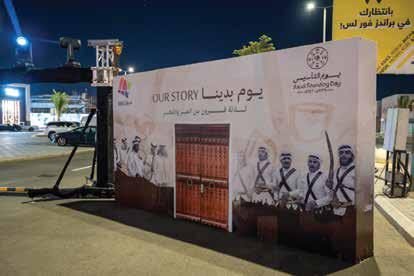
Flex is the PVC material most outdoor banners in the Kingdom are printed on: strong, unharmed by water and printed on one face. It suits a shop front during a fit out, fences, scaffolding and roadside frames. Its opaque blockout grade carries a print on both faces without either showing through, for a banner seen from both sides of a street.
Mesh banners for windy sites
Mesh is a perforated vinyl full of small holes. From the street the picture reads whole, while the wind passes through the holes and the load on the fixings drops. It is the material for construction hoardings, large faces on scaffolding, stadium fences and coastal sites. Fine detail and small text lose sharpness on it, so the design stays bold.
Fabric banners and backdrops
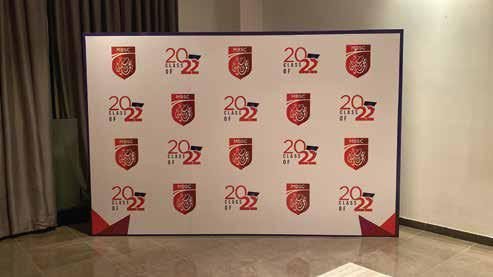
Printed fabric has no shine under spotlights and photographs well, which makes it the choice for stage backdrops, photo walls and banners in hotel ballrooms and halls. It folds without cracking, weighs less than flex vinyl, and is finished with stitched hems, pole pockets or a silicone edge that presses into a frame.
Hanging banners in halls and malls
A banner hung from a truss, a ceiling or an atrium railing is seen from below and from far away, often from both sides. It is usually fabric printed on both faces, with a pocket at the top and a bar or weight at the bottom, so it hangs straight and does not turn in the draught from the air conditioning.
Wall murals
A mural is a print that covers a whole wall in an office, a school, a showroom or a café. It is printed on wall vinyl or printed wallpaper and applied to a clean, sound wall. The choice between a removable and a permanent adhesive depends on who owns the wall and how long the design should stay.
Feather, teardrop and hand flags
A feather flag is tall with a curved edge, and a teardrop flag holds a rounded shape that reads even in still air. Both stand on a ground spike in sand or soil, or on a cross base with a water weight on paving. Hand flags on small sticks are ordered for National Day, school occasions and welcomes along a route.
How Banner Printing Runs From Brief to Removal
Each step answers a question that would otherwise come up on the day of installation.
The site and the purpose
We start with where each banner goes, what it is fixed to, whether it is inside or outside, how long it stays and who has to approve it. A photograph of the place with rough measurements does more than a long brief.
Material and edges
Each banner gets a material and an edge. A hem is the edge folded back and heat welded on flex or stitched on fabric, so it neither frays nor tears. Eyelets are metal rings punched through the hem for ties. A pole pocket is a sleeve for a pipe or a rod. On large outdoor banners a rope or webbing inside the hem spreads the pull along the whole edge.
A file prepared at final size
The artwork is set at the finished size or to scale, with bleed beyond the edge that folds into the hem and no text near the eyelets. Resolution is judged at the viewing distance, not by zooming in on a monitor. Colours are prepared for print rather than for a screen, and every Arabic line is checked by a native reader for joined letters and the right direction.
A colour proof on the real material
Flex, mesh and fabric take the same colour in different ways. For a brand colour that matters, a proof is printed on the actual material and approved before the run, and the banners of one campaign are printed together so they match when they hang side by side.
Printed in our factory
The banners are printed in our own factory, finished with the edges named in the quote, and rolled with the print facing out, so they reach the site without creases.
Installation and removal
Our own team installs the banners with the fixing the site allows, checks the tension and the reading from the street, and takes them down when the campaign ends. Removal is agreed at the start: the date, the ties and fixings to clear, and whether the banners go into our storage or are disposed of.
How Long Banner Printing Takes
Printing
Graphics are printed in 1 to 5 working days once the artwork is approved, depending on material and quantity.
Installation
Depends on the number of locations, the height, the access and the hours the site allows. The quote states the date.
Approvals
The time a building owner, a mall or the municipality takes is theirs, so the request goes in before the artwork is final.
Reprints
A flex or fabric banner damaged during the campaign is reprinted from the approved file within the same printing window.
What Sets the Price of Banner Printing
We publish no price list, because each order is priced from its own list of banners. These are the lines that move the cost of banner printing, named so you can compare quotes fairly.
Material
Standard flex vinyl is the economical end. Mesh, blockout flex for printing both faces, fabric and wall vinyl each cost more for the same area, and a fire rated fabric more again.
Area and quantity
The total printed area is the first factor. Many banners of one design cost less each than many different designs, because the file and the setup are prepared once.
Edges
Welded hems, eyelets on every side, pole pockets, reinforced corners and a rope in the hem each add work. They also decide whether the banner survives the wind, so they are the last place to save.
Printing both faces
A hanging banner or a flag seen from both directions is printed on both faces, with a blocking layer between them on flex. It costs more than a single face, and less than a reversed back seen by everyone on the other side.
Height and access
A banner on a fence at street level is quick work. A building face, an atrium ceiling or a tall lamp post needs more hands, more time and sometimes a lift or a scaffold, named as its own line.
Night work and approvals
Many malls and some venues allow hanging only after closing, and some ask for drawings, a written method statement or a fire certificate for the material. Each is a named line, and the fees of those bodies stay with them.
Send the locations with a photograph of each, rough sizes, the dates and your artwork. An itemised quote for your banner printing reaches you within 24 hours. Request a quote or message 0567069088 on WhatsApp. If your banners are part of an exhibition budget, our guide to exhibition stand cost in Saudi Arabia shows how that budget is built line by line.
Fixing and Permission: Who Approves What
Every way of fixing a banner belongs to someone. On a building, the owner decides what may be fixed to the facade, and a banner facing the street is outdoor advertising that the municipality may need to license. A building wrap is possible only where the owner allows it, and it hangs from a frame or cables fixed to the structure, never from the glass. Inside a mall, management sets the hanging points, the working hours and the fire rating of the material, and its rules apply to every tenant. On a lamp post or beside a road, the municipality is the one to ask. In a venue or an exhibition, the organiser decides. We prepare the drawings and material details each of them asks for, and the approval stays with them. Banners for a store opening are planned with the rest of the day on our grand opening events page, and a banner hung over an atrium is part of mall activation in Saudi Arabia. A backdrop behind a speaker belongs with event stages, and flags along the road to a festival with our work as festival organisers. Printed walls on a booth have their own page, exhibition stand graphics, and a permanent sign over a shop front is shop signage, made to stay for years rather than a season.
Questions That Pick the Right Banner
Answer these for each location on your list before you order banner printing, and the material, the edges and the fixing follow.
Inside or outside?
Indoors, fabric looks better, hangs softly and photographs without glare. Outdoors, flex vinyl or mesh stands up to sun, dust and the passing storm. Fabric outdoors works for a short event in calm weather, not for a campaign that stays.
How exposed to wind?
A sheltered wall or a shop front takes flex vinyl. An open fence, a scaffold, a rooftop or a coastal road takes mesh, with a fixing at every eyelet. If you are unsure, assume the wind and choose mesh.
Seen from one side or both?
A wall banner is read from the front only. A banner across a street, hanging in an atrium or flying as a flag is seen from both directions, and needs printing on both faces or a design with no text that still works from behind.
For one event or many?
A banner for a single weekend can be plain flex with the date on it. One that returns every season leaves the date off, uses a material that rolls without cracking, and is stored dry between uses.
A banner or something else?
For a reception desk or an indoor corner, a roll up or a pop up display may be the better object. On a permanent shop front a banner looks temporary, and a fixed sign is the right answer.
Banner Mistakes That Show From the Street
Each of these is cheap to prevent when the banner printing is ordered, and costly to fix after installation.
A solid banner on an open fence
A full flex vinyl banner tied along an exposed fence catches every gust. Sooner or later the eyelets rip out, or the banner pulls the fence over with it. The answer is mesh, more fixing points and a braced fence, all decided before printing.
Eyelets with no hem behind them
An eyelet punched through a single layer of material tears under load. Every eyelet sits in a welded or stitched hem, and the corners, where the pull is strongest, get extra reinforcement.
Wind slits instead of mesh
Cutting half moon slits into a flex banner lets a little air through and spoils the picture with flapping tongues. On an exposed site it is a poor substitute for mesh, which spreads the openings over the whole surface.
A file prepared for a screen
Artwork saved in screen colours prints duller than it looked, and an image taken from a website turns soft at banner size. Ask the designer for a print file at the final size, with bleed, and the logo as a vector.
Arabic that falls apart
Software without proper Arabic support prints the letters disconnected or reversed, and a designer who does not read Arabic will not notice. A native reader checks every line on the printed proof, not only in the design file.
Banners folded into storage
Flex vinyl folded flat cracks along the fold, and damp fabric sealed in a bag spots with mould. Flex is rolled around a tube with the print facing out, fabric is dried before it is folded, and each banner is marked with its location for next time.
Print and Installation From One Company
Design, CNC and laser cutting, joinery, paint, acrylic, large format print and installation sit under one roof with us, so the banner printed from your file is fixed by the same company that planned where it goes. We have more than one location in the Kingdom, and your banners are printed in our own factory and installed by our own team. The brands we have worked for include Kinan, the Heritage Commission, Saudia Holidays, Johnson & Johnson MedTech, Cartoon Network, Ganache, Oceanera, Al Khaleej Al Gharbiya, Saudia, Ascenda, Swarovski and Gucci Flora.
Print Work From Our Factory
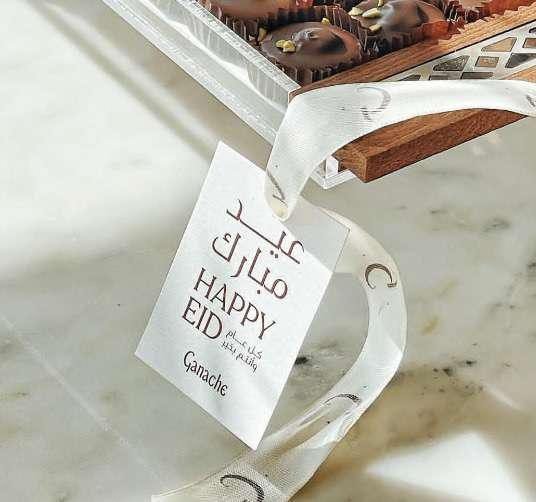
Print jobs we delivered: offset, digital, boxes and labels.

Questions About Banner Printing
What companies, shops and event organisers ask before they order banner printing.
What is the difference between flex, vinyl and mesh?
Flex is the common name in the Kingdom for a PVC vinyl banner material that is solid, waterproof and printed on one face. Mesh is a vinyl with small holes that let the wind through. Both are for outdoors: flex for sheltered places, mesh for open and windy ones.
Which material is best for an outdoor banner?
For a shop front or a sheltered wall, flex vinyl. For fences, scaffolding, rooftops and coastal sites, mesh. Fabric outdoors suits only a short event in calm weather. In every case, ask for ink and material rated for sunlight.
Can you print fabric backdrops for a stage or a photo wall?
Yes. Fabric is printed without shine, so it photographs well under event lighting, and it is finished with pole pockets, stitched hems or a silicone edge to suit the frame. Tell us the frame or structure it hangs on and the size, and the edges follow from that.
How are banners fixed?
Through eyelets with cable ties or bungee cords to a fence or a scaffold, through pole pockets on a rod or a lamp post bracket, stretched in a frame, or hung from a truss or a ceiling point with a weighted bar at the bottom. The surface and the permission decide which.
Who approves a banner on a building or in a mall?
On a building, the owner, and the municipality where the banner faces a street as outdoor advertising. In a mall, management sets the hanging points, the hours and the rules for the material. We prepare the drawings and details they ask for, and the decision is theirs.
Do you print wall murals for offices and schools?
Yes. A mural is printed on wall vinyl or wallpaper and applied to a smooth, clean, dry wall, with a removable adhesive where the wall is rented or the design may change. A freshly painted wall is left until the paint has fully cured before anything is applied.
Can you make flags for National Day and events?
Yes: feather and teardrop flags with their bases, and hand flags for National Day, school occasions and welcomes. The national flag is reproduced exactly as it is, with no logo on it, and company flags carry your own identity instead.
What should the artwork file look like?
A print ready PDF at the final size or to scale, with bleed around every edge, print colours, a vector logo and images good enough for the viewing distance. Keep text clear of the edges taken by eyelets and hems. If all you have is a logo and a message, our studio can lay out the banner.
How long does banner printing take?
Graphics are printed in 1 to 5 working days once the artwork is approved, depending on material and quantity. Installation depends on the number of sites, the height and the hours each site allows, and the quote states the dates.
Can banners be stored and reused, and how do we start?
Yes, if they were made for it: no dates in the artwork, a material that rolls without cracking, and dry storage, and they can be kept in our storage between campaigns. To start, send the locations, photos and dates on WhatsApp at 0567069088 or through the quote page, and an itemised quote follows within 24 hours.
Banners for Your Next Campaign?
Send the locations, a photograph of each and the dates. Within 24 hours you have an itemised quote that names every banner, its material, its edges and its fixing.
More specific pages on this
If your question is narrower than this page, these are written for one question each.

