
Projection Mapping in Saudi Arabia
Projection Mapping in Saudi Arabia Cut to the Shape of the Surface
Projection mapping in Saudi Arabia has moved from national celebrations to product launches, store openings, galas and conference stages. The idea is simple: video is made for the exact shape of a surface, whether a building facade, a stage set, a car, a model or the walls of a room, so the object itself seems to move, open, fill with colour or tell a story. What makes it work is less simple: a survey of the surface, a 3D model, content built for that model, darkness, power, sound, permissions and a test night. This page walks through each of them, so you can brief a projection show with the right questions.
Why a Projection Show Instead of Another Screen
A screen displays a picture beside your building or your product. Projection mapping puts the picture on the thing itself, and that changes what people remember after the night.
The building becomes the screen
A facade already has windows, columns, arches and a roofline. Content drawn on those lines can light each window in turn, make a column seem to crack open or draw a pattern across the stone, and the building is untouched once the projectors are switched off. Nothing is fixed to the wall, which matters when the building belongs to someone else.
Scale for a whole crowd
A light show on a building can be seen by everyone in a square or a car park at the same moment, from far enough away that nobody pushes to the front. It suits an audience that is standing, arriving over an hour, or watching from cars and terraces, where a stage screen would only serve the first rows.
A reveal that belongs to one moment
At a launch the projection can dress a covered product or a white car in lines and colour, then the cover drops to show the real thing. At an opening, the facade can be drawn line by line until the brand name appears. The moment is timed to music and a countdown, so the whole audience looks the same way in the same second.
Content that lives after the night
The files that run the show become a film for your channels: a locked capture from the best viewing point, short vertical cuts and a version with no crowd in front. Planned before production, this costs little extra, and it is often what reaches the people who were not there.
The Teams Around a Projection Show
The projection is the part people film on their phones. Around it sit the set, the print, the hosts and the content, all from teams under one roof.
Printing & Promotional Gifts
Invitations, signs that guide guests to the viewing area, branded barriers and the gifts handed out afterwards. Graphics are printed in 1 to 5 working days.
Acrylic & Wood Fabrication
The surfaces a projection lands on: a set wall, a white model, a sculpture or a reveal box, cut on CNC and laser machines and painted in a matt finish that suits projection.
Promoters & Brand Ambassadors
Hosts who welcome guests, guide them to the viewing area and keep the space in front of the projectors clear, led by a supervisor.
Branding & Creative Studio
The idea, the storyboard and the look of the projection show, so the facade speaks in your identity and your colours.
Digital Solutions
An invitation and registration page, attendance taken at the gate, and screens that repeat the picture for guests standing at the back.
Experiences & Events
The full occasion the projection belongs to: a launch, an opening, a gala, a conference opening or a national celebration.
Social Media & Content
Filming from the best viewing point and short clips cut for each platform, ready to post the same night.
Custom Exhibition Stands
When the projection lives inside an exhibition stand, the dark enclosure that protects it is designed with the stand from the first drawing.
Kinds of Projection Mapping
Projection mapping in Saudi Arabia comes in several kinds, and each has its own surface, its own audience and its own risks. Naming the kind early saves weeks of the wrong questions, because a facade has little in common with a dinner table.
Building facade
The best known kind: a hotel, a government building, a mall front or a heritage wall turned into a canvas after sunset. It reaches the largest audience and needs the most preparation: a survey of the facade, permission from the building owner and often the municipality, projector positions across a street or a square, and control of the street lights and lit signs that wash the picture out.
Stage and set
A set built for projection, made of flat panels, steps, arches or a cut out skyline, stands behind the speakers at a conference opening or a gala. Stage lighting has to be kept off it, so the lighting designer and the projection team plan together. Because the set is made for the image, its edges line up with the content every time it is rebuilt.
Product or car reveal
The product sits on a plinth or under a cover, and light dresses it before the reveal: lines tracing its shape, colour running over it, the logo forming on its body. A car works best in a white or pale matt wrap, because dark gloss paint swallows the light and throws the projector back into the eyes of the audience.
Immersive room
Several projectors cover the walls, and sometimes the floor, of a closed room so guests stand inside the story. The images overlap at their edges and are blended in software, so the room reads as one picture. The room needs full blackout, ventilation for the equipment and an entrance that keeps daylight out.
Table mapping at a gala dinner
Projectors above a dining table turn the tablecloth and plates into a moving scene between parts of the dinner: a welcome, the story of the company, a pattern that follows the menu. Guests watch from their seats, so the content is drawn for a view from above and close by, and the projectors are rigged high enough to stay out of sight.
Model and master plan mapping
A white architectural model lit from above can reveal phases, roads, green areas and services appearing one after another. It suits real estate launches and government exhibitions, and the model is built for the projection, with matt surfaces and clean edges the content can follow.
How a Projection Show Is Planned and Run
The order matters: surface, model, content, test, then the night itself. Projection mapping in Saudi Arabia is usually booked around a fixed date, so no step starts before the one before it is finished.
The occasion and the audience
We start with what the night is for and who will watch: invited guests at a gala, a crowd in a square, a seated audience in a hall, or cameras for a film. The date, the time after sunset, how long it runs and how many times it repeats shape everything that follows.
The site survey
The survey is made from where the audience will stand and from the places a projector could go. It records the surface and its colour, glass and anything that reflects, every light that cannot be switched off, the distance between the projector position and the surface, the viewing area and its angle, power, access for equipment and safe routes for cables.
A 3D model of the surface
Content cannot be drawn on a photograph. The facade, the set or the product is measured or scanned and rebuilt as an accurate 3D model, with every window, column and edge in its place. The animators work on that model, so the light lands on the stone and not a hand's width beside it.
Content and sound made for that model
The storyboard is approved first, then the animation is produced for the real surface and the real viewing point, with music or a voice composed or licensed for the same length. The quote names who produces the content, our digital solutions side or your agency, and who owns the files afterwards.
Build and test night
A set, a model or a reveal surface is built in our factory and the projection is tried on it there. On a facade, the full show runs on site after dark on a night before the event: alignment, brightness, sound levels, the view from the edges of the audience and the timing with the countdown are checked and corrected.
Show night and take down
Our own team installs what we build, stays through the night and dismantles afterwards, with a technician beside the show control from start to finish. The show is started, paused or repeated live in step with the MC and the programme, and the equipment comes down once the audience has left.
How Long a Projection Show Takes to Prepare
Content for the surface
It depends on the running time, the detail of the surface, the languages and the rounds of approval. The quote states the date.
A set or a model built for projection
As for a custom stand, 6 to 8 weeks from brief to the event, with the design approved at the start.
Permission for a public facade
It is set by the building owner and the relevant authority, not by us. Ask early, and the plan is counted back from their answer.
Signs and printed material
Printed in 1 to 5 working days once the artwork is approved.
What Shapes the Cost of Projection Mapping in Saudi Arabia
We publish no price list, because each projection show is priced from its surface, its site and its content. These are the lines that move a quote, named so offers can be compared fairly.
The surface and the picture size
A larger facade, a darker or rougher surface and a wider viewing angle each need more projectors, overlapped and blended. The number is set by the survey, not guessed in advance.
Projectors and show control
The projectors, the media server that plays the show and the control desk are often hired from a specialist for the night. Each is a named line in the quote, with who supplies it and for how many nights.
Content and sound
Animation made on a 3D model is the part the audience actually sees, and its length, detail and number of versions move the cost most. Music written for the show and a sound system for the viewing area are separate lines.
Towers, housings and weather cover
Outdoors the projectors sit on braced towers or scaffolding inside housings that keep out dust and wind, usually fenced off. That structure, and the crew who build it, can weigh more in the quote than people expect.
Power and permissions
A generator or a supply from the building, cable protection along the route, and the drawings and paperwork the building owner or the authority asks for. Their own fees stay with them and are listed beside the quote.
Test night, crew nights and filming
Every night on site, the test and the event, is crew time and equipment hire. Filming the projection for your channels is its own line, and where transport applies it is a named line in the quote.
Send the occasion, the date, the surface you have in mind with a few photos taken at night, and where the audience will stand. An itemised quote for your projection show follows within 24 hours. Request a quote or message 0567069088 on WhatsApp. When the projection sits inside an exhibition stand, our guide to exhibition stand cost in Saudi Arabia explains how the stand itself is budgeted.
Permissions, Power and Safety: Who Decides What
A projection on a facade happens in the open, so more people have a say than at an indoor event. The building owner decides whether the facade can be used and when, and a street, a square or a public building usually also needs the municipality or the relevant authority, who may ask about crowd management, road closures, sound levels and the hours of the show. A venue decides on rigging from its roof and on the power it can supply. These approvals are theirs; we prepare the drawings, the site plan, the equipment list and the paperwork they ask for. On the night, projector towers stand braced and fenced, cables are covered where people walk, and nobody is allowed to stand in the beam or look into a lens. Projection as one of several interactive formats is explained on interactive brand experiences, and when a space is too bright for projection, LED screens for exhibitions compares screens with projectors. A reveal in light is planned with the rest of the programme on product launch events, and a facade lit for a new branch, with the ribbon and the guests, on grand opening events. The set and the platform a projection lands on are covered on event stages, and a national occasion with its heritage content on Saudi Founding Day corporate events.
Projection, LED Screen or Both?
Projection is the right tool on some nights and the wrong one on others. A few questions settle it before anyone talks about equipment.
How dark can the place get?
Projection needs darkness. On a facade after sunset, with the street lights near it switched off, it is at its best. In a bright hall, a sunlit mall atrium or a daytime event, an LED screen or a lit set reads better, and projection belongs inside an enclosure.
Is the surface the story?
If the message is the building, the product or the model itself, mapping it says that better than any screen. If the message is a film or a presentation, a screen beside the stage is clearer and takes less preparation.
Where will the audience stand?
The illusion is strongest from the front, near the point the content was drawn for. A crowd spread along a street or all around a product sees parts of it distorted, so the viewing area is planned with the content, not after it.
One night or many?
A single night puts the budget into content and the moment. A projection repeating every evening through a season or a festival needs housings, cooling, a routine for switching on and off, and someone checking alignment each day.
Will it be filmed?
If most people will see it on a phone, plan the camera position, the music rights and a vertical cut from the start. A projection designed only for the people in the square loses many of its best moments on a small screen.
Where Projection Mapping Goes Wrong
Each of these is cheap to prevent at the survey and expensive on the night.
A street lamp nobody switched off
A single lamp post, a lit shop sign or a floodlight on the building can wash out a whole section of the picture on the facade. List every light source in the survey, and agree in writing who switches each one off and when.
Content drawn on a photograph
Animation made on a photograph instead of a measured model lands slightly off every edge, and a building that seems to move becomes a picture sliding across it. The model comes first, then the content.
Windows that swallow or reflect the light
Glass lets light pass into the building or throws it back at the audience, so a facade with large windows is left with black holes. Blinds, a film fixed on the inside or content designed around the glass solves it, with the building owner's agreement.
A tower that moves in the wind
A projector tower that sways a little moves the picture a lot on a distant facade. Towers are braced and weighted, housings are closed against dust, and the forecast is checked on the day with a fixed time to decide on the wind.
Power that drops at the wrong second
A generator that stumbles restarts the media server, and the show begins again in front of everyone. Projectors and the media server need their own supply with a backup, and the generator stands far enough away that its noise does not cover the sound.
Sound out of step with the picture
Across a large square, sound reaches the back of the crowd later than light, and speakers in the wrong place make the music feel late. Speakers are placed and timed for the viewing area, and the sound is checked from the back on the test night.
One Team for the Surface, the Set and the Night
Under one roof we design, cut on CNC and laser machines, build the joinery, paint, make the acrylic, print in large format and install, so the set or model a projection lands on is built by the team that tests the projection on it. We work from more than one location in the Kingdom, and whatever we make for your night comes out of our own factory and is installed by our own team. We have worked for Saudia, the Heritage Commission, Kinan, Johnson & Johnson MedTech, Swarovski and Gucci Flora, and a single campaign of ours has passed a reach of more than 10 million.
Screens From Our Work
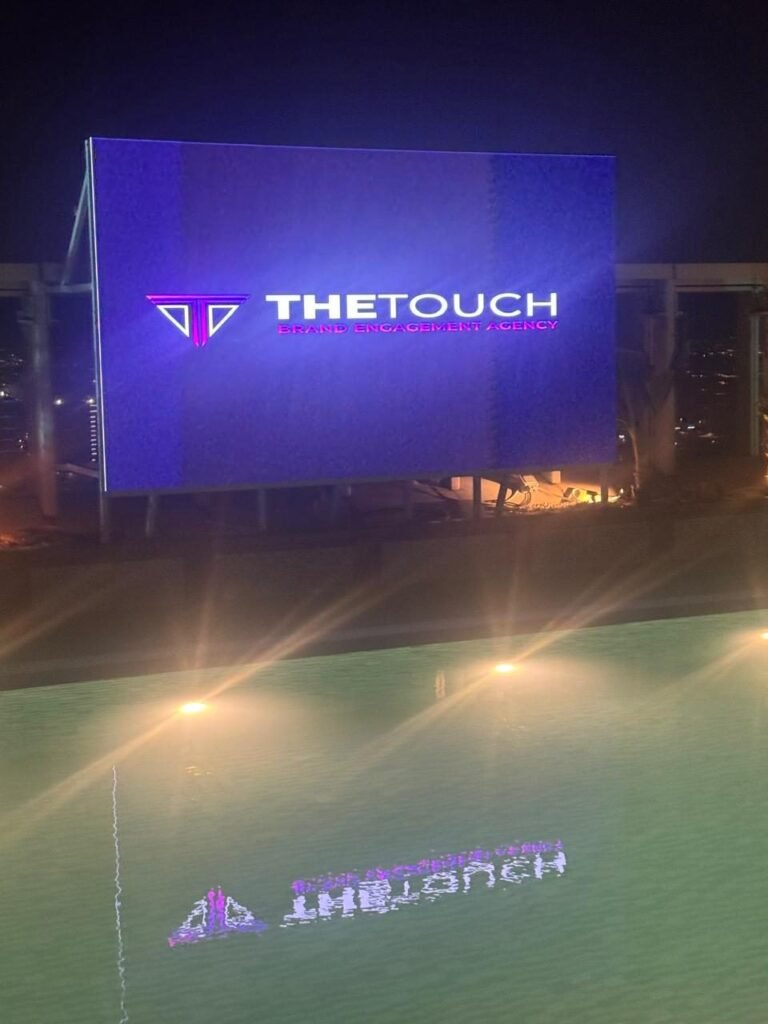
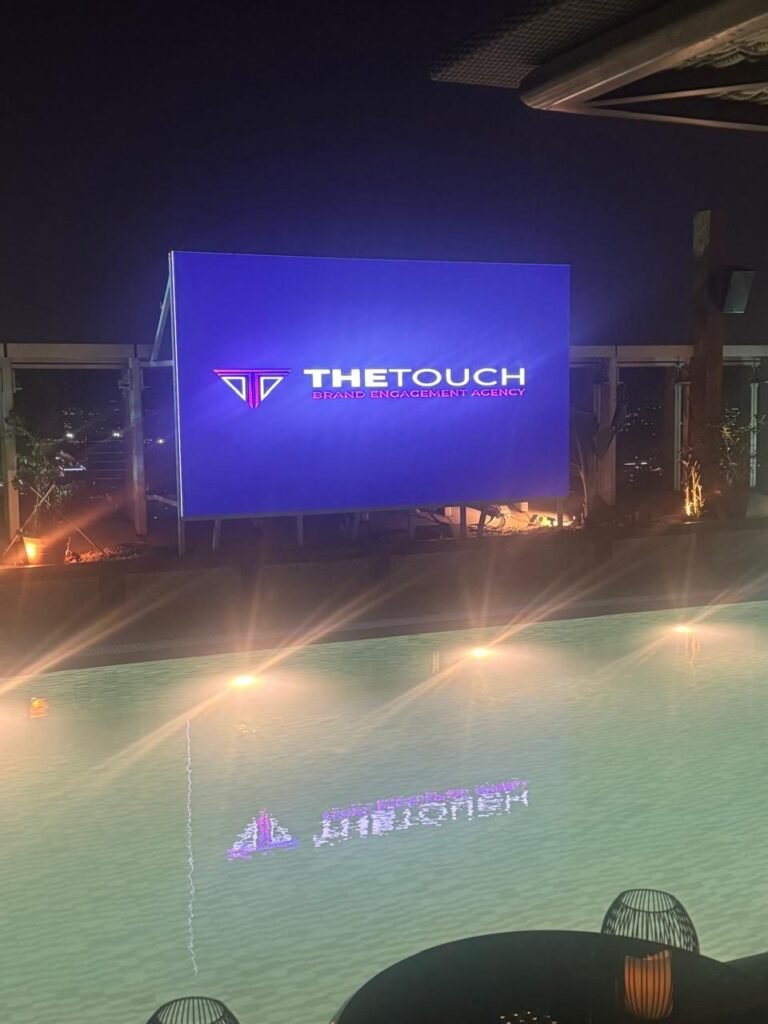
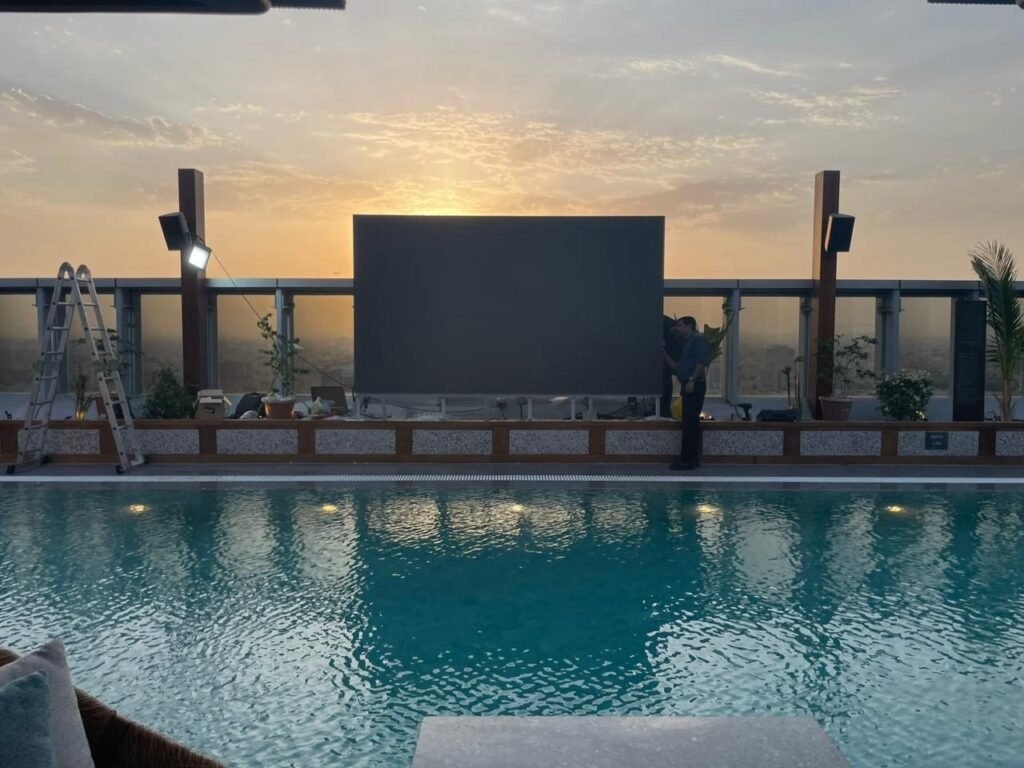
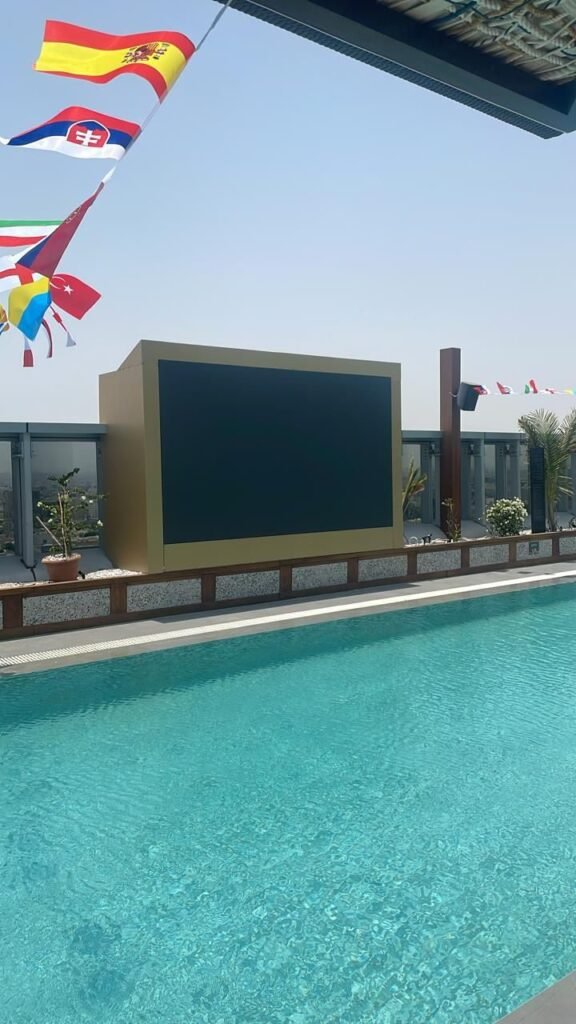
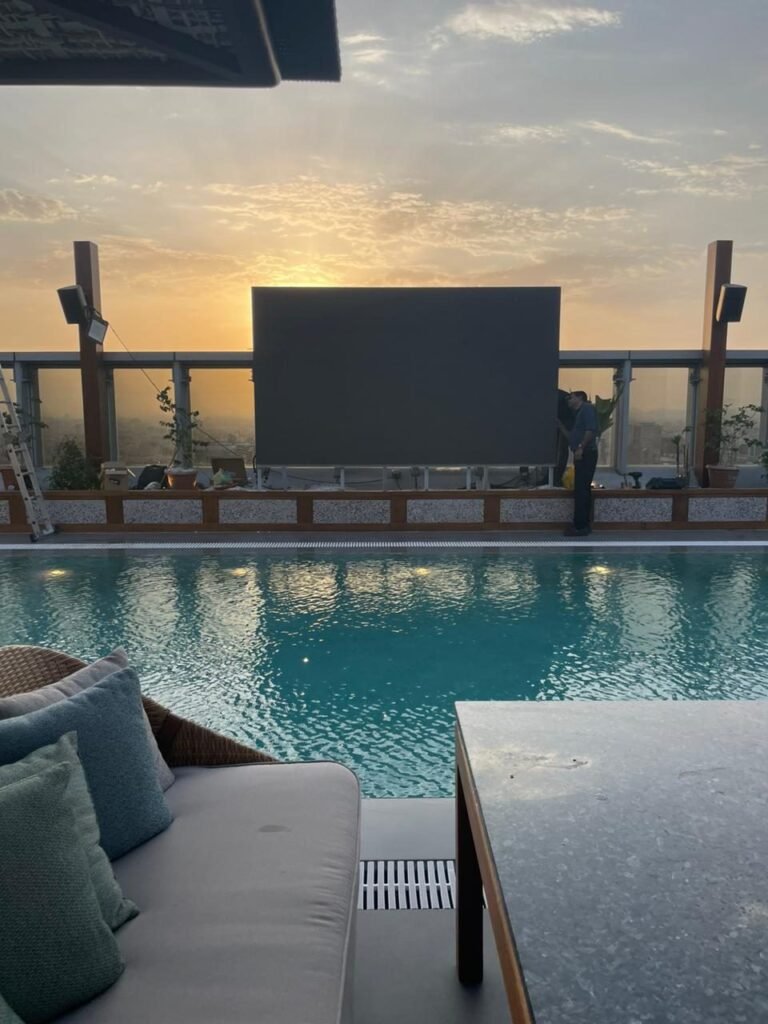
Display screens we installed at exhibitions and events.
Questions About Projection Mapping in Saudi Arabia
What organisers and brands ask before they book a projection.
What is projection mapping?
It is video made to fit the exact shape of a surface, so a building, a set, a product or a room seems to move, change colour or come apart. The content is drawn on a 3D model of that surface and played through projectors aligned to it. Done well, the audience forgets it is watching a projection.
Do you do projection mapping on building facades?
Yes. We plan the facade projection from the site survey to the night itself, prepare the drawings and paperwork the building owner and the authority ask for, and run it live. Projectors and show control may come from a specialist, and each is a named line in the quote.
Which surfaces work best?
Light, matt and even surfaces: pale stone, render, white panels and a car in a pale matt wrap. Dark colours, gloss and large areas of glass need more projector power and more careful content design, and the survey tells you how your surface will behave.
Does projection work in daylight or in a bright hall?
Not well. Projection needs darkness, so outdoor projections start after sunset once the sky is fully dark, and indoor ones need the room lights down or an enclosure. In a bright space an LED screen or a lit set is usually the better choice.
Who gives permission for a projection on a public building or a street?
The building owner first, and for a street, a square or a public building usually the municipality or the relevant authority as well. They decide the hours, the sound and the crowd plan. We prepare the drawings, the site plan and the papers they ask for, and the decision stays with them.
What happens if it is windy or dusty on the night?
Projector towers are braced and weighted, and housings protect the equipment from dust. The forecast is watched in the days before, and a time is agreed to decide whether to go ahead, delay or change the plan, so nobody improvises in front of the guests.
Can the projection have its own music and voice?
Yes, and it should. The sound is composed or licensed for the exact length, in Arabic, English or both, and played on a sound system placed for the viewing area. Licensed music has to cover posting online as well if the film will be shared.
Why is a test night needed?
Because alignment, brightness, stray light and sound can only be checked on the real surface in the real dark. The test night is when the edges are corrected, the strongest light that cannot be switched off is found, and the timing with the programme is rehearsed.
Can we use the content on social media afterwards?
Yes, if it is planned. The projection is filmed from its best viewing point with a locked camera, short vertical cuts are prepared, and the music licence covers online use. The quote names who owns the content files after the event.
How do we start, and how long does it take?
Send the occasion, the date, the surface and a few photos taken at night on WhatsApp at 0567069088 or through the quote page. An itemised quote follows within 24 hours, and the date in it depends on the content, the survey and the permissions your site needs.
A Projection Show for Your Next Occasion?
Send the occasion, the date and the surface you have in mind. Within 24 hours you have an itemised quote that names the survey, the content, the projectors, the sound and every night on site.
More specific pages on this
If your question is narrower than this page, these are written for one question each.

