
Logo T-Shirt Printing
Logo T-Shirt Printing for Events, Teams and Campaigns
Logo t-shirt printing for a company event, a launch, a fun run, National Day or a school team usually starts with a date that cannot move and a crowd in every size. We supply t-shirts printed with your logo for companies, event organisers, schools, sports teams and campaigns, in cotton or sports fabric, with the print method chosen for the design and the quantity, colours checked against your brand, a sample before the full run, and every shirt packed by size or by name. This page explains the fabrics, the print methods, where the logo sits and how to plan the order back from the event day or the campaign launch.
Fabric First: Cotton, Blends and Sports Fabric
In logo t-shirt printing, the print is only as good as the shirt under it. The fabric decides which print methods work, how the shirt feels at an outdoor event in the heat, and whether people keep wearing it after the campaign ends.
Combed cotton
Cotton is the default for a company day or a giveaway because it is soft, breathes and takes almost every print method. Combed or ring spun cotton has had its short fibres removed, so the surface is smoother and a fine logo prints with cleaner edges than on open end cotton, which is rougher and cheaper. Cotton shrinks a little in its first wash unless it was pre-shrunk, so ask which one you are getting before you settle the sizes.
Cotton and polyester blends
A blend keeps much of the softness of cotton but creases less, shrinks less and dries faster, which suits a crew that wears the same shirt across several event days. Blends take screen print and DTF well. The polyester part reacts to heat, though, so curing temperatures and dark dyed blends need the care described in the mistakes section further down this page.
Sports fabric for the heat
For a fun run, a sports day or a crew working outdoors in a Saudi summer, a polyester performance fabric pulls sweat away from the skin and dries quickly, where heavy cotton turns wet and heavy. A mesh or bird eye knit breathes more again. Light colours stay cooler in direct sun, and this is also the fabric that sublimation needs.
Weight, cut and shirt colour
Fabric weight is given in grams per square metre: a lighter shirt is cooler and cheaper, a heavier one hangs better and lasts longer as a keepsake of the campaign. Unisex cuts cover most crews, while fitted women's cuts and children's sizes matter for schools and family events. The shirt colour itself changes the print, because dark shirts need a white base under the colours.
Around the Shirts: What Usually Comes With Them
A printed t-shirt is rarely ordered alone. These services work from the same logo files and the same event date.
Printing & Promotional Gifts
Caps, mugs, bags, stickers and cards from the same campaign artwork, and the banners and backdrops for the event, printed in 1 to 5 working days.
Acrylic & Wood Fabrication
Award shields, podiums and acrylic signs for the finish line or the prize table of a sports day.
Promoters & Brand Ambassadors
Hosts and promoters with a supervisor, wearing the campaign t-shirt and handing the rest out to visitors.
Branding & Creative Studio
The shirt artwork itself: the logo as a clean vector file, colour references and the slogan set in Arabic and English.
Digital Solutions
A registration page that collects each participant's t-shirt size as they sign up for a run or an event.
Experiences & Events
Fun runs, sports days, launches, campaigns and company celebrations where the shirts are part of the plan, not an afterthought.
Social Media & Content
Photos and short videos of the crowd in your shirts, ready for your channels throughout the campaign.
Custom Exhibition Stands
Stands built in our own factory, with the stand team's shirts printed in the colours of its walls.
Print Methods for Logo T-Shirt Printing
No single method is best. Each suits a different design, fabric and quantity, and a supplier who knows the work names the method in the quote and explains why it was chosen.
Screen print for large runs of few colours
Ink is pushed through a fine mesh screen, a separate screen for each colour, so the setup costs the same whether the run is small or large. That makes screen print the economical choice for a big order with a logo in a few flat colours, and the thick, bright ink lasts many washes. Plastisol ink sits on the surface and stays vivid on dark shirts, while water based ink soaks into cotton and feels softer but suits light shirts best.
DTF for full colour and short runs
Direct to film prints the design onto a clear film with a white layer and an adhesive powder, and the film is then heat pressed onto the shirt. It handles gradients, photographs and many colours without a screen for each, works on cotton, blends and polyester, and makes short runs and mixed designs practical. You can feel the print as a thin, flexible layer on the fabric.
Heat transfer vinyl for names and numbers
Coloured vinyl is cut by a plotter into letters or shapes, the waste is weeded away by hand, and the result is pressed onto the shirt with heat. It is the usual way to give each shirt its own name or number for a sports team or an event crew, in a solid colour or a reflective or metallic finish, while the logo itself is printed by another method.
Sublimation for polyester
Sublimation ink turns into a gas under heat and bonds into polyester fibres, so the print becomes part of the fabric, with no feel at all and nothing to crack. It can cover the whole shirt from seam to seam, which suits running and team kits. It works only on white or very light fabric that is mostly polyester and it cannot print white, so it is not a method for cotton.
Direct to garment for detailed artwork
Direct to garment printing works like an inkjet printer on the shirt itself, with its best results on cotton. It reproduces fine detail and photographs with a soft feel and no screens, which suits a short run of a complex design. On dark shirts it needs a pretreatment and a white layer first, and it is slower than other methods on large quantities.
More than one method on a shirt
Many orders combine methods: the logo screen printed on the chest across the whole run, names and numbers in vinyl on the back, a campaign sponsor panel in DTF on the sleeve. Each method goes where it works best, and the proof shows which part is made which way.
How the Order Runs From Brief to Packed Cartons
The printing is the quick part. Most of what makes an order for logo t-shirt printing arrive right happens before the first shirt is printed.
The occasion, the date and who wears it
We start from the occasion and its date, and from who will wear the shirts: an event crew, every employee, the runners or the audience of a campaign, indoors or outdoors. That decides the fabric, the cut and how much time the order really has.
Fabric and shirt colour from real swatches
You choose the fabric and the shirt colour from swatches you hold, because a shirt colour on a screen is never the colour of the knit. Dark or light is settled here, since it changes both the print method and the cost.
Artwork, position and size on a proof
Your logo is prepared as clean vector artwork and placed on a flat proof of the shirt, on the chest, the back and the sleeve, at its printed size. The proof names the method, the ink colours and the position, and you approve it before a single piece is printed.
Colour matched to the brand
Screen print ink can be mixed to your brand colour reference. Digital methods such as DTF and sublimation print from a fixed set of process inks, so a spot colour is approximated as closely as the method allows and checked on a printed piece, not on a monitor.
A sample before the full run
A finished shirt is printed with the real artwork on the real fabric. You check the colour in daylight, the size and position of the print on a person wearing it, and the feel after a wash, and the full run then follows the approved sample.
Size run, production and packing
Sizes come from the team or from the registration list, collected by name. The shirts are printed, folded and packed by size, or bagged per person with the name on the label, in cartons per team, per branch or per campaign location with a packing list.
How Long Logo T-Shirt Printing Takes
Stock shirts with a printed logo
Depends on the shirt being available in your colour and sizes, and on the print method. The quote states the date.
A custom colour or all over sublimation
Takes longer, because the fabric or the full print panels are prepared to your design before the shirts are sewn. The date is set once the design is approved.
A name or number on each shirt
Adds time for every personalised piece and depends on the size list being final. Late changes to names move the date.
Counted back from the event day
Give the date of the event or the campaign launch with the brief. The plan works back from it, with room for the proof, the sample and delivery to every location.
What Shapes the Price of Printed T-Shirts
There is no fixed price list, because the price of logo t-shirt printing is built from the shirt, the print and the packing together. When you compare two offers, compare them on these lines.
The shirt itself
Fabric, weight, cut and the make of the blank set much of the price before any ink. A light open end cotton shirt, a heavy combed cotton one and a polyester sports shirt sit far apart.
Method and number of colours
Screen print is priced by colours and positions, because each colour needs its own screen. DTF and sublimation are priced more by printed area than by colour count, which is why they suit full colour designs.
Print positions and size
A chest logo, a back print, a sleeve and a neck print are separate steps on every shirt. A larger print uses more ink or film and more press time.
Dark shirts
A dark shirt needs a white base under the colours in screen print and a white layer in DTF, an extra pass that a white shirt does not need.
Names, numbers and sizes
A different name or number on each shirt turns a batch into individual pieces, each checked against the size list one by one.
Packing and delivery
Bulk cartons by size take less handling than a bag per person with a name label. Where transport applies, it is a named line in the quote.
Send the occasion and its date, the shirt you have in mind, your logo file and who will wear it. An itemised quote reaches you within 24 hours. Request a quote or message 0567069088 on WhatsApp. Printing shirts for a stand crew at a show? The whole stand budget is broken down in our guide to exhibition stand cost in Saudi Arabia.
Companies, Organisers, Schools and Teams: Who Orders and Why
Logo t-shirt printing serves very different buyers. A company prints one design for every employee for a staff day, a National Day or Founding Day celebration or a team trip, and needs sizes collected across departments. An event organiser dresses the crew, volunteers and marshals so visitors can find them, often in a colour nobody else at the venue is wearing. A school or university wants cuts for students and staff, sometimes children's sizes, for a sports day or a trip. A sports team or a fun run needs sports fabric, numbers and sponsor logos. A brand hands out shirts as a giveaway within a campaign, and there the design has to be good enough to be worn long after the campaign is over. On National Day shirts the official identity of the year is used as published, and the national flag and the state emblem stay off commercial print. Daily staff workwear with an embroidered logo has its own page on corporate uniforms, and occasion gifts for employees and clients are under Saudi National Day corporate gifts. Shirts for a crew handing out samples are part of our product sampling in Saudi Arabia work, a store opening crew is planned on the grand opening events page, branded gifts for clients are covered under corporate gifts in Saudi Arabia, and the people who wear the shirts at your event come from event hostesses in Saudi Arabia.
Where the Logo Sits and How Big It Prints
In logo t-shirt printing, position and size decide how the shirt reads in a crowd and in photographs. These are the usual choices, described the way they look on a person.
Left chest
A small logo over the heart, roughly the size of a palm, is the quiet choice for a company day or a crew that also wears a lanyard. It reads up close and in portraits but disappears across a hall, so it is often paired with a print on the back.
Full front
A centred design across the chest, starting a few fingers below the collar so it does not slide down to the stomach. This is the giveaway and campaign position, read from a distance and in group photos. Keep it narrower than the space between the sleeve seams.
Back across the shoulders
A wide print below the collar, across the shoulder blades, carries the event name, the campaign slogan, a crew role or sponsor logos. For marshals and crew it matters more than the front, because people look for staff from behind in a crowd.
Sleeve and back of the neck
A small logo on the sleeve or a campaign hashtag under the back collar adds a second touch without crowding the chest. These small positions suit a sponsor or a hashtag, and each one is an extra step on every shirt, so keep only what will be seen.
Print size against shirt size
A print sized for a large shirt looks huge on a small one, and one sized for a small shirt looks lost on an extra large. On orders with many sizes, a smaller version of the artwork is set for the small sizes and children's shirts and approved on the proof.
Mistakes That Spoil a Printed Shirt
Each of these mistakes in logo t-shirt printing is caught on the proof or the sample at almost no cost, and none can be fixed once the run is printed.
A logo taken from a screenshot
A low resolution image copied from a website or a chat prints with soft, stepped edges. The logo needs a vector file, or it is redrawn as one and approved before printing.
Colours that sink into a dark shirt
Without a white base under the colours, ink on a black or navy shirt comes out dull and muddy. A good supplier plans the underbase for dark shirts and shows it on the sample.
A red shirt that turns white print pink
Dye in some polyester and blend shirts, red above all, can migrate into a white or light print when it is cured with heat, turning it pink after printing. Low bleed inks or a blocker layer prevent it, and checking the sample again before the run catches it.
Sizes from a guess
A carton of mediums arrives at a team that needed every size. Collect sizes by name with the cut stated, unisex or fitted, and order a small reserve for late joiners and exchanges.
Heavy cotton at an outdoor run
Dark heavy cotton on runners or crew in the summer sun is soaked and heavy long before the finish line. Outdoor events need light colours in sports fabric.
Sublimation chosen for cotton
Sublimation bonds only with polyester. On cotton the print washes out, and on a coloured shirt it barely shows. Check the fabric content before choosing the method.
One Brief From Logo File to Packed Cartons
Design, print and the rest of our production sit with our own teams under one roof, so logo t-shirt printing runs like the rest of our work: one brief, a proof you approve and an itemised quote that names every line. We have more than one location in the Kingdom and deliver to every site on your list. We have worked for Ganache, Oceanera, Ascenda, Swarovski, Al Khaleej Al Gharbiya, Saudia Holidays, the Heritage Commission, Kinan and Johnson & Johnson MedTech.
Gifts and Giveaways From Our Work
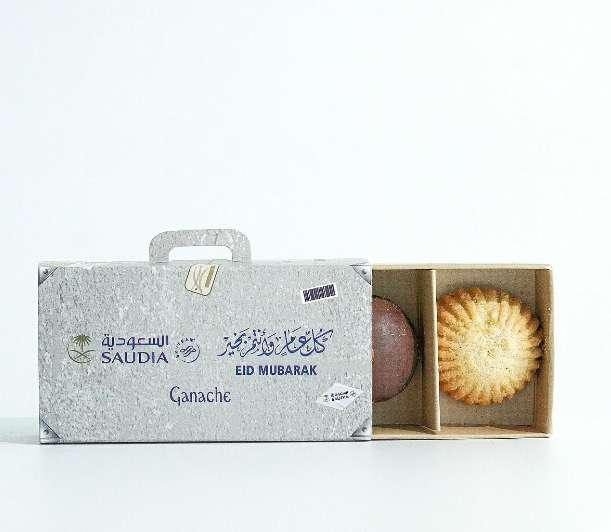
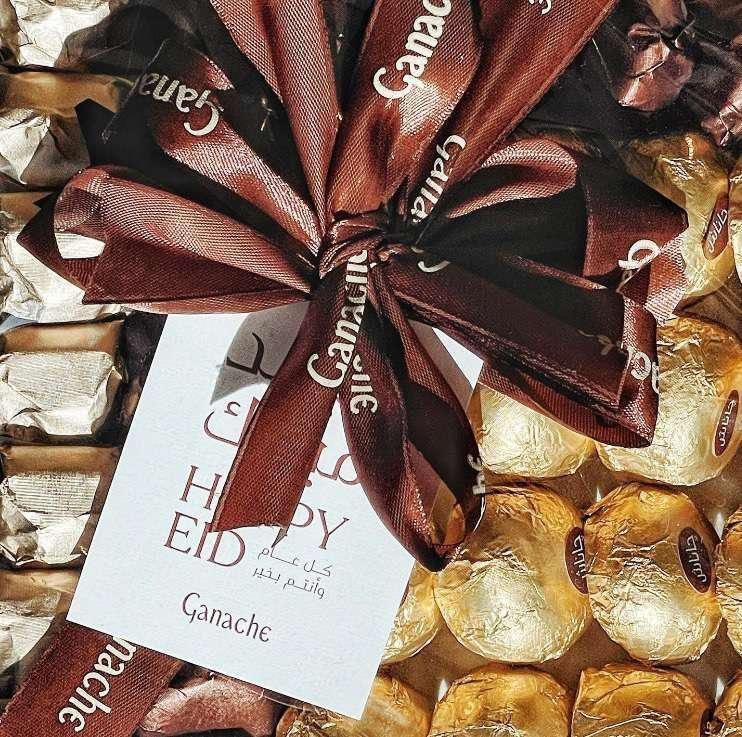
Seasonal gifts and boxes we prepared for clients, from design to packing.



Questions About Logo T-Shirt Printing
What companies, organisers, teams and campaign managers ask before they order printed shirts.
Which print method is best for a logo on t-shirts?
It depends on the design, the fabric and the quantity. Screen print is the economical choice for a large run of a logo in a few flat colours, DTF suits full colour designs and short runs, vinyl suits names and numbers, and sublimation suits light polyester sports shirts. The quote names the method and the reason.
Do you supply the shirts as well as the print?
Yes. We supply the complete printed t-shirt: the shirt in the fabric, colour and sizes you choose, printed with your logo, sampled first and packed by size or by name. The quote lists the shirt, the print and the packing as separate lines.
Can the print match our brand colour exactly?
Screen print inks can be mixed to your brand reference and approved on a sample. Digital methods print from process inks, so a spot colour is approximated as closely as the method allows. Either way the colour is approved on a printed shirt in daylight, not on a screen.
Is there a minimum order?
It depends on the method. Screen print needs a screen for each colour, so it pays off on larger runs, while DTF and vinyl make small runs and single names practical. Tell us how many shirts you need and the design, and the quote for logo t-shirt printing shows the method that fits that quantity.
Can each shirt carry a different name or number?
Yes. Names and numbers are usually added in heat transfer vinyl or DTF, on the back or the chest, from a list that matches each name to a size. The list is checked before printing, because every personalised shirt is made for one particular person.
Can we see a sample before the full run?
Yes, and we recommend it. A shirt is printed with the real artwork on the real fabric, so you check colour, position, size and feel before production. A change made at this stage costs far less than a change made after it.
How do we collect sizes from a large team?
Use a short form per person with the name, the cut, unisex, fitted or children's, and the size, and send it through managers or the event registration page. Add a small reserve of the common sizes for late joiners and exchanges.
How should printed t-shirts be washed?
Turn the shirt inside out, wash it in cool or warm water rather than hot, skip bleach and tumble dry on low heat or hang it to dry. Never iron directly on the print. Treated this way, a well cured screen print or DTF print keeps its colour for many washes.
Can you make National Day and Founding Day t-shirts?
Yes. National Day shirts usually carry the colours of the occasion and the official identity of the year, placed as published and kept apart from your logo, and the national flag and state emblem do not go on commercial print. Founding Day has its own historical identity, and both orders are best started well ahead of the date.
Where are you, and how do we start?
We work from more than one location in the Kingdom and deliver to every site on your list. Send the occasion, its date, the shirt you have in mind and your logo on WhatsApp at 0567069088 or through the quote page, and an itemised quote follows within 24 hours.
Shirts Ready for Your Next Event?
Send the occasion, the date and your logo. Within 24 hours you have an itemised quote for your logo t-shirt printing that names the shirt, the print method, every logo position and the packing.
More specific pages on this
If your question is narrower than this page, these are written for one question each.

